COT-RS-230 is a 100% cotton ripstop fabric purpose-engineered for tactical, military, and security uniform programs — where a tear that starts in the field can compromise a mission, and garment durability directly impacts operational readiness.
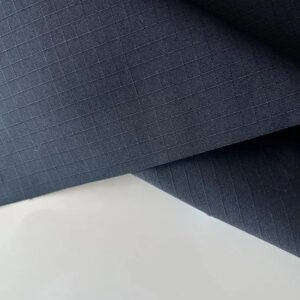
The ripstop structure sets this fabric apart from standard cotton twill. A reinforcing yarn (double-ply, heavier count) is woven into the fabric every 5mm in both directions, creating a visible crosshatch grid. When a tear starts — from a barbed wire snag, a equipment edge, or a rough surface — the reinforcing yarn stops it from running. The tear does not propagate beyond one grid cell.
This is the standard construction for military combat uniforms globally, including the US Army OCP (Operational Camouflage Pattern) uniform.
✅ MIL-DTL-44047 (OCP pattern) — meets US military durability requirements
OEKO-TEX Standard 100
✅ Available upon request
Cotton vs. Cotton/Nylon Ripstop
Factor
COT-RS-230 (100% Cotton)
CN-RS-280 (88/12 Cotton/Nylon)
Tear strength
≥35 N
≥50 N
Abrasion resistance
≥25,000 Martindale
≥40,000 Martindale
Breathability
Excellent — 100% cotton
Good — 88% cotton
IR treatment compatibility
✅ Excellent — cotton absorbs IR treatment evenly
⚠️ Nylon content can cause IR signature variation
Cost
Baseline
+15–20%
Best for
Tactical, patrol, security — where breathability and IR treatment matter
Mining, heavy industrial — where maximum durability is critical
For military and law enforcement programs, 100% cotton ripstop remains the preferred specification for two reasons:
IR signature control — Cotton accepts IR-reducing treatments more evenly than nylon blends. A nylon-containing fabric can create hotspots in night vision that compromise concealment.
Breathability — Tactical uniforms are worn for extended durations in the field. 100% cotton provides the best moisture management among natural fibers.
OCP & Camouflage Printing
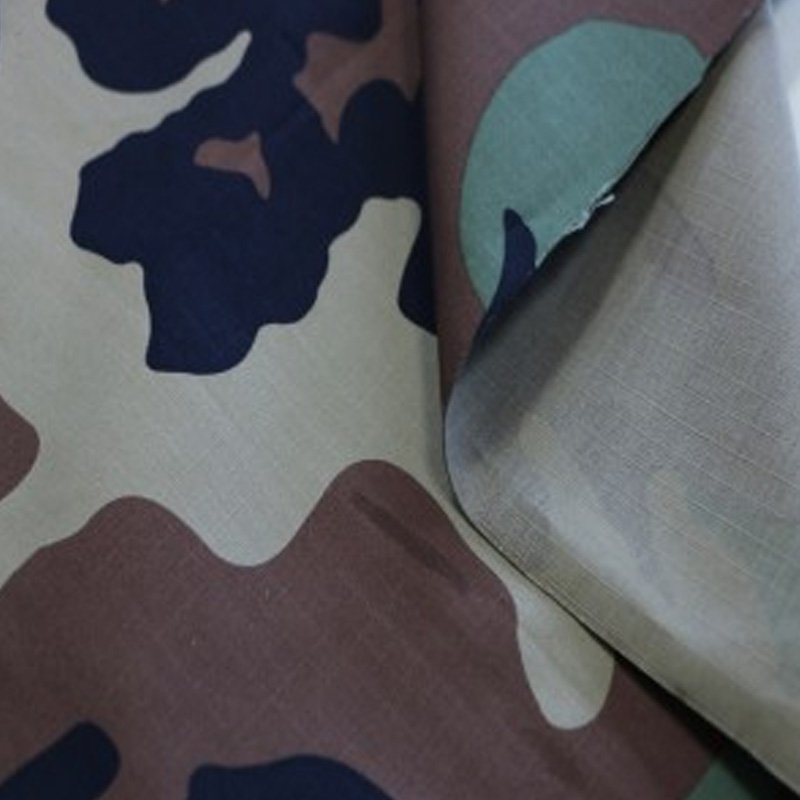
This fabric is the standard substrate for OCP (Operational Camouflage Pattern) and other multi-color camouflage prints. The cotton surface accepts pigment and reactive dye prints with excellent color definition and shade consistency. IR-treated variants reduce near-infrared reflectance for night-vision compatibility.
Fabric Hand & Appearance
Hand feel: Soft, broken-in feel from the start. The pre-wash and sanforizing treatment eliminates the stiffness of greige cotton ripstop. The ripstop grid is visible to the touch as a slightly raised crosshatch pattern.
Appearance: Visible 5mm × 5mm ripstop grid — a distinctive textured appearance that signals durability. Matte finish — no shine. Suitable for tactical, security, and field uniforms.
Drape: Moderate structure — holds a trouser crease for dress occasions, but the ripstop grid gives the fabric a slight dimensional stability that resists bagging at knees and elbows.
Note: Camouflage printing requires color-separated artwork and strike-off approval. Minimum 1000m per pattern design. Lead time: 35–45 days including strike-off approval.
Machine wash 60°C, normal cycle — industrial wash compatible
Bleaching
Do not bleach — chlorine weakens cotton fibers and fades camouflage prints
Drying
Tumble dry medium, or hang dry
Ironing
High iron (200°C), steam — ripstop fabric presses well
Dry cleaning
Permitted (PCE)
⚠️ Camouflage care: For camouflage-patterned fabrics, wash inside out to reduce abrasion on printed surface. Do not bleach. Avoid fabric softener (can affect IR treatment performance). IR-treated fabrics maintain their low-reflectance properties through 50+ washes under standard care.
FAQ
Q: What is the difference between this and standard cotton twill for tactical uniforms? A: Standard cotton twill tears freely once a tear starts — a snag on barbed wire or equipment can run 5–10cm before stopping. The ripstop grid in COT-RS-230 stops tears within one grid cell (5mm). For tactical and patrol uniforms, this is the difference between a small repair and a failed garment.
Q: Does the ripstop grid affect camouflage appearance? A: The grid is visible at close range (within 1–2 meters) as a subtle crosshatch pattern. At typical observation distances, it blends into the background and does not affect camouflage effectiveness. All major military camouflage patterns worldwide are printed on ripstop fabric — OCP, Multicam, Flecktarn, DPM, and others.
Q: Is this fabric IR-treated for night vision compatibility? A: The standard stock fabric is not IR-treated. IR treatment is available as an add-on finish (product code COT-RS-230-IR). IR-treated fabric meets MIL-DTL-44047 requirements for near-infrared reflectance reduction. Camouflage patterns printed on IR-treated base fabric retain their low-reflectance properties.
Q: Can I order OCP-patterned fabric? A: Yes. OCP (Operational Camouflage Pattern) is available on order. We hold the color-separated screens for OCP. Minimum 1000m per order. We are compliant with US military technical data package requirements for OCP production.
Q: What is the most common weight for tactical trouser programs? A: 230–240gsm is the standard for year-round tactical trousers. 250gsm is used for cold-weather and heavy-duty patrol programs. 180–200gsm is available for lightweight / summer tactical shirts.
Q: Is this fabric suitable for embroidery (unit patches, name tapes)? A: Yes. The 100% cotton ripstop holds embroidery cleanly without puckering. The ripstop grid structure provides dimensional stability during high-density embroidery. Use standard 40–60 weight embroidery thread.








Reviews
There are no reviews yet.