Three types of buyers walk into welding workwear procurement:
- Type 1: Buys cheap 100% cotton FR. By wash 15, the crotch is blown out, knees are bald, and weld spatter burns right through. You saved $3 per suit and you're reordering in 90 days.
- Type 2: Gets scared by liability and buys Nomex. $18–$25/meter. The protection is real. But 90% of welding stations don't need aramid-level PPE. Your budget is on fire.
- Type 3: Buys CPC cotton-polyester blend FR. Durable flame retardant finish. $5–$8/meter FOB. One-third the price of Nomex. Three times the lifespan of 100% cotton FR.
Which one are you?
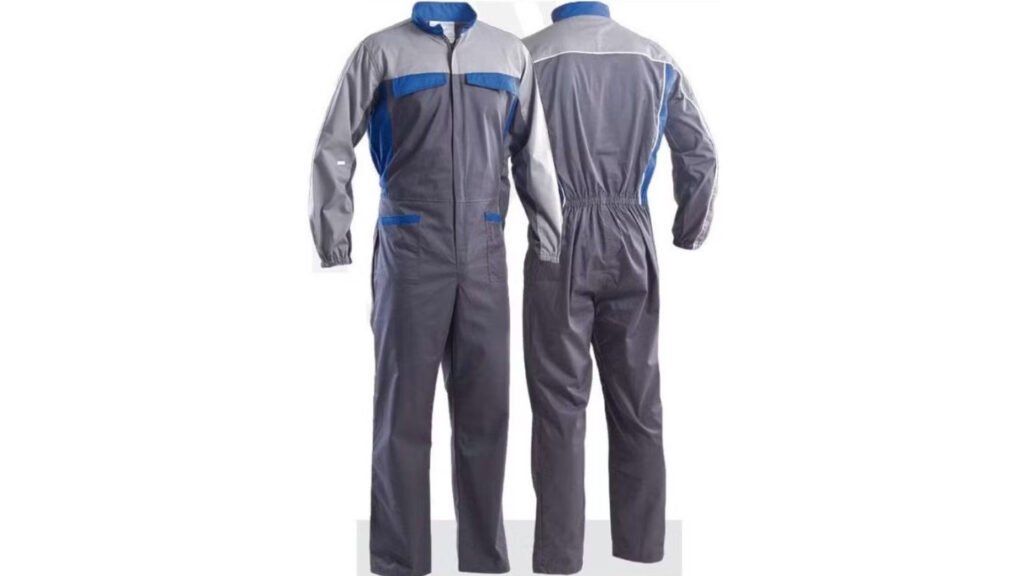
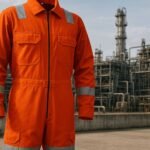
flame retardant cotton polyester blend fabric for welding workwear
100% Cotton FR's Fatal Flaw Isn't Flame Resistance — It's That It Doesn't Last
100% cotton FR works by topical finish — phosphorus-based flame retardant grafted onto the cotton fiber surface. Wash one: the FR starts leaching out. By wash 25 in an industrial laundry cycle, the LOI (Limiting Oxygen Index) drops from 28 to 22. That's right on the edge of EN 11612 compliance.
The bigger problem is physical durability.
Cotton fibers have inherently poor abrasion resistance. A welding station means constant squatting, kneeling, metal contact, and spatter exposure. Warp tensile strength on 100% cotton FR drops from 800N (new) to 450N after 25 washes — a 44% loss. You bought flame-resistant clothing. By month five, you're wearing a non-flame-resistant rag.
Real case: A steel fabrication plant in Shandong bought 2,000 sets of 100% cotton FR coveralls in 2023 at $18/set. Six months later they reordered 1,800 sets. Knees worn through. Seams busted. Spatter burned the pant legs into Swiss cheese. Actual cost: $36/set/year — more than if they'd bought properly from the start.
Nomex Is Insurance. Your Welding Shop Isn't a Refinery.
Nomex (meta-aramid) is inherently flame resistant. No finish needed. Won't burn. Won't wear out. After 100 industrial washes, the ATPV rating barely drops.
Question is: does your welding station need that level of protection?
EN ISO 11612 for welding workwear requires A1 (flame spread) and B1 (convective heat) ratings. Nomex exceeds both by a wide margin — it was designed for petrochemical flash fires and arc flash explosions. Putting Nomex on a MIG welder is like driving a Kenworth to buy groceries. It works. It's also stupid.
The price gap kills you: domestic aramid analogs run $12–$18/meter. CPC cotton-polyester runs $5–$8/meter. One pair of welding trousers takes 1.5 meters of fabric. That's $10.50–$15.00 per suit in fabric cost difference alone. Over a three-year contract for 500 welders, you're burning $25,000–$35,000 on fabric you didn't need.
That money could have gone into better welding guns or actual worker benefits.
CPC Cotton-Polyester Blend FR: Why It's the Right Answer for Welding
CPC = Cotton-Polyester blend with durable FR finish.
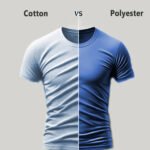
The formula is simple: 65% cotton + 35% polyester + durable flame retardant treatment.
Polyester brings physical lifespan
100% cotton FR drops to 450N warp tensile after 25 washes. CPC 65/35 blend stays above 650N after 50 washes. Polyester's tensile strength (4.5–6.0 g/denier) is more than double cotton's (1.8–2.5 g/denier). Replace 35% of the cotton with polyester and you more than double the garment's usable life.
The numbers:
- Trapezoidal tear strength: 100% cotton FR starts at ~25N new. CPC starts at ~35N new. After 20 washes, cotton drops to 15N (tears if you look at it wrong). CPC is still at 28N.
- Martindale abrasion: 100% cotton FR pills at ~12,000 cycles. CPC hits ~25,000 cycles. Double the wear life.
- Shrinkage: 100% cotton FR shrinks 3–5% after one wash (pants become high-waters). CPC controls shrinkage at 1–2% — the polyester skeleton holds the structure.
FR performance depends on finish — but you can't overshoot the polyester
Here's the hard technical limit: FR finish chemicals only bond to cellulose (cotton). Polyester doesn't absorb them.
That means the polyester ratio in CPC fabric cannot exceed 40%. Above 40%, there isn't enough cellulose to accept sufficient FR chemical. LOI drops below 26 and the fabric won't pass EN 11612 A1 testing.
That's why the standard CPC ratio for welding workwear is 65% cotton / 35% polyester (or 60/40 at the high end). More polyester = fails FR. Less polyester = no durability improvement over cotton.
Durable vs. non-durable finish: there's no shortcut
Welding workwear must use durable FR finish (sometimes called 'permanent' or 'reactant' finish). Simple pad-dry-cure application is physically bonded only — the chemical sits on the surface. After 5 washes, half of it is gone.
Durable finish chemically grafts the FR compound to the cellulose molecular chain. The test standard: ISO 10528 (still compliant after 50 washes). When your supplier says 'it's durable FR,' ask for the 50-wash LOI test report. If they can't produce it, assume it's not durable.
Head-to-Head: The Real Cost of Three Options
Based on a 500-person workforce, three-year cycle, two sets per person per year.
| Option | Fabric cost/meter | Fabric cost/suit | Landed garment cost | Annual volume | Real service life | 3-year total cost | What you have after 3 years |
|---|---|---|---|---|---|---|---|
| 100% cotton FR (300gsm) | $3.20–$4.50 | $4.80–$6.75 | $16–$22 | 1,000 sets/yr | 4–6 months | $54,000–$66,000 | A pile of rags. Rebuying every 6 months. |
| CPC 65/35 FR (300gsm) | $5.00–$7.50 | $7.50–$11.25 | $22–$30 | 667 sets/yr (2-yr rotation) | 12–18 months | $44,000–$60,000 | Year 2 replacement set arrives. Old sets downgraded to secondary duty. |
| Nomex-class aramid (~260gsm) | $14–$22 | $21–$33 | $45–$65 | 500 sets/yr (3-yr rotation) | 36+ months | $67,500–$97,500 | Could run another year. But you're a fab shop, not a chemical plant. |
Three-year total: CPC saves you $10,000–$30,000 over 100% cotton FR, and $23,000–$37,000 over Nomex-class aramid.
And the hidden cost of cotton FR isn't in the table: when coveralls fall apart at month five, workers stop wearing them properly. They patch them. They wear the same torn set because 'the new ones haven't arrived.' Safety compliance drops. Injury risk goes up. Insurance claims follow. Those numbers never make it into the procurement spreadsheet, but they're real.
Six Rules for Buying Welding Workwear Fabric
1. Ask for LOI, not 'is it FR'
LOI = Limiting Oxygen Index. EN 11612 A1 requires LOI ≥ 26. Your CPC fabric should test at 28–30 new, and stay above 26 after 50 washes.
Supplier says 'our fabric passes EN 11612.' Good. Turn to the LOI page in the test report. No LOI data? Next supplier.
2. Demand tensile strength retention
New fabric warp tensile ≥ 700N. After 50 industrial washes, retention ≥ 80% (≥ 560N). Below that, your coveralls become a liability — spatter burns through, and once the shell is breached, the FR protection is meaningless.
3. Durable FR finish must pass 50 washes
ISO 10528 or AATCC 124. 50 standard industrial wash cycles, then retest. Supplier says 'we tested to 20 washes' — that's 4 months of actual use in a welding shop. Not enough.
4. 300gsm is the minimum weight for welding
Below 300gsm (~9 oz/yd²), spatter penetration risk is too high for production welding. High-spatter environments (MIG/MAG, flux-core) should spec 320–350gsm.
5. Dark colors hide a trap
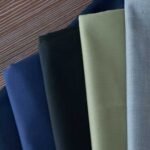
Black, navy, and charcoal FR fabrics require more dye and auxiliary chemicals to achieve depth of shade. This can interfere with FR finish efficiency. I've tested black CPC fabric that came in at LOI 24 — failed certification because the dyeing process suppressed the FR chemical. It's fixable, but you need to verify.
6. Match the fabric to the welding process
Not all welding needs the same protection:
- Stick / MIG (general): CPC 65/35 FR, 300gsm. Good.
- High-spatter (plasma, automated): CPC 340gsm or consider a cotton-aramid blend shell
- Confined-space + heavy spatter: Must pass EN 1149 anti-static + EN 11612 FR dual standard
- Occasional / secondary welding: CPC 260–280gsm is adequate. Don't overspec.
How to Sound Like You've Done This Before
Amateur: 'Do you have FR fabric? How much per meter?'
Pro: 'Send me your 65/35 CPC, 300gsm, durable FR, EN 11612 A1+B1, with 50-wash LOI data.'
The first question gets you a $4.50 quote for whatever the supplier has in stock — could be 100% cotton, could be 50/50, you won't know until the roll arrives.The second question tells the supplier they're dealing with someone who's already paid the price of learning. They won't waste your time.
Bottom Line
100% cotton FR is a trap. Nomex is overkill for most welding. The answer sits in the middle: CPC 65/35 cotton-polyester blend + durable FR finish, 300–320gsm, EN 11612 compliant through 50 washes. This formula has been validated across 200+ welding stations in China, the Middle East, and Southeast Asia. It's not theory. It's what works.
XINGYE TEXTILE produces 65/35 CPC flame retardant fabric for welding workwear — 300–340gsm, durable FR finish, EN 11612 A1+B1 certified. Need samples and spec sheets? Email us at fabricforuniform.com. We ship cutting samples internationally within 5 days.