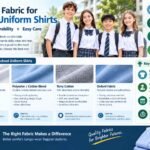
Choosing the right fabric for school uniforms is a critical decision that impacts comfort, durability, maintenance, and cost. Among the most popular fabric blends for uniforms are TC (Tetron Cotton) and CVC (Chief Value Cotton) fabrics. Both are poly-cotton blends but differ significantly in fiber composition and performance characteristics. This comprehensive guide explores TC vs CVC fabric for school uniforms, helping educators, uniform suppliers, and parents make informed decisions.
TC vs CVC Fabric for School Uniforms
What Are TC and CVC Fabrics?
Before diving into comparisons, it’s essential to understand what TC and CVC fabrics are:
-
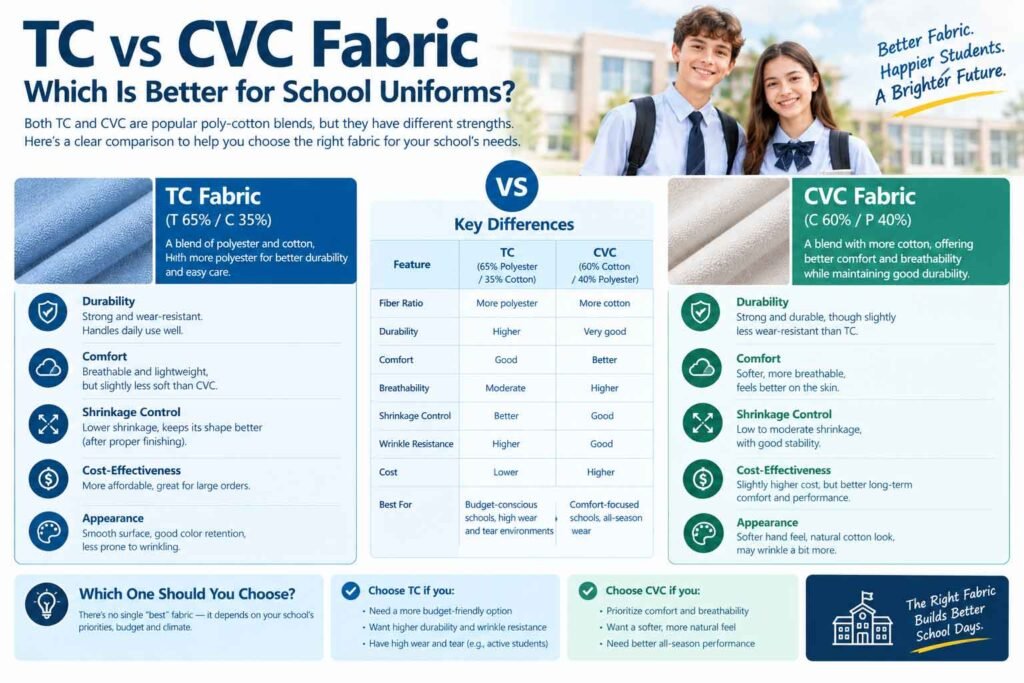
TC Fabric (Tetron Cotton): Polyester-dominant blend, typically 65% polyester and 35% cotton. The polyester fibers form the structural backbone, providing high durability and wrinkle resistance.
-
CVC Fabric (Chief Value Cotton): Cotton-dominant blend, usually 60% or more cotton and 40% or less polyester. Cotton fibers dominate the fabric face, offering superior breathability and comfort.
Why Fiber Dominance Matters in School Uniforms
The fiber content ratio directly influences how the fabric performs in key areas such as comfort, durability, shrinkage, and maintenance. For school uniforms — which endure frequent washing, active wear, and sometimes harsh environments — selecting the right blend is crucial.
Key Differences Between TC and CVC Fabrics
| Feature | TC Fabric (65/35 Polyester/Cotton) | CVC Fabric (60/40 Cotton/Polyester) |
|---|---|---|
| Fiber Dominance | Polyester-dominant | Cotton-dominant |
| Hand Feel | Slightly synthetic, smooth, less soft | Soft, natural cotton feel, warm and breathable |
| Durability | High tensile strength, abrasion-resistant | Moderate durability, better pilling resistance |
| Breathability | Moderate; traps heat if weave is tight | High; excellent moisture absorption and evaporation |
| Shrinkage | Low (around 1.5% to 2%) | Moderate (3% to 5% unless sanforized) |
| Wrinkle Resistance | Excellent; self-iron properties | Moderate; requires ironing |
| Cost | Lower cost due to polyester dominance | Higher cost linked to cotton content |
| Printing Compatibility | Sublimation possible; polyester surface | Best for screen printing; cotton surface |
Durability vs Comfort: What Matters More?
Durability: Why TC Fabric is Preferred for Longevity
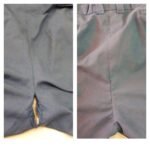
TC fabric’s polyester dominance gives it superior tensile strength and abrasion resistance, making it ideal for uniforms that face high mechanical stress. Polyester fibers resist tearing, chemical degradation from chlorine bleaches, and repeated industrial laundering cycles — common in school laundry services.
- TC uniforms can last up to 50% longer than CVC fabrics under heavy use.
- They dry faster and maintain shape better after washing.
- Wrinkle resistance reduces the need for ironing, saving time and energy.
Comfort: Why CVC Fabric Excels in Breathability
CVC fabric’s cotton-rich structure provides excellent moisture absorption and breathability, which are essential for students wearing uniforms for extended hours, especially in hot and humid climates.
- Cotton fibers absorb sweat and allow evaporation, keeping the wearer cool.
- The soft, natural hand feel reduces skin irritation and static buildup.
- Ideal for school shirts, blouses, and summer uniforms where comfort is prioritized.
Shrinkage and Maintenance Considerations
Shrinkage is a common concern in school uniforms due to frequent washing. Here’s how TC and CVC compare:
-
TC Fabric: Exhibits minimal shrinkage (about 1.5% to 2%), especially when pre-shrunk or sanforized. Its polyester content stabilizes the fabric dimensions, making it easier to maintain consistent sizing.
-
CVC Fabric: Typically shrinks between 3% to 5%, but this can be reduced to approximately 1.5% with mercerization and sanforizing finishing processes. However, unsupervised washing at high temperatures can increase shrinkage.
Maintenance Tips:
- Wash TC fabrics in warm water (up to 60°C) for hygiene without shrinkage.
- CVC fabrics should be washed in cooler water (30-40°C) and dried on low heat to preserve size and softness.
- Avoid chlorine bleach on CVC as cotton fibers degrade more quickly.
Printing and Aesthetics: Which Fabric is Better for School Uniforms?
-
CVC Fabric: Since cotton dominates the fabric face, it is highly receptive to screen printing, DTG (Direct to Garment), and water-based inks. This makes CVC ideal for embroidered logos, school crests, and vibrant prints.
-
TC Fabric: Polyester on the surface allows for sublimation printing, which is excellent for all-over prints and sports uniforms but less common in traditional school uniforms.
Cost Analysis: Budget-Friendly or Premium?
-
TC Fabric is generally more cost-effective, benefiting from polyester’s lower raw material cost and higher production efficiency.
-
CVC Fabric tends to be more expensive due to higher cotton content and more complex finishing processes like mercerization and sanforizing.
For large-scale institutional purchases, TC fabric often offers better value over the garment lifecycle because of its durability and lower maintenance needs.
Application Recommendations: TC vs CVC for School Uniforms
| Use Case | Recommended Fabric Blend | Reasoning |
|---|---|---|
| Daily School Uniform Shirts | CVC (60/40 or 70/30) | Prioritizes comfort, breathability, and printability |
| School Trousers & Blazers | TC (65/35) | Requires durability, wrinkle resistance, and shape retention |
| Sports Uniforms | TC (65/35) or higher polyester | Moisture-wicking, quick-dry, abrasion resistance |
| Summer Uniforms | CVC (cotton-rich blends) | Better thermoregulation and sweat absorption |
| Budget-Conscious Bulk Orders | TC | Cost-effective, longer garment life |
Expert Insights: Engineering and Finishing Matter
The real performance of TC and CVC fabrics depends on yarn spinning, weaving density, and finishing techniques such as mercerization and sanforizing.
- Mercerization enhances cotton fiber strength and luster, improving comfort and color vibrancy in CVC fabrics.
- Sanforizing mechanically stabilizes fabric dimensions, reducing shrinkage.
- Reduction clearing in TC fabrics prevents color bleeding in multi-colored uniforms, especially where polyester and cotton panels meet.
These processes ensure that school uniforms maintain their appearance and fit through repeated industrial laundering.
Common Mistakes to Avoid When Choosing TC or CVC
- Confusing TC and CVC as interchangeable: Their fiber dominance leads to fundamentally different performance and care requirements.
- Ignoring finishing quality: Low-cost fabrics without proper finishing can pill, shrink excessively, or bleed colors.
- Overlooking printing needs: Selecting TC for screen printing or CVC for sublimation leads to poor decoration results.
- Neglecting wearer environment: In hot climates, polyester-heavy TC uniforms may cause discomfort.
Frequently Asked Questions (FAQs)
Q1: Which fabric shrinks less after washing?
A: TC fabric shrinks less (usually under 2%), while CVC can shrink 3-5% unless properly finished.
Q2: Is CVC fabric better for hot weather?
A: Yes, CVC’s cotton dominance makes it more breathable and comfortable in warm climates.
Q3: Can TC fabric be used for school shirts?
A: While possible, TC feels more synthetic and less breathable, so it’s less preferred for shirts worn close to the skin.
Q4: Which fabric is better for embroidered school logos?
A: CVC fabric offers better printability and embroidery results due to its cotton surface.
Conclusion: Choosing Between TC and CVC Fabric for School Uniforms
When deciding TC vs CVC fabric for school uniforms, the choice boils down to durability versus comfort:
-
Choose TC fabric if you prioritize durability, wrinkle resistance, and cost-efficiency for uniforms subjected to heavy wear and frequent industrial laundering.
-
Choose CVC fabric if comfort, breathability, and superior printability are paramount, especially for shirts and summer uniforms worn in warmer climates.
By understanding the technical differences and application-specific benefits, schools and uniform suppliers can select fabrics that enhance student comfort, reduce maintenance costs, and extend garment lifespan.
Ready to select the perfect fabric for your school uniforms?
Explore trusted suppliers offering certified TC and CVC fabrics with quality finishing and test reports to ensure your uniforms meet the highest standards. Share this guide with your team and make an informed choice today!