In today’s high-tech world, where electronic devices are becoming smaller, faster, and more sensitive, controlling static electricity is critical. Whether you’re involved in semiconductor manufacturing, printed circuit board (PCB) assembly, or cleanroom operations, the choice of fabric used in protective clothing can significantly impact product quality and safety. Two terms often arise in this context: antistatic fabric and ESD fabric. While they are related, they are not exactly the same. This article dives deep into antistatic fabric vs ESD fabric, explaining their differences, applications, and how to choose the right fabric for your needs.
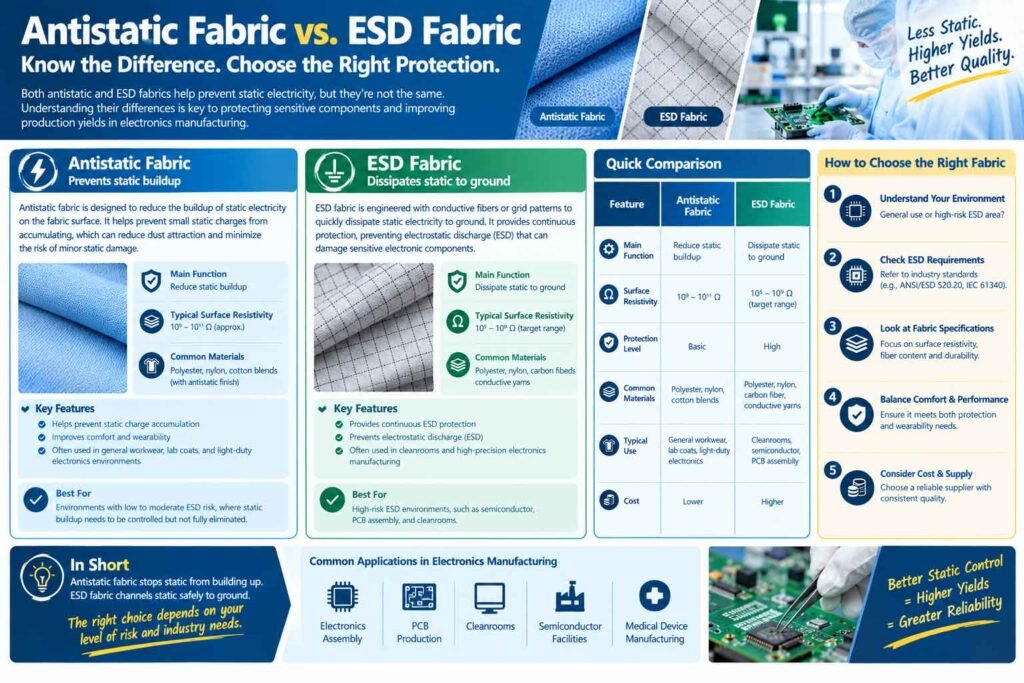
Antistatic Fabric vs ESD Fabric
What Are Antistatic Fabric and ESD Fabric?
Antistatic Fabric
Antistatic fabric is a broad category of textiles designed to reduce or prevent the buildup of static electricity on the fabric surface. It achieves this by either incorporating conductive fibers or applying chemical finishes that attract moisture to dissipate static charges safely. Antistatic fabrics are commonly used in industries where static buildup can cause discomfort, dust attraction, or minor operational issues.
ESD Fabric
ESD (Electrostatic Discharge) fabric is a specialized subset of antistatic fabric engineered specifically to control and dissipate static electricity in environments sensitive to electrostatic discharge. ESD fabrics contain woven conductive yarns—often carbon fiber or metal-coated filaments—that create a permanent conductive network within the textile. This network safely channels static charges away from sensitive electronic components, preventing damage.
Antistatic Fabric vs ESD Fabric: Key Differences
| Feature | Antistatic Fabric | ESD Fabric |
|---|---|---|
| Primary Purpose | Reduce static buildup and prevent minor shocks | Control and safely dissipate electrostatic discharge to protect sensitive electronics |
| Conductive Elements | May include chemical finishes or conductive fibers | Contains woven conductive yarns (carbon fiber, metal-coated filaments) |
| Durability | Chemical finishes can wear off after washing | Conductive fibers embedded in fabric provide long-lasting protection |
| Electrical Resistance | Higher resistance, less precise control | Controlled surface resistivity, usually in the static dissipative range (10^6 to 10^9 ohms) |
| Applications | General static control in textiles, apparel | Electronics manufacturing, cleanrooms, semiconductor fabs, ESD-sensitive environments |
| Performance Stability | Varies with humidity and washing | Stable performance across various environments and after repeated industrial laundering |
How Do Antistatic and ESD Fabrics Work?
The Science Behind Antistatic Fabric
Antistatic fabrics reduce static buildup mainly by allowing charges to dissipate slowly over the fabric surface, often aided by moisture absorption or temporary chemical treatments. These treatments work well under specific conditions but may lose effectiveness over time or in low-humidity environments.
The Role of Conductive Yarn in ESD Fabric
ESD fabrics rely on conductive yarns, such as carbon fibers or metal-coated filaments, woven into the textile in patterns like grids or stripes. This conductive network acts as a Faraday cage, distributing and safely dissipating static charges before they can accumulate to dangerous levels.
- Grid vs Stripe Patterns: A tighter grid pattern (e.g., 2.5 mm spacing) offers better static charge neutralization than wider stripes (5 mm or 10 mm), making it ideal for high-sensitivity areas like cleanrooms.
- Surface Resistivity: ESD fabrics are engineered to maintain surface resistivity within the static dissipative range (10^6 to 10^9 ohms), ensuring controlled charge flow without sudden sparks.
Why Is ESD Fabric Essential in Electronics Manufacturing?
Electrostatic discharge can cause immediate or latent damage to expensive electronic components such as:
- Integrated circuits (ICs)
- Printed circuit boards (PCBs)
- Semiconductor wafers
- Microprocessors and sensors
Even a discharge as low as 30 volts can harm sensitive devices, which is why ESD fabric is indispensable in electronics production environments. Using certified ESD garments reduces:
- Hidden product failures and warranty claims
- Manufacturing scrap and rework costs
- Contamination risks in cleanrooms
Additionally, ESD fabrics contribute to higher production yields and improved product reliability, crucial in industries like automotive electronics, medical devices, and consumer electronics.
Common Applications of Antistatic and ESD Fabrics
| Industry/Application | Typical Fabric Type | Key Requirements |
|---|---|---|
| Semiconductor Fabrication | 100% polyester continuous filament ESD fabric | Low lint, tight conductive grid, cleanroom compatible |
| PCB Assembly | TC (tetoron cotton) blend ESD fabric | Comfort, static dissipation, durability |
| Consumer Electronics | Polyester-cotton blend ESD fabric | Static control, breathability, washability |
| Automotive Electronics | High-performance ESD fabric | Durability, abrasion resistance |
| Medical Electronics | Certified ESD fabric | Reliability, contamination control |
| Cleanroom Garments | Polyester ESD fabric with carbon fiber grid | Particle control, static dissipation |
How to Choose the Right Fabric: Antistatic Fabric vs ESD Fabric
1. Understand Your Environment and Sensitivity Level
- For highly sensitive electronics or cleanroom environments, opt for ESD fabric with a tight conductive grid and certified static dissipative properties.
- For less sensitive applications or general static control, antistatic fabrics with chemical finishes might suffice.
2. Check Fabric Composition and Conductive Yarn Quality
- Ensure the fabric contains woven conductive fibers (carbon or metal-coated) rather than relying solely on chemical finishes.
- Uniform distribution of conductive yarns ensures consistent static dissipation.
3. Evaluate Electrical Performance
- Confirm surface resistivity falls within the recommended static dissipative range (10^6 to 10^9 ohms).
- Review test data for static decay time and resistance after repeated industrial washing.
4. Consider Durability and Comfort
- Fabrics should maintain electrostatic properties after 50+ industrial wash cycles.
- Breathability and moisture management improve wearer comfort during long shifts.
5. Verify Supplier Credentials
- Choose suppliers with quality management systems aligned with ANSI/ESD S20.20 and IEC 61340 standards.
- Look for customization options and technical support for your specific application.
Maintaining ESD Fabric Performance: Best Practices
- Washing: Use non-ionic detergents, avoid bleach and fabric softeners which can insulate conductive fibers.
- Drying: Air dry or use low heat settings to preserve fabric integrity.
- Testing: Regularly test garments for surface resistance and panel-to-panel continuity.
- Replacement: Retire garments once resistance exceeds acceptable limits (e.g., >10^9 ohms).
Conclusion: Making the Right Choice Between Antistatic Fabric and ESD Fabric
While antistatic fabric and ESD fabric are often used interchangeably, understanding their differences is crucial for protecting sensitive electronics and ensuring manufacturing quality. Antistatic fabrics reduce static buildup in general applications, but ESD fabrics provide durable, reliable, and certified electrostatic discharge control essential for electronics manufacturing and cleanroom environments.
When selecting fabrics for your facility, prioritize woven conductive yarns, stable electrostatic performance, durability, and compliance with industry standards. Doing so will safeguard your products, reduce costly failures, and improve operational efficiency.
Take Action
Are you ready to upgrade your static control apparel? Explore specialized ESD fabric solutions designed to meet the stringent demands of electronics manufacturing. For expert guidance and high-quality anti static and ESD fabrics, consider partnering with trusted suppliers who offer customization, compliance certification, and long-lasting performance.