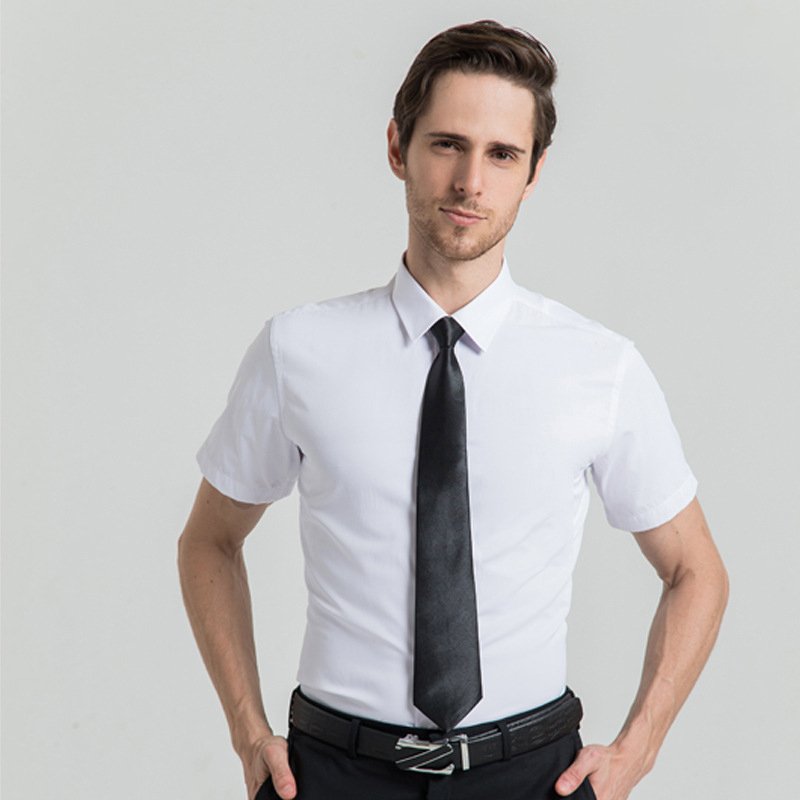
Short Sleeve White Uniform Shirt | Wholesale White Uniform Shirts for Service & Hospitality Teams
White uniform shirts have one job that’s harder than it looks: staying white. Most white uniform fabric looks fine in the first month and visibly dulls or yellows by month three — not because the fabric is dirty, but because of what’s actually happening at the fiber level during high-frequency commercial laundering. This shirt is built to resist that specific failure mode, not just to look good on delivery day.
Why White Uniforms Actually Yellow (And What We Do About It)
Most white fabric relies on fluorescent whitening agents (optical brighteners) — compounds that absorb UV light and re-emit it as visible blue light, which is what makes “white” fabric look bright white rather than dull off-white. The problem: these brighteners wash out gradually with every commercial laundry cycle, and their loss is what most people perceive as a shirt “yellowing,” even when no actual discoloration has occurred — the fabric is simply losing the brightening effect it started with.
The second, separate cause is genuine chemical yellowing from repeated chlorine-bleach exposure, common in commercial hotel and hospitality laundry protocols. Certain finishing treatments and lower-grade optical brighteners react with residual chlorine over repeated cycles, producing a true yellow discoloration that isn’t reversible with more washing.
We address both mechanisms directly rather than relying on brightness alone:
Higher wash-fastness optical brightener application — formulated to resist the gradual wash-out that causes most commercial white uniforms to look “tired” within the first few months
Chlorine-compatible finishing — selected and tested specifically for facilities using chlorine-based bleach in their standard wash protocol, rather than a finish optimized only for home laundering conditions
Whiteness verified per AATCC 110 — the industry standard CIE whiteness index test, checked before and after extended wash cycles rather than assumed from a single delivery sample
Fabric Specification
Spec
Detail
Composition
65% Polyester / 35% Cotton (T/C)
Weave
Poplin, lightweight plain weave
Weight
130–150 GSM
Whiteness Retention
Verified per AATCC 110, tested after 50 industrial wash cycles at 75°C with bleach
Fit: Regular fit; tailored fit available on request
Size Chart (in / cm)
Size
Chest (in / cm)
Length (in / cm)
Sleeve (in / cm)
S
36–38 / 91–97
28 / 71
8 / 20
M
39–41 / 99–104
29 / 74
8.5 / 22
L
42–44 / 107–112
30 / 76
9 / 23
XL
45–47 / 114–119
31 / 79
9.5 / 24
XXL
48–50 / 122–127
32 / 81
10 / 25
Available Options
Standard white · Moisture-wicking performance weave · Custom embroidery placement
Customization
Embroidery — logo, name, or department identification
Fabric upgrade — moisture-wicking performance poplin for active service roles
Consistent reorder specs — every reorder ships against the same documented fabric and finishing specification, so whiteness performance stays consistent across multi-year programs
Applications
Hospitality and restaurant service staff
Retail employees
Security personnel
Facility management teams
Any program where white is the required uniform color and industrial laundering is frequent
Quality Verification
Before committing to a bulk order, we provide:
Pre-production sample for approval
Whiteness retention test data (AATCC 110) after extended wash cycles, on request
Colorfastness test certificates (ISO 105-C06)
Batch-specific test reports matching your shipment’s roll numbers
FAQ
Will these shirts yellow after repeated hotel or commercial laundering? We test whiteness retention specifically under chlorine-bleach wash conditions at 75°C, not just standard home-laundering conditions. Ask us for the AATCC 110 test data at your facility’s typical wash cycle count before committing to a large order — this is the single most useful piece of data for predicting long-term appearance.
What’s the difference between “yellowing” and just losing brightness? Both look similar but have different causes. Optical brightener wash-out (the more common cause) makes fabric look dull rather than truly discolored. Chemical yellowing from bleach interaction is a genuine, non-reversible discoloration. Our finishing is selected to resist both, but if you’re seeing yellowing on existing uniforms from another supplier, it’s worth identifying which mechanism is responsible before switching fabric.
What’s the minimum order quantity? 50 units per style and color.
Can we get a moisture-wicking version for active roles? Yes — the same shirt is available in a moisture-wicking performance poplin for security, food service, or other high-activity roles.
What documentation do you provide with bulk orders? Fiber composition certificates, whiteness retention data (AATCC 110), and colorfastness test reports (ISO 105-C06), batch-specific and matched to your shipment’s roll numbers, available on request.







Reviews
There are no reviews yet.