White is the most iconic uniform color in the culinary world. For over a century, the white chef coat — the veste de cuisine — has been the symbol of the professional kitchen, worn by everyone from Escoffier's brigade in 1890s Paris to the executive chef plating tonight's tasting menu.
But white is also the most impractical color in existence for a kitchen. It shows every splash, every smear, every speck of dust. So why do chefs insist on the one color that can't hide anything?
The answer has nothing to do with fashion. It comes down to history, psychology, hygiene, and physics — in roughly that order.
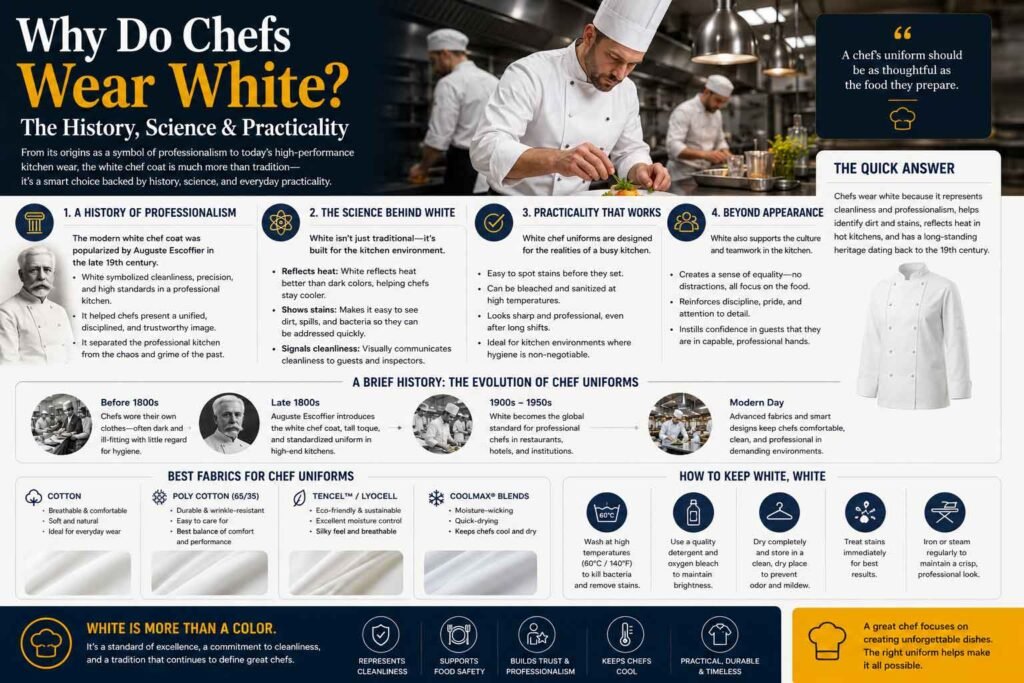
Why Do Chefs Wear White
The History: How White Became the Chef's Color
1829 — The Ancestor: The Uniform Rebellion
Before the modern chef coat, kitchen workers wore whatever protected them: heavy aprons, rolled sleeves, and dark clothing that hid stains. The kitchen was considered rough, manual labor — nobody dressed for appearance.
1890s — Escoffier's Revolution
The white chef coat as we know it was standardized by Georges-Auguste Escoffier, the father of modern French cuisine, at the Savoy Hotel in London. He redesigned the kitchen uniform for a deliberate reason:
The white coat was a declaration that cooking is a clean, precise profession — not a dirty trade.
Escoffier wanted to elevate the status of the chef from 'kitchen laborer' to 'professional craftsman.' The white coat borrowed visual language from other respected professions that wore white — doctors, scientists, butchers (in their clean whites) — and applied it to the kitchen.
The Double-Breasted Design
The classic chef coat is double-breasted for a practical reason that also explains white's survival:
| Feature | Purpose |
|---|---|
| Two overlapping layers | Double protection against heat and steam burns |
| Reversible | If the front gets stained, flip the coat — clean side out, no uniform change |
| Two button rows | Button the opposite side after flipping |
This is the key insight: the double-breasted coat was designed to be white — because when it got dirty, the chef simply turned it around. White + reversible = practical after all.
The 6 Reasons White Endures
1. Cleanliness as a Professional Statement
A white coat cannot lie. Every stain is visible, and that's exactly the point.
- A stained white coat is honest — it shows the chef has been working
- A clean white coat signals discipline and hygiene to the dining room
- Customers can see the kitchen through open windows or pass doors — white tells them the kitchen is clean
The psychology: When a chef wears white, they behave more carefully. A garment that shows every stain changes behavior — chefs wipe surfaces, use towels, and keep their workspace cleaner because the coat holds them accountable.
2. The Hygiene Signal
White is the traditional color of medical and scientific professions for the same reason:
| Profession | Why White |
|---|---|
| Doctors | Sterility, cleanliness, professional trust |
| Scientists/lab workers | Contamination visibility |
| Butchers | Freshness, cleanliness standards |
| Chefs | Same logic — kitchen hygiene is food safety |
A white uniform says: 'I meet a cleanliness standard that I'm willing to be judged on.' In an industry where hygiene failures can sicken customers, this visual signal carries real commercial value.
3. Heat Reflection — The Physics
This is where white's advantage is measurable, not just symbolic:
| Coat Color | Solar/Heat Reflectance | Surface Temp in Hot Kitchen |
|---|---|---|
| White | 70–80% of radiant heat reflected | +8–12°C above ambient |
| Light gray | 50–60% | +10–15°C |
| Black | 5–10% | +18–25°C above ambient |
A white coat keeps the chef 5–10°C cooler at the skin than a black coat in the same kitchen. Standing in front of a 250°C oven, a grill, or a sauté station for hours, that difference is substantial.
Why it matters: Kitchens routinely hit 35–45°C ambient. Radiant heat from ovens and grills is constant. White is the only color that actively reflects that heat instead of absorbing it.
4. Stain Visibility = Stain Control
Paradoxically, the color that shows stains most is also the color that produces the least staining over time:
- Chefs in white notice spills immediately and deal with them
- Chefs in dark colors may carry stains for hours — which can dry, set, and become permanent
- The double-breasted coat handles the occasional unavoidable splash — flip and continue
The result: white coats are replaced because they wear out, not because they're stained beyond saving. A well-laundered white coat with a bleach cycle looks new for months.
5. Equality & Hierarchy in the Brigade
In the classical French brigade system, white is the uniform of the kitchen's core — chefs and cooks. White serves as the visual baseline that makes hierarchy legible:
| Kitchen Role | Typical Coat |
|---|---|
| Executive chef | White double-breasted (or black in modern kitchens) |
| Sous chef | White |
| Chef de partie | White or striped |
| Line cooks | White or striped |
| Other staff | Colored or black |
The black coat for executives in modern kitchens only exists because white is the default — black is the exception that signals rank against the white baseline.
6. Brand & Professional Identity
A white coat is instantly readable as 'chef' — in a restaurant, on TV, in a cookbook photo. It carries cultural shorthand:
- White + tall hat = culinary authority
- White + double-breasted = classical training
- White + clean = professional standards
No other color carries this recognition. A chef in black might be mistaken for a waiter in some contexts; a chef in white never is.
The Counter-Arguments: Why Some Chefs Don't Wear White
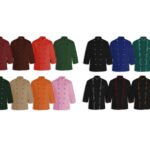
The white coat isn't universal anymore. Modern kitchens increasingly use black or colored coats:
| Reason for Non-White | The White Counter |
|---|---|
| Black hides stains better through a shift | White + reversible coat solves this — flip, don't hide |
| Black looks 'modern' | White remains the professional standard in fine dining |
| Black differentiates executive rank | Rank can be shown with buttons, collars, embroidery |
| White needs more laundry | Industrial laundering makes white easy — bleach handles it |
| Colored coats match branding | Brand colors work for casual dining; white carries authority |
The balance: Fine dining, hotels, and traditional kitchens stay white. Modern casual, gastropubs, and branded chains adopt black/colors. Both are valid — but white remains the reference point that all other choices define themselves against.
The Fabric That Makes White Work
White only works as a chef coat color if the fabric is engineered for it:
| Fabric Requirement | Why | Standard |
|---|---|---|
| Bleach-safe | White must be bleached to remove stains and sanitize | Cotton or poly-cotton with chlorine-resistant finish |
| High-temperature wash tolerance | Hotel laundries wash at 75–85°C | TC 65/35 or CVC |
| Opacity | Must not go translucent when wet | Tight weave, minimum 240 GSM |
| Pre-shrunk | No surprise shrinkage in first washes | Pre-shrunk cotton |
| Dobby or twill weave | Ventilation + durability | Cotton dobby (classic) or twill |
The white-coat trap to avoid: Cheap white fabric uses optical brighteners that wash out after 10–15 cycles — the coat turns yellow. Quality white chef coat fabric uses bleached cotton with a chlorine-resistant finish that stays white for 50+ washes without brighteners.
White Chef Coat Care
| Care Step | Why It Matters |
|---|---|
| Wash at 60°C with detergent | Removes oils and food stains |
| Use oxygen bleach regularly | Keeps white bright without degrading fabric |
| Never mix with dark colors | Dye transfer ruins white permanently |
| Treat oil/grease stains before washing | Pre-set stains survive washing |
| Dry promptly, iron slightly damp | Crisp professional appearance |
| Replace when fabric thins | A worn coat has no thermal protection |
White vs. Other Chef Coat Colors — Quick Comparison
| Factor | White | Black | Striped | Colored |
|---|---|---|---|---|
| Heat reflection | ★★★★★ | ★★☆☆☆ | ★★★☆☆ | ★★★☆☆ |
| Stain visibility | Shows everything | Hides most | Hides some | Shows some |
| Professional signal | Authority + hygiene | Modern authority | Working chef | Brand identity |
| Laundry difficulty | High (but bleach solves) | Low | Medium | Medium |
| Traditional image | ★★★★★ | ★★★☆☆ | ★★★★☆ | ★★☆☆☆ |
| Public recognition as 'chef' | ★★★★★ | ★★★☆☆ | ★★★☆☆ | ★★☆☆☆ |
Why Do Chefs Wear White? The Short Answer
Chefs wear white for four layered reasons:
- History — Escoffier standardized it in the 1890s to elevate cooking into a clean, respected profession
- Hygiene — White visibly proves cleanliness standards, a commercial necessity in food service
- Physics — White reflects 70–80% of radiant heat, keeping chefs 5–10°C cooler near ovens
- Design — The double-breasted reversible coat was built for white: stained? Flip it over.
It's one of the few uniform traditions where symbolism and science point the same way — and after 130 years, it's still the color that says 'chef' louder than any other.
About Xingye Textile — White Chef Coat Fabric
XINGYE TEXTILE manufactures white chef coat fabrics engineered for the demands of professional kitchens — bleach-safe, industrial-laundry durable, and pre-shrunk. With 30 years in textile manufacturing and exports to 50+ countries, we supply chef coat fabric and finished coats to restaurants, hotels, culinary schools, and uniform programs.
Our chef coat fabric range:
| Fabric | Composition | Weight | Best For |
|---|---|---|---|
| Cotton Twill | 100% cotton, pre-shrunk, bleach-safe | 260–360 GSM | Traditional fine dining coats |
| Cotton Dobby Weave | 100% cotton, ventilated texture | 240–280 GSM | Classic French-style coats |
| CVC 60/40 Twill | 60% cotton / 40% poly | 260–300 GSM | All-purpose — comfort + durability |
| TC 65/35 Twill | 65% poly / 35% cotton | 240–280 GSM | Industrial laundry programs |
Our white-coat capabilities:
- ✅ Chlorine-resistant white finish — no yellowing for 50+ washes
- ✅ No optical brighteners — real bleached-cotton whiteness
- ✅ Custom development — weight, weave, collar style
- ✅ Finished garment manufacturing — single & double-breasted coats
- ✅ Private labeling for uniform brands
Sourcing white chef coats for a restaurant, hotel, or culinary school? [Contact us] for samples, spec sheets, and bulk pricing.
By Andy Tian, Export Sales Manager, XINGYE TEXTILE
Andy Tian has 10 years of experience in textile export at XINGYE TEXTILE, covering fabric sourcing, pricing, sampling, and order execution for uniform fabric buyers worldwide.