Walk into any professional kitchen, and the chefs' jackets tell you who's in charge before anyone speaks. White, black, double-breasted, striped—each color and style communicates rank, responsibility, and kitchen philosophy.
But chef uniform colors are not just tradition. Every color choice has a functional reason rooted in kitchen conditions, laundry requirements, and kitchen hierarchy.
This article covers the meaning behind each chef coat color, which fabrics work best for professional kitchens, and what to consider when sourcing chef uniforms for a restaurant, hotel, or culinary school.
chef uniform color meaning
White — The Original & The Standard
Symbolism: Cleanliness, precision, authority, tradition Worn by: Head chefs, executive chefs, fine dining chefs, culinary school students Best for: Fine dining, haute cuisine, hotels, any kitchen where presentation matters
Why White Became the Standard
Chef uniforms have been white since Georges-Auguste Escoffier standardized modern chef attire in the late 19th century. The white chef coat—or veste de cuisine—was a deliberate choice with two purposes:
1. Cleanliness as a statement. A white jacket shows every stain, every splash, every speck of dust. There is no hiding. For Escoffier, this was the point: a chef's white coat signals to the kitchen and the dining room that the chef holds themselves to the highest standard of hygiene.
2. Heat reflection. White reflects radiant heat from ovens, stovetops, and grills far better than any dark color. In a kitchen where ambient temperature regularly hits 35–45°C, every degree matters.
| Temperature factor | White chef coat | Black chef coat |
|---|---|---|
| Surface temp in 40°C kitchen + oven radiant heat | +8–12°C above ambient | +18–25°C above ambient |
| Comfort difference over 10-hour shift | Significant | Noticeably hotter |
| Stain visibility | Shows everything | Hides most stains |
What White Signals to the Kitchen
- Authority without intimidation — White is associated with expertise, not power
- Transparency — A stained white coat is honest; a stained black coat hides mistakes
- Tradition — White says 'I respect the craft and its history'
Fabric Requirements for White Chef Coats
White chef coats face the toughest laundry conditions of any uniform:
| Requirement | Why It Matters | Fabric Solution |
|---|---|---|
| Bleach resistance | White must be bleached to remove stains and sanitize | Cotton or poly-cotton with chlorine-resistant finish |
| High-temperature wash | Hotel laundries wash at 75–85°C | TC 65/35 or CVC — stable at industrial wash temps |
| Wrinkle resistance | Pressed look without re-ironing after each wash | Poly-cotton blend or treated cotton |
| Breathability | Standing over hot stoves for hours | Cotton-rich twill (260–300 GSM) or dobby weave |
| Opacity | Must not become translucent when wet or stretched | Tightly woven cotton or poly-cotton twill, minimum 240 GSM |
Common white chef coat fabrics:
- Cotton twill (280–360 GSM) — Traditional, breathable, heavy-duty; shrinks without proper pre-treatment
- TC 65/35 twill (240–280 GSM) — Industry standard for hotel laundries; wrinkle-free, durable, bleach-safe
- Cotton dobby weave (240–280 GSM) — Classic textured weave with micro-pores for ventilation; traditional French chef look
- Cotton-poly ripstop or oxford weave — Modern alternatives with tear resistance
Important note on white: Cheap white chef coats use optical brighteners in the finishing process. These degrade after 10–15 washes, causing the coat to yellow. Quality white chef uniform fabric uses bleached cotton with a chlorine-resistant finish — the fabric stays white for 50+ industrial washes without chemical brighteners.
Black — The Modern Standard
Symbolism: Authority, power, experience, professionalism Worn by: Executive chefs in many contemporary kitchens, sous chefs (in some houses) Best for: Modern/trendy restaurants, open kitchens where the chef is on display, hot kitchens with oven/grill exposure
Why Black Is Growing in Popularity
Black chef coats have become increasingly common since the 1990s, driven by:
1. Stain concealment. A black coat looks clean for a 12-hour shift that a white coat would look dirty after 3 hours. For chefs who work in visible open kitchens or who don't have time for mid-shift uniform changes, black is practical.
2. Modern image. Black chef coats project a 'modern chef' identity — less traditional, more aggressive, more creative. This is particularly common in:
- Gastropubs and casual fine dining
- Fusion and contemporary cuisine
- Celebrity chef brands
- TV cooking shows
3. Authority differentiation. In kitchens where all cooks wear white, the chef's black coat immediately signals rank.
The Heat Problem with Black
Black absorbs significantly more heat than white. In a kitchen:
- White coat with apron: comfortable at 35°C kitchen temp
- Black coat with apron: 3–5°C warmer at the skin level
- Black coat without apron against ovens: noticeably hotter
Solutions for black chef coats:
- Use lighter-weight fabric (240–280 GSM instead of 320–360 GSM) to compensate
- Cotton-rich blends breathe better than poly-heavy blends
- Linen-cotton blends are the coolest option but wrinkle easily
- Mesh-lined or vented back panel designs help
What Black Signals
- Seniority — In mixed-color kitchens, black is the experienced chef's choice
- Competence — Less 'show and tell,' more 'just get it done'
- Modernity — Black says 'this is not your grandmother's kitchen'
Double-Breasted (Both White and Black)
Symbolism: Practicality, protection, professionalism Structure: Two overlapping layers of fabric, reversible with two rows of buttons
Why Double-Breasted Exists
The double-breasted chef coat (also called a 'reversible coat') is not a fashion choice — it's pure function:
| Feature | Purpose |
|---|---|
| Two overlapping layers | Double fabric thickness at the chest — protects against steam burns and hot splashes |
| Reversible | If the front is stained, flip to the clean side mid-service — no uniform change needed |
| Two rows of buttons | Swap buttons to secure the opposite side; also means no metal buttons touching hot surfaces |
| High collar | Protects the neck from steam and splashes from boiling pots |
When to Choose Double-Breasted
- High-volume kitchens where chefs work over steam kettles, fryers, and grills
- Hotel banquets where a chef may need to go from kitchen to dining room without changing
- Classical French cuisine kitchens that follow Escoffier tradition
Fabric Sourcing for Double-Breasted Coats
Double-breasted coats use 20–30% more fabric than single-breasted. This means:
- Heavier fabric weight (300–360 GSM) for the double layer to remain breathable
- Fabric cost is higher per garment
- But fewer garments are needed per chef per year (because of the reversible feature)
Striped / Checked Chef Coats
Symbolism: Practicality, French culinary tradition, casual kitchens Worn by: Line cooks, bistro chefs, pastry cooks, culinary school students Best for: Bistros, brasseries, casual dining, teaching kitchens
The Blue/White Stripe
The traditional French striped chef coat (often blue and white or grey and white) serves one primary function:
Contrast pattern hides stains better than solid white.
The blue or grey stripes create visual noise that breaks up the stain pattern — a tomato splash is far less noticeable on a striped coat than on solid white. This makes striped coats the most practical daily-wear option for busy line cooks who:
- Work through service without uniform changes
- Operate in high-spatter environments
- Need to look presentable for 8+ hours
What Striped Coats Signal
- Line cook / working chef — The chef in stripes is the one cooking, not supervising
- French tradition — Striped coats are associated with classical French brigade system
- Casual competence — Less formal than the pressed white coat of a fine dining chef
Checked Patterns
Less common than stripes but used in some casual kitchens:
- Houndstooth — Traditional European pastry chef
- Gingham check — BBQ, southern cooking, casual American kitchens
- Windowpane — Modern casual dining
Gray Chef Coats
Symbolism: Practical, modern, less formal Worn by: Sous chefs, pastry chefs, casual dining chefs Best for: Production kitchens, bakeries, catering operations
Gray is a compromise between white and black:
| Feature | Gray vs. White | Gray vs. Black |
|---|---|---|
| Stain visibility | Better than white, worse than black | Shows more dust than black |
| Heat absorption | Cooler than black, warmer than white | — |
| Professional appearance | Less formal than white | More approachable than black |
| Laundry ease | Shows fading after repeated wash (gray shifts warm/cool) | More forgiving |
Gray chef coats are most common in:
- Bakery and pastry (flour dust is invisible on gray)
- Catering (different color for different tiers of staff)
- Cafeteria and institutional kitchens
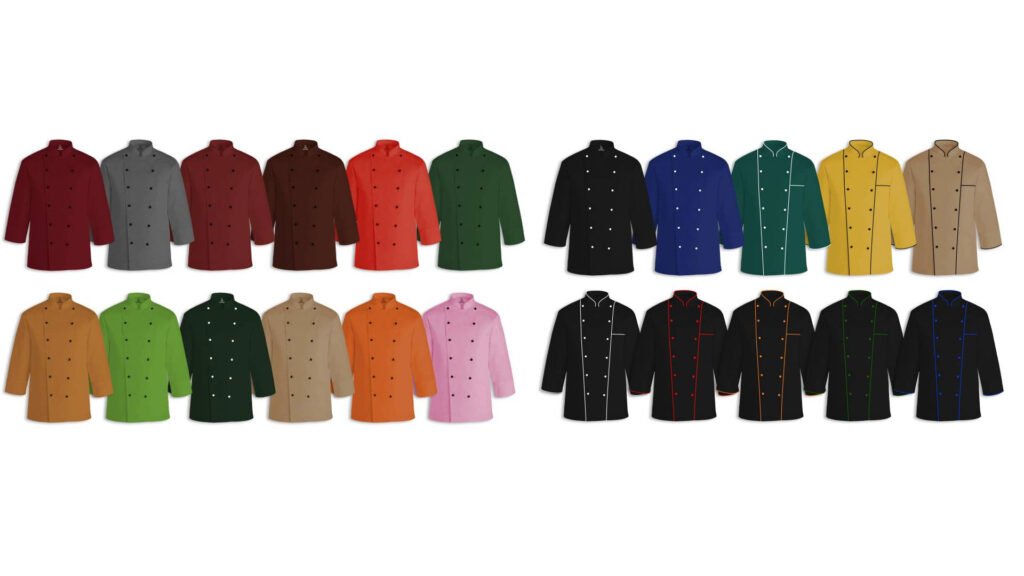
Colored Chef Coats (Blue, Red, Green, etc.)
Symbolism: Brand identity, department differentiation, casual atmosphere Worn by: Branded restaurants, hotel brigade systems, casual dining chains Best for: Branded restaurant chains, themed concepts, large hotel kitchens with multiple stations
Why Restaurants Choose Colored Coats
1. Brand color integration. A restaurant with a red logo puts chefs in red coats. A sushi restaurant uses black or dark blue. Blue apron + blue coat = complete brand immersion.
2. Departmental differentiation in large kitchens.
| Color | Typical Department |
|---|---|
| White | Executive chef, sous chef |
| Black | Grill / sauté station |
| Blue | Pastry / bakery |
| Green | Garde manger (cold station) |
| Red | Butcher station |
| Brown | Pantry / prep |
3. Casual atmosphere. Colored coats are less formal than white — appropriate for fast-casual chains, pizzeria, sports bars, and food trucks.
Considerations for Colored Chef Coat Fabric
- Lightfastness matters. Red and blue fade fastest under repeated industrial washing. Fabric must be dyed with reactive or vat dyes (not pigment) for color stability.
- Bleach kills color. If your laundry uses chlorine bleach, colored uniforms will fade rapidly. Use oxygen bleach (peroxide-based) instead.
- Color matching across batches. For large chain restaurants, maintaining consistent blue or red across production runs is challenging. Order single-dye-lot for full uniforms.
Apron Color Meanings
In many kitchens, the apron carries more color significance than the coat:
| Apron Color | Meaning |
|---|---|
| White full apron | Classical fine dining, pastry chef |
| Black half/bistro apron | Server, sommelier, front-of-house; modern chef style |
| Blue or striped apron | Line cook, casual kitchen |
| Brown or leather apron | Butcher, heavy prep work |
| Branded color apron | Chain restaurant identity |
Chef Uniform Color Comparison Chart
| Color | Authority | Stain Concealment | Heat Performance | Laundry Difficulty | Cost to Maintain |
|---|---|---|---|---|---|
| White | ★★★★★ | ★☆☆☆☆ | ★★★★★ | ★★★★★ (highest) | High (frequent replacement) |
| Black | ★★★★★ | ★★★★★ | ★★☆☆☆ | ★★★★☆ | Medium |
| Grey | ★★★☆☆ | ★★★★☆ | ★★★☆☆ | ★★★☆☆ | Medium-low |
| Striped | ★★★☆☆ | ★★★★☆ | ★★★★☆ | ★★★★☆ | Medium |
| Blue | ★★★☆☆ | ★★★☆☆ | ★★★☆☆ | ★★★☆☆ | Medium |
| Red | ★★★★☆ | ★★★☆☆ | ★★☆☆☆ | ★★☆☆☆ | High (fades fastest) |
| Green | ★★★☆☆ | ★★★☆☆ | ★★★☆☆ | ★★★☆☆ | Medium |
Chef Uniform Fabric Guide
What Makes Good Chef Uniform Fabric?
| Fabric Property | Why It Matters | Best Choices |
|---|---|---|
| Twill weave | Durable, resists snags, drapes well | 100% cotton twill, TC 65/35 twill |
| Dobby weave | Micro-perforations for ventilation | Traditional cotton dobby |
| Tear strength | Coat must survive daily wear + industrial laundry | Minimum 2.5 lbs warp, 2.0 lbs fill (ASTM D1424) |
| Shrinkage control | Must not shrink more than 3% after industrial wash | Pre-shrunk cotton or poly-cotton blend |
| Wrinkle resistance | No re-ironing after laundry | TC 65/35 or CVC — best wrinkle recovery |
| Oil/stain repellency | Optional but valuable | DWR or stain-release finish can be applied |
| Breathability | Cooks work in 35–45°C heat | Cotton content above 50%, GSM 240–300 |
| Weight | Too light = transparent; too heavy = hot | 240–320 GSM ideal for chef coats |
Chef Coat Weights by Usage
| Weight | Best For | Characteristics |
|---|---|---|
| 240–260 GSM | Casual dining, fast-casual chains, summer kitchens | Lighter, cooler, less durable |
| 280–300 GSM | Standard all-purpose chef coat | Best balance of durability + comfort |
| 320–360 GSM | Fine dining, heavy-use kitchens, double-breasted | Maximum durability, heavier, hotter |
Chef Pants
Chef pants typically differ from the coat:
- Black and white houndstooth / check — Classic baggy chef pants, pattern hides stains
- Solid black — Most common, especially in modern kitchens
- Solid white — Less common, high-maintenance, traditional pastry chef
Chef pants are usually:
- Cotton or poly-cotton twill, 240–280 GSM
- Loose fit for mobility and air circulation
- Elastic waist or drawstring for comfort during long shifts
Kitchen Hierarchy by Uniform Color
A common color-based brigade system (not universal — varies by establishment):
| Position | Typical Coat Color | Notes |
|---|---|---|
| Executive Chef | White double-breasted, or black | The highest standard — white = tradition, black = modern |
| Head Chef / Chef de Cuisine | White double-breasted | Standard fine dining head chef |
| Sous Chef | White or black | May wear white to match exec, or black for differentiation |
| Chef de Partie (Station Chef) | White or striped | White in formal kitchens, striped in casual/bistro |
| Line Cook / Commis | Striped or colored | Entry-level — most practical, easiest to maintain |
| Pastry Chef | White or blue | White is traditional; blue is practical (flour invisible) |
| Prep Cook / Kitchen Hand | Colored or black | Lowest differentiation — practical colors |
What to Look for When Sourcing Chef Uniforms
If you're a restaurant group, hotel, uniform manufacturer, or culinary school sourcing chef uniforms, here are the key decisions:
1. Choose your color hierarchy first:
- One-color all-staff (simple, lower costs) vs.
- Multi-color brigade (complex, higher costs, clearer hierarchy)
2. Select fabric based on laundry setup:
- In-house laundry → easier to wash uniforms frequently → heavier cotton preferred
- Third-party industrial laundry (like linen services) → TC 65/35 blend for durability through 50+ wash cycles
- Home laundry (small restaurant) → CVC blend, easy-care
3. Double-breasted vs. single-breasted:
- Double-breasted: +20–30% fabric cost, longer garment life (reversible)
- Single-breasted: Lower cost, lighter, less hot
4. Color + fabric dye specifications matter:
- White: Chlorine-resistant finish, no optical brighteners
- Colors: Reactive dyes for washfastness, no pigment dyes
- Specify Pantone references for color consistency
About Xingye Textile — Chef Uniform Fabric & Garments
XINGYE TEXTILE manufactures woven uniform fabrics suitable for chef coats, chef pants, and hospitality uniforms. With 30 years in the textile industry and exports to 50+ countries, we supply fabric and finished garments to restaurant chains, hotel groups, and uniform manufacturers.
Our fabric range suitable for chef uniforms:
| Fabric | Composition | Weight | Best For |
|---|---|---|---|
| Cotton Twill | 100% cotton | 260–360 GSM | Traditional chef coats — breathable, bleach-safe, professional drape |
| TC 65/35 Twill | Polyester-cotton | 240–280 GSM | Industrial laundry chef coats — wrinkle-free, durable, fade-resistant |
| CVC 60/40 Twill | Cotton-polyester | 260–300 GSM | All-purpose chef coats — cotton-rich feel with wrinkle resistance |
| Linen/Cotton 55/45 | Linen-cotton | 200–260 GSM | Resort/hospitality uniforms — lightweight, breathable, natural texture |
| Cotton Dobby Weave | 100% cotton | 240–280 GSM | Traditional French chef coats — ventilated weave, classic look |
| Poly-Cotton Oxford | Polyester-cotton | 240–280 GSM | Chef pants — durable, wrinkle-resistant, easy care |
Our color capabilities:
- ✅ Custom Pantone color matching
- ✅ White with chlorine-resistant finish
- ✅ Colorfast dyes: reactive and vat dyes for long wash life
- ✅ Bulk dye-lot consistency for large uniform programs
We also manufacture:
- ✅ Finished chef coats (single and double-breasted)
- ✅ Chef pants
- ✅ Hospitality uniform shirts
- ✅ Private labeling for uniform brands
- ✅ OEM / ODM — your design, our production
Sourcing chef uniforms for a restaurant chain, hotel, or uniform program? [Contact us] for fabric samples, spec sheets, and bulk pricing.