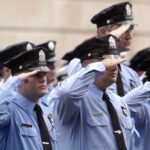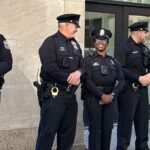
Walk through any airport or city center, and you'll see police officers in different colors: navy blue, black, khaki, white, even green. These are not random choices or fashion preferences.
Police uniform colors are carefully selected by departments based on:
- Psychological impact on the public
- Functional performance in specific environments
- Historical tradition in their jurisdiction
- Practical maintenance (dirt, fading, replacement cost)
- Operational role (patrol vs. tactical vs. traffic)
This article breaks down the meaning behind each common police uniform color — what it signals to the public, where it works best, and which fabric technologies make it practical.
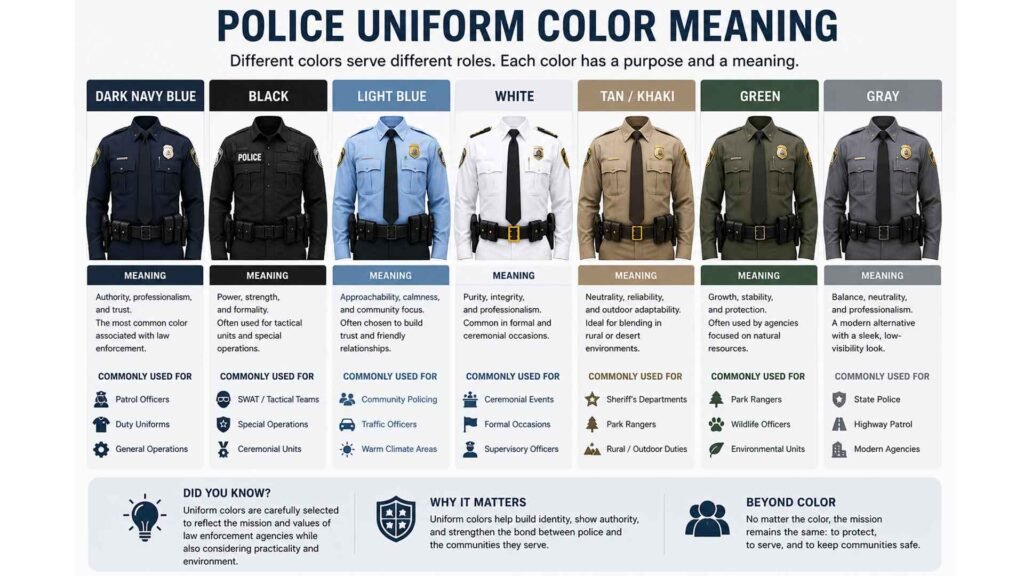
Police uniform color meanings
Navy Blue
The global standard. Over 80% of police departments worldwide use navy blue as their primary uniform color.
| Aspect | Detail |
|---|---|
| Symbolism | Authority, stability, trust, professionalism |
| Common users | NYPD, Chicago PD, London Met, most European/Australian/Asian police |
| Best for | General patrol, community policing, all-purpose duty |
| Psychological rating | Highest across trustworthiness and competence (peer-reviewed studies) |
What Navy Blue Signals
Navy blue strikes a deliberate balance: authoritative enough to command respect in an enforcement situation, but approachable enough for community interaction. Research on color perception in uniform contexts consistently rates navy blue as the most 'professional' choice across demographic groups.
When navy blue is the right choice:
- Municipal police departments covering diverse communities
- Agencies where officers interact with the public frequently (community policing model)
- Departments that need one uniform to work for patrol, traffic, and administrative duties
- Large forces where uniform consistency across thousands of officers matters
When it's not ideal:
- Tactical/SWAT units (black performs better in low-light)
- Highway patrol on foot near traffic (navy blends into dark road surfaces at night)
- Extreme hot climates (absorbs more heat than khaki or light blue)
Fabric for navy blue uniforms: To maintain deep, consistent navy across production runs and industrial launderings, quality specifications require:
- Vat or sulfur dyes for cotton/CVC blends — best lightfastness and washfastness
- Disperse dyes for polyester component in TC blends — fade-resistant through 50+ washes
- Spectrophotometer verification — ΔE ≤ 1.0 for batch consistency
Black
The fastest-growing police uniform color since the 1990s, driven by tactical aesthetics and military influence.
| Aspect | Detail |
|---|---|
| Symbolism | Power, seriousness, intimidation, authority |
| Common users | LAPD tactical, Dallas PD, Atlanta PD, Phoenix PD, SWAT teams, federal tactical units |
| Best for | Tactical operations, night patrol, paramilitary units |
| Psychological rating | Highest intimidation; lowest approachability |
What Black Signals
Black projects raw authority. It is perceived as the most powerful and serious color — but also the least approachable. This is deliberate for units where the priority is deterrence and control, not community engagement.
Why black is chosen over navy:
- Night concealment — Black is nearly invisible in low-light conditions
- Modern aesthetics — Reflects contemporary tactical gear design
- Perceived professionalism — Some officers and departments view black as more 'modern' than traditional navy
- Transition to semi-military role — Black aligns with the appearance of special operations units
Key considerations for black uniforms:
- Shows lint, dust, pet hair, and chalk more than navy
- Higher heat absorption — surface temps 5–8°C hotter than navy in direct sun
- Requires FR-rated black fabric for tactical units that may encounter flash or fire
- Black dye has the most potential for color metamerism — the same black can look different under sunlight vs. streetlights vs. vehicle headlights
When black is the right choice:
- Tactical/SWAT units with nighttime operations
- Highway patrol (in combination with hi-vis traffic vest)
- Departments shifting to a 'modern' enforcement-first image
- Agencies operating predominantly at night
Khaki / Tan / Brown
The traditional color for sheriff's departments, park police, and warm-climate agencies.
| Aspect | Detail |
|---|---|
| Symbolism | Approachable, traditional, earthy, community-oriented |
| Common users | County sheriffs (US South/West), park rangers, campus police, some tropical/desert police forces |
| Best for | Rural policing, community engagement, hot climates |
| Psychological rating | Highest approachability; lowest authority |
What Khaki Signals
Khaki projects familiarity and accessibility. It's the least intimidating police uniform color — associated historically with sheriffs, rural deputies, and park rangers who depend on community cooperation rather than enforcement.
Why departments choose khaki:
- Heat performance — Reflects sunlight, stays significantly cooler than navy or black
- Practicality in rural environments — Hides dust, dirt, and dry mud well
- Community perception — A khaki uniform says 'I'm here to help' more than 'I'm here to enforce'
- Tradition — County sheriff departments have worn khaki since the 19th century in the US
Key considerations:
- Shows wet stains, oil, grass, and food spills prominently
- Difficult to keep looking crisp in urban environments with exhaust and grime
- Lower color consistency across batches than dark dyes — khaki formulations require careful spectro verification
- Lower night visibility than white or light blue
Light Blue / Medium Blue
Common among state police, highway patrol, and transit police.
| Aspect | Detail |
|---|---|
| Symbolism | Approachable, trustworthy, calm |
| Common users | LAPD (classic blue), California Highway Patrol, transit police, some state police |
| Best for | Traffic enforcement, community interaction, daylight operations |
| Psychological rating | High trust, moderate authority |
What Light Blue Signals
Light blue is the least threatening dark-color uniform choice. It signals calm competence and transparency — a deliberate choice for agencies that prioritize public confidence.
Why departments choose light blue:
- High visibility — Easy for the public to spot in daylight
- Less intimidating than dark navy or black
- Cooler in sun than dark colors
- Distinct from dark navy — Light blue forces can be immediately differentiated from city police (useful in overlapping jurisdictions)
Key considerations:
- Shows dirt and stains more readily — needs more frequent replacement
- Less practical at night — can look white or grey under street lighting
- Harder to dye consistently — light shades show batch variation more than dark shades
- Less suitable for tactical work — visible from distance in low-light
White
Ceremonial, command, and tropical — the most maintenance-intensive police uniform color.
| Aspect | Detail |
|---|---|
| Symbolism | Purity, formality, command, visibility |
| Common users | High-ranking officers (dress uniform), ceremonial units, traffic police in tropical countries, some Caribbean/African police |
| Best for | Ceremonial occasions, traffic duty in hot climates, command presence |
| Psychological rating | Highest visibility; command association |
What White Signals
White is not a practical duty color. It is reserved for situations where appearance and visibility matter more than durability:
- Ceremonial uniforms — Parades, official events, promotions, funerals
- Tropical traffic police — White reflects maximum heat, keeps officers cool
- Senior officer dress uniforms — White shirt or white uniform top signals rank
Key considerations for white uniform fabric:
- Requires optical brighteners in the dyeing/finishing process — these degrade with washing and UV exposure
- Must be washed separately to avoid color transfer
- Shows every stain — oil, rust, pen ink, sweat, dirt
- Typical replacement cycle: 40–60% shorter than navy blue for the same garment
- Best woven in poly-cotton or TR for easy-care properties — 100% cotton white requires professional laundry
Green
Most common in military police, forest service, and countries with military-style police forces.
| Aspect | Detail |
|---|---|
| Symbolism | Service, nature, military heritage |
| Common users | Military police (USA, UK, Canada), forest rangers, Indian police (khaki-green), some South American police |
| Best for | Rural/wooded environments, military installations, paramilitary police |
What Green Signals
Olive green and forest green uniforms are inherited from military traditions. They serve specific operational needs:
- Concealment in wooded/rural environments
- Alignment with military police role
- Historical continuity — many national police forces originated as military branches
Common green uniform variations:
| Shade | Users | Application |
|---|---|---|
| Olive drab | US Army MPs, Indian Police | All-purpose duty |
| Forest green | Canadian Police (some units), Park Police | Rural/national park patrol |
| Dark green | Nigerian Police, some Caribbean forces | Traditional service uniform |
Grey / Charcoal
A modern alternative growing in popularity, especially in suburban and northern police departments.
| Aspect | Detail |
|---|---|
| Symbolism | Neutral, professional, modern |
| Common users | Suburban departments (USA), some Canadian police, transit police |
| Best for | Suburban patrol, transit, cooler climates |
| Psychological rating | Moderate authority, moderate approachability |
What Grey Signals
Grey is a compromise color — less intimidating than black, less traditional than navy, less casual than khaki.
Advantages of grey uniforms:
- Less heat absorption than navy or black
- Better concealment than light colors at night
- Hides dust well (better than khaki, worse than navy)
- Modern professional appearance without the baggage of navy's 'traditional' connotation
Challenges:
- Limited dye stability — grey formulations can shift warm or cool after repeated washing
- Less public recognition — citizens may not immediately identify a grey uniform as police
- Harder to color-match across batches than pure navy or black
Color Meaning by Police Role
| Role | Common Color | Why That Color |
|---|---|---|
| General patrol | Navy blue | Best balance of authority + approachability + practicality |
| Tactical / SWAT | Black | Night concealment, intimidation, paramilitary alignment |
| Traffic enforcement | Light blue or white + hi-vis | Maximum visibility on roadways |
| Sheriff / rural patrol | Khaki / tan | Cooler in heat, community-oriented tradition |
| Transit police | Light blue or grey | Visible in stations/underground without being aggressive |
| School resource officer | Khaki or light blue | Less intimidating, more approachable for students |
| Ceremonial / command | White or navy with gold trim | Formality, distinction |
| Military police | Olive green or dark green | Military tradition, woodland concealment |
| Park ranger / forest service | Khaki, green, or grey | Approachable in recreational, concealed in wilderness |
| Motorcycle unit | Light blue or white + reflective | Maximum road visibility, heat reflection while riding |
| K-9 unit | Navy or black | Practical for vehicle work + tactical flexibility |
Color Variation by Country
Police uniform colors are not universal. Different countries and regions have distinct traditions:
| Country/Region | Primary Color | Notes |
|---|---|---|
| United States | Navy blue (most), black (growing), khaki (sheriffs) | Highly decentralized — every department chooses |
| United Kingdom | Dark blue (all forces) | Highly standardized — Metropolitan Police Act tradition |
| Canada | Navy blue (RCMP), grey/blue (municipal), dark green (some) | Provincial variation |
| Australia | Navy blue (all states) | Standardized since the 1990s |
| Germany | Dark blue (most states since 2000s transition) | Previously green; modernized to blue |
| France | Dark blue (National Police), khaki-green (Gendarmerie) | Two forces, two traditions |
| Japan | Dark blue | Uniform since Meiji era, influenced by European models |
| India | Khaki (most state police), white (traffic), olive (military police) | Climate-driven — khaki dominant in hot weather |
| Brazil | Dark blue (most states), khaki (some rural) | State-level variation |
| Nigeria | Dark blue (standard), camouflage (special forces) | British colonial tradition |
| UAE / Saudi Arabia | Dark blue (standard), white (traffic/tropical) | Climate and tradition |
| Scandinavia | Dark blue (all countries) | Heavy community policing tradition |
The Trend: What's Changing in Police Uniform Colors
1. Black Is Encroaching on Navy
Since the early 2000s, the shift from navy blue to black has been the most significant color trend in police uniforms, particularly in the United States. Departments cite:
- Modern tactical aesthetics
- Officer preference
- Night operational advantage
However, the trend may be slowing — some departments that switched to black are reconsidering due to heat concerns and public perception.
2. Hi-Vis Is Becoming Mandatory (Over Any Color)
Regardless of base uniform color, hi-vis vests or outerwear are increasingly standard on traffic, event, and night duty. This changes the conversation: if officers always wear hi-vis over their base uniform for traffic and night operations, the base color matters less for safety and more for identity and tradition.
3. Fabric Innovation Is Driving Color Changes
Better dye technology is allowing departments to choose colors that were previously impractical:
- Lightfast reactive dyes for khaki and light blue — less fading
- Dope-dyed polyester — color is in the fiber, not a surface dye; extremely fade-resistant
- FR treatments in any color — not just traditional navy and black
4. Community Policing Is Influencing Color Choice
Departments emphasizing community engagement are choosing lighter colors (khaki, light blue) over dark navy or black. This is part of a broader trend toward:
- 'Soft' uniforms for community roles
- Distinct colors for different assignments within the same department
- Removing the 'militarized' appearance associated with solid black
What This Means for Uniform Buyers
If you're sourcing police uniforms or police uniform fabric, color choice affects more than appearance:
| Decision | Impact on Procurement |
|---|---|
| Choose navy blue | Easiest dye consistency, easiest to match across batches, highest fabric supplier availability, best lightfastness |
| Choose black | Higher heat impact on wearer, lint/dust visible, tactical advantages, requires FR consideration |
| Choose khaki | Lower batch-to-batch consistency, more sensitivity to UV fading, best for hot climates |
| Choose light blue or grey | Requires premium dyes for washfastness, more frequent replacement, good for community image |
| Multiple colors across roles | Increases minimum order quantities and complexity — single-color core with colored accessories is simpler |
About Xingye Textile
XINGYE TEXTILE manufactures police uniform fabric in multiple colors and compositions for law enforcement agencies, uniform manufacturers, and government procurement worldwide. With 30 years in the textile industry and exports to 50+ countries, we understand the color specifications and performance standards required for police uniforms.
Our police uniform fabric — available in any standard police color:
| Fabric | Colors Available | Weight Range | Best For |
|---|---|---|---|
| TC 65/35 Twill | Navy, black, khaki, light blue, grey, white | 240–260 GSM | Class B shirts & trousers — wrinkle-free, industrial laundry safe |
| CVC 60/40 Twill | Navy, black, khaki, light blue, grey | 260–300 GSM | Patrol shirts — more natural feel with wrinkle resistance |
| TR Twill | Navy, black, khaki, grey | 250–320 GSM | Dress uniforms — matte finish, professional drape |
| 100% Cotton Twill | Navy, black, khaki, olive green | 300–400 GSM | Tactical uniforms, heavy-duty trousers |
| Nylon-Cotton Ripstop | Navy, black, khaki, olive, grey | 200–280 GSM | Duty jackets, tactical pants |
| FR Cotton / Cotton-Nylon | Navy, black, khaki | 280–360 GSM | Tactical entry, SWAT uniforms — NFPA compliant |
| Poly-Wool Blend | Navy, black, dark grey | 260–320 GSM | Class A dress uniforms |
Our color capabilities:
- ✅ Pantone-matched dye formulation for any specified color
- ✅ Spectrophotometer verification — ΔE ≤ 1.0 batch-to-batch
- ✅ AATCC lightfastness Grade 4+ and washfastness Grade 4+
- ✅ Single-dye-lot production for full-uniform consistency
- ✅ Finished garment manufacturing — fabric to finished uniform
Sourcing police uniform fabric in navy, black, khaki, or any other color? [Contact us] for spec sheets, samples, and bulk pricing.