The Difference Between a Uniform That Protects and One That Just Covers
A police uniform is not a fashion choice. It is a piece of safety equipment that has to do five things simultaneously every single day:
- Withstand 8-12 hours of continuous wear, often in a patrol car in summer heat
- Hold up to 15+ pounds of duty belt equipment without sagging or tearing
- Survive industrial laundry at high temperatures, frequently 3-5 times per week
- Present a professional, authoritative appearance at all times
- In some cases, provide flame resistance, tear resistance, or stab protection
Cotton can't do that. Pure polyester can't do that. The fabric that police uniforms are actually made from is a carefully engineered blend — usually polyester-cotton (TC), polyester-viscose (TR), or a high-tenacity nylon-cotton blend for tactical units.
This guide covers what police uniform fabrics are made of, why each material is chosen, and what to look for when buying law enforcement uniforms — whether you're a police department procurement officer, a uniform distributor, or a manufacturer.
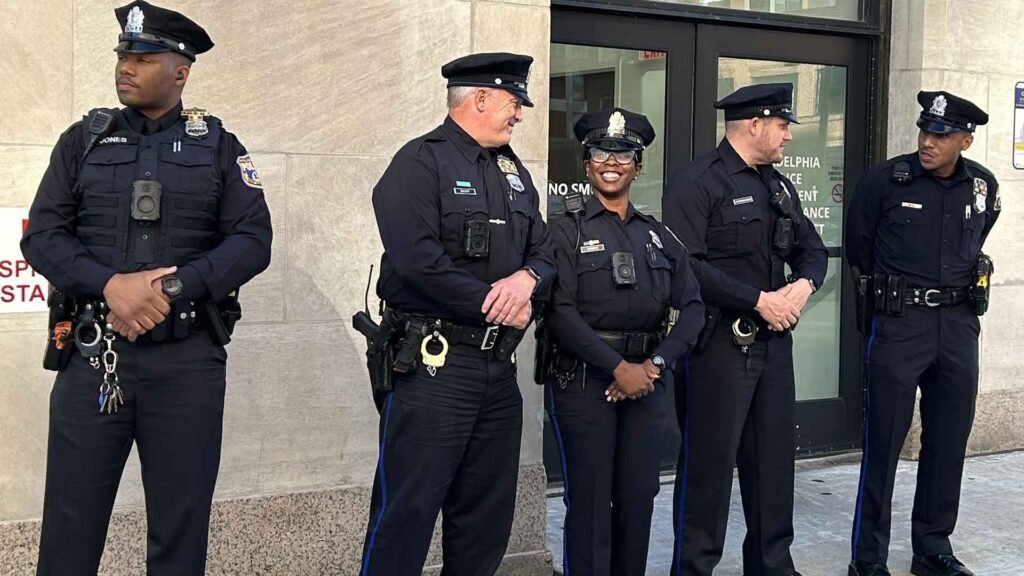
What Are Police Uniforms Made Of
The Historical Shift: From Wool and Cotton to Performance Blends
| Era | Fabric | Problem |
|---|---|---|
| 1900s-1960s | Wool serge | Hot, heavy, expensive, shrinks in rain, uncomfortable in summer |
| 1960s-1990s | 100% cotton twill or poplin | Wrinkles badly, shrinks 5-8% in hot wash, fades, wears out in 20-30 washes |
| 1990s-present | Polyester-cotton blends (TC) | Wrinkle-resistant, durable, affordable, industrial laundry safe |
| 2000s-present | Polyester-viscose blends (TR) for dress uniforms | Better drape, sharper appearance, closer to wool look without wool cost |
| Tactical units | Nylon-cotton ripstop or Nomex® | Tear resistance, flame protection for SWAT and patrol |
Most modern police departments have standardized on TC 65/35 (polyester-cotton) in a twill weave for their daily patrol uniforms. It's the best balance of appearance, durability, comfort, and cost.
What Are Patrol Uniforms Made Of?
The standard daily-wear police uniform — the one you see on patrol officers, traffic enforcement, and response units — is typically made from:
65% Polyester / 35% Cotton (TC) Twill — 240-280 GSM
| Component | Typical Fabric | Why |
|---|---|---|
| Shirt (long sleeve or short sleeve) | TC 65/35 twill, 200-240 GSM | Wrinkle-resistant, breathable enough for full-day wear, holds crease |
| Trousers | TC 65/35 twill with reinforcement, 240-280 GSM | Heavier weight for abrasion resistance, reinforced seat and knees |
| Class A / Dress uniform | TR 65/35 (polyester-viscose) gabardine, 260-300 GSM | Sharper drape, better color, closer to wool appearance |
| BDU / Tactical pants | 50/50 nylon-cotton ripstop, 200-240 GSM | Tear resistance, quick-dry, abrasion resistance |
| Outer vest carrier | 100% polyester or nylon mesh | Lightweight, breathable, holds ballistic panels |
Why not 100% cotton? Cotton police uniforms fail in three ways:
- They wrinkle within hours — an officer in a wrinkled uniform looks unprofessional by mid-shift
- They shrink progressively — a shirt that fits in January may be too short by June
- They wear out fast — 20-30 industrial wash cycles vs 80-100 for poly-cotton blends
The Key Properties a Police Uniform Fabric Must Have
| Property | Why It Matters | Target Spec |
|---|---|---|
| Wrinkle resistance | Officers wear the same uniform all shift — no time to iron mid-day. Fabric must release wrinkles when hung overnight | Polyester content 50%+ (65% preferred) |
| Tensile strength | Uniforms are stressed by duty belts, kneeling, grappling, and vehicle entry/exit. Fabric must resist tearing | Minimum 400 N (twill weave) |
| Tear resistance | A tear in a patrol uniform can escalate quickly. Ripstop weave is preferred for tactical use | ASTM D2261 — 30 N+ |
| Abrasion resistance | Seat area, knees, and elbows wear fastest. Heavier GSM and ripstop construction add life | 240 GSM minimum for trousers |
| Shrinkage | Sizing consistency across the shift matters. Officers should not have to buy new uniforms every 6 months | ≤2% after 50 industrial washes |
| Color fastness | Police uniforms must stay the same shade across the department. Re-order matching is essential | Delta E < 1.5 across production runs |
| Breathability | Patrol cars in summer, foot beats, physical activity — fabric must allow air movement | TC breathes better than pure polyester |
| Flame resistance (optional) | Some patrol units and all tactical/SWAT units require FR fabrics for flash-fire protection | NFPA 1971 or NFPA 1951 compliant |
Fabric Comparison — What Police Uniforms Are Made Of vs Alternatives
| Fabric | Best Use | Durability | Wrinkle Resistance | Breathability | Cost |
|---|---|---|---|---|---|
| TC 65/35 Twill | Standard patrol shirt & trousers | ★★★★☆ | ★★★★☆ | ★★★★☆ | $$ |
| TR 65/35 Gabardine | Dress uniforms, command staff | ★★★★☆ | ★★★★★ | ★★★☆☆ | $$ |
| 50/50 Nylon-Cotton Ripstop | BDU pants, tactical patrol | ★★★★★ | ★★★☆☆ | ★★★☆☆ | $$$ |
| 100% Cotton Twill | Budget / temporary uniforms | ★★☆☆☆ | ★★☆☆☆ | ★★★★★ | $ |
| Nomex / FR Blends | SWAT, hazmat, fire overlap | ★★★★★ | ★★★☆☆ | ★★☆☆☆ | $$$$ |
| 100% Polyester Gabardine | Low-budget contract uniforms | ★★★★☆ | ★★★★★ | ★☆☆☆☆ | $ |
How Police Uniforms Are Constructed
The fabric is only half the story. The construction of a police uniform is as important as the material.
Seam construction — double or triple needle. A standard shirt has single-needle seams. A police uniform needs double-needle or even triple-needle stitching at stress points: crotch, seat, armhole, hip pocket corners, belt loops. These are the first failure points in a standard garment.
Reinforced crotch and seat. Police officers sit in a patrol car for hours, then jump out and run. The crotch seam and seat panel take more stress than any other part of the uniform. A quality police trouser has a reinforced crotch gusset and a double-layer seat panel.
Duty belt reinforcement. A standard duty belt with gun, taser, baton, handcuffs, radio, and magazine pouches weighs 12-20 pounds. That load hangs from the trouser waistband and belt loops. Standard belt loops tear under this weight. Police trousers need reinforced belt loops (bar-tacked or metal-riveted) with a wide waistband to distribute the load.
Knee reinforcement. Some police trousers include a double-layer knee panel with a knee pad pocket. This extends trouser life for officers who kneel frequently (traffic stops, evidence collection, crowd control).
Mic tab / radio mic attachment. Most police uniform shirts have a mic tab on the left shoulder or chest — a small fabric loop or strap to hold the radio microphone cord in place, keeping it from swinging loose during movement.
Trousers vs Shirts — Different Fabrics for Different Demands
Police trousers and shirts have very different durability requirements. Many departments use different fabrics for each despite them being part of the same uniform set.
| Part | Fabric | GSM | Key Requirement |
|---|---|---|---|
| Shirt | TC 65/35 Twill | 200-240 | Wrinkle resistance, breathability, professional appearance |
| Trousers | TC 65/35 Twill (heavy) or 50/50 Nylon-Cotton Ripstop | 240-300 | Abrasion resistance, tear strength, duty belt support |
| Dress shirt | TR 65/35 Gabardine | 240-260 | Sharp drape, color depth, wrinkle-free |
| Dress trousers | TR 65/35 Gabardine | 260-300 | Sharp crease, matching fabric to tunic |
What Are Tactical Police Uniforms Made Of?
SWAT and tactical team uniforms use different materials than patrol uniforms because the requirements are different: higher tear resistance, flame protection options, and better mobility.
| Fabric | Used In | Key Properties |
|---|---|---|
| 50/50 Nylon-Cotton Ripstop | BDU pants and shirts (most common tactical uniform) | Tear resistance 3x higher than standard twill, quick-dry, abrasion resistant |
| Nomex / Aramid Blends | Entry suits, flash-over protection layers | Inherent flame resistance, does not melt or drip, NFPA compliant |
| Cotton-Nylon-Spandex Blends | Tactical polo shirts, patrol base layers | Stretch for mobility, moisture-wicking, comfortable under vest |
| 100% Cotton FR (flame-resistant treated) | Budget FR uniforms | Treated for flame resistance, less durable than Nomex, lower cost |
The 50/50 nylon-cotton ripstop is the most common tactical uniform fabric in the world. The nylon provides tear and abrasion resistance. The cotton provides breathability and comfort. The ripstop grid prevents small tears from running across the entire panel.
What Are Police Shirts Made Of?
The classic police uniform shirt — the button-front, two-pocket style with collar brass and epaulettes — is almost universally made from:
65% Polyester / 35% Cotton (TC) Twill, 200-240 GSM
Specific features of police uniform shirts:
- Two chest pockets with flap and button closure — for notebook, pen, badge, glasses
- Epaulettes — fabric loops at each shoulder for rank insignia
- Mic tab — small strap on the left shoulder or collar for radio mic cord
- Badge reinforcement — extra fabric layer at the badge attachment point to prevent tearing
- Collar brass loops — small eyelets on the collar tips for collar brass
- Zipper front with button overlay — zipper for quick donning, buttons for traditional appearance
- Wrinkle-resistant finish — critical for officers who put on a fresh shirt at 5 AM and wear it until 6 PM
What Are Police Pants Made Of?
Police trousers face the toughest conditions of any garment in the uniform. They support a 15-20 lb duty belt, survive kneeling on asphalt and concrete, and must still look pressed after 10 hours.
Standard patrol trouser fabric: 65% Polyester / 35% Cotton (TC) Twill, 260-280 GSM
Key features of quality police trousers:
- Reinforced belt loops — bar-tacked or riveted, 2-3 inches wide, spaced to support duty belt load distribution
- Double-layer seat — extra fabric panel at the seat to delay wear from car seat friction
- Reinforced crotch gusset — diamond-shaped gusset insert that reduces crotch seam stress
- Knee reinforcement (optional) — double-layer knee panel or knee pad pocket
- Proper fit at waist — trousers must sit at the natural waist (not hips) to support the duty belt weight correctly
- Hemmed with extra length — allows for kneeling without trousers riding above the boot top
- Back pocket reinforcement — for wallet and badge case
How to Buy Police Uniforms — What to Specify
If you're ordering police uniforms for a department, specify these fabric and construction requirements to your supplier:
Fabric:
- TC 65/35 twill, 240-260 GSM for shirts
- TC 65/35 twill or 50/50 nylon-cotton ripstop, 260-300 GSM for trousers
- TR 65/35 gabardine, 260-300 GSM for dress uniforms
- Anti-pilling rating 4.0+ (ASTM D4970)
- Shrinkage ≤2% after 5 industrial washes (AATCC 135)
- Color fastness rating 4+ (AATCC 61)
Construction:
- Double-needle stitching on all major seams
- Reinforced crotch gusset on trousers
- Bar-tacked belt loops rated for 20 lb duty belt
- Double-layer seat panel on trousers
- Mic tab on left shoulder of shirt
- Badge reinforcement panel on left chest
Frequently Asked Questions
Q: Why are police uniforms made of polyester-cotton blend? A: The polyester provides wrinkle resistance, durability, and color retention. The cotton provides breathability and comfort against the skin. Neither fiber alone meets all the requirements of a 12-hour shift with industrial laundry.
Q: Do police uniforms have flame-resistant requirements? A: Standard patrol uniforms do not require FR fabric. SWAT, tactical entry, and hazmat overlap units typically require NFPA-compliant FR fabrics. Some progressive departments are adopting FR fabrics for all patrol units as a safety upgrade.
Q: What fabric are police dress uniforms made of? A: Dress uniforms (Class A) are typically made from TR gabardine — a polyester-viscose blend that mimics the drape and hand feel of wool serge without the cost, weight, and care requirements of wool.
Q: Why do police pants have reinforced knees? A: Officers kneel frequently — traffic stops, evidence collection, crowd control, building searches. Standard trouser fabric wears through at the knee in weeks of daily kneeling. Reinforcement extends trouser life 3-5x.
Q: How often do police uniforms need to be replaced? A: With quality TC fabric and proper care: 12-18 months for daily-wear shirts, 18-24 months for trousers. High-quality TR dress uniforms can last 2-3 years with proper rotation.
Get a Quote — Police Uniform Fabrics and Garments
XINGYE TEXTILE manufactures police uniform fabrics and finished garments for law enforcement agencies worldwide. TC 65/35 twill, TR gabardine for dress uniforms, and 50/50 nylon-cotton ripstop for tactical units. Industrial laundry rated, color-matched across production runs, custom spec development available.
Minimum order: 500 pieces per color/size. Sample-first ordering.