Walk into any hospital, and the first thing you notice is the color. Not the walls — the staff. Blue, teal, pink, green, navy, patterned prints — each department in a hospital often wears a different scrub color.
This is not random. Hospital scrub color coding is a deliberate system that helps patients, visitors, and staff instantly identify who does what. But unlike chef coats or police uniforms, there is no single global standard. Scrub colors vary by hospital, by country, and sometimes even by shift.
This article breaks down the most common scrub colors, what they typically mean, which fabrics work for medical environments, and what to consider when sourcing nurse uniforms for a hospital or healthcare facility.
nurse uniform color meaning
Why Hospitals Use Color-Coded Scrubs
Scrub color coding solves a real problem: in a busy hospital, every person in scrubs could be a nurse, a doctor, a technician, a phlebotomist, or a housekeeper. Color helps patients and staff distinguish roles at a glance.
Benefits of color-coded scrubs:
| Benefit | How It Works |
|---|---|
| Patient safety | A patient can identify the right person to ask for help — 'I need a nurse, not a housekeeper' |
| Department identification | Green = surgery, blue = med-surg, pink = maternity |
| Role distinction | Different shades distinguish RNs from LPNs from CNAs |
| Infection control | Dedicated colors stay within their department — reduces cross-contamination risk |
| Visitor navigation | Visitors can find the right person in a busy unit |
| Staff morale | Colors create team identity within each department |
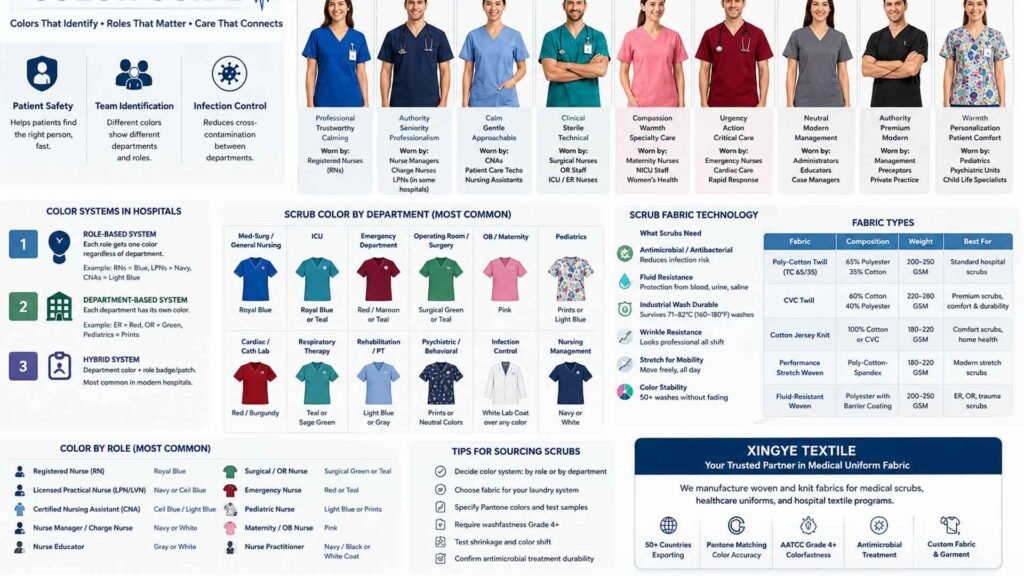
How Color Systems Work
Most hospitals use one of two systems:
1. Role-based system: Each role gets one color regardless of department
- RNs wear royal blue, LPNs wear navy, CNAs wear ceil blue
- Simple, consistent, but doesn't help identify department
2. Department-based system: Each department has its own color
- Emergency wears red, pediatrics wears colorful prints, ICU wears teal
- Clear departmental identification, but staff from different roles are hard to tell apart
3. Hybrid system: Department color + role patch/badge
- Most common in modern hospitals
- Color identifies department, badge identifies role
Common Scrub Colors & Their Meanings
Royal Blue — The Most Common Nurse Color
Meaning: Professional, trustworthy, calming Worn by: Registered Nurses (RNs) in many hospitals Best for: Med-surg, general nursing, ICU, step-down units
Royal blue is the single most common scrub color for registered nurses in North America. It's practical, professional, and research shows it is perceived by patients as the most 'trustworthy' and 'competent' color option.
Why hospitals choose royal blue for RNs:
- Universally perceived as professional — patients consistently rate blue scrubs highest in competence
- Color psychology: Blue lowers blood pressure and anxiety — appropriate for patient-facing roles
- Practical: Royal blue hides minor stains better than light blue or pink
- Dye stability: Blue is one of the most colorfast colors across wash cycles
- Gender-neutral: Works well for both male and female nurses
Navy Blue / Dark Navy
Meaning: Authority, seniority, professionalism Worn by: Nurse managers, charge nurses, LPNs (in some hospitals), leadership roles Best for: Management, administration, emergency department leadership
Navy blue signifies seniority. It's often worn by:
- Charge nurses and shift supervisors
- Nurse managers and directors
- LPNs / LVNs (in many hospitals — navy distinguishes them from RNs in royal blue)
- Some hospitals use navy for all nursing staff while royal blue is for techs
Ceil Blue / Light Blue / Sky Blue
Meaning: Calm, gentle, approachable Worn by: CNAs, patient care techs, nursing assistants, pediatric staff Best for: Pediatrics, long-term care, rehabilitation
Light blue is a subordinate color in many hospital systems — the 'softer' blue signals a supportive, non-authoritative role. It's also popular in:
- Pediatrics — soft color is less intimidating for children
- Geriatric units — easier on aging eyes than dark colors
- Rehabilitation / physical therapy — approachable, activity-appropriate
Pink / Rose / Blush
Meaning: Compassion, warmth, specialty care Worn by: Maternity nurses, NICU staff, breast health center staff (in some hospitals) Best for: Obstetrics, NICU, women's health, breast cancer centers
Pink scrubs are strongly associated with women's health and maternity. This is one of the most universally recognized color codes in hospitals.
What pink signals:
- Immediate identification — visitors instantly know they're in the right unit
- Emotional warmth — pink is associated with care and gentleness
- Not used for life-threatening emergencies — pink signals 'this unit is safe, not critical'
Note on gender: As the nursing profession becomes more gender-diverse, some hospitals have moved away from pink-only policies for OB units, offering pink alongside teal or blue.
Green / Teal / Sage
Meaning: Clinical, sterile, technical Worn by: Surgical nurses, OR staff, ER nurses (in some hospitals), respiratory therapists Best for: Operating rooms, emergency department, ICU, respiratory care
Green — particularly surgical green or teal — is the standard color for scrubs worn in sterile environments.
Why green in the OR?
- Color contrast with red tissue — surgical green reduces eye fatigue for surgeons and OR nurses working under bright lights for hours
- Afterimage reduction — staring at red tissue then looking at white walls creates green afterimages; green walls and scrubs neutralize this effect
- Calming under stress — green is associated with clinical precision
- Practical for blood concealment — green hides blood splashes better than light colors
Teal / blue-green: Growing in popularity as a modern alternative to traditional surgical green — especially in ED and trauma settings.
Red / Burgundy / Maroon
Meaning: Urgency, action, critical care Worn by: Emergency department nurses, cardiac care nurses, rapid response teams Best for: Emergency department, cardiac units, trauma centers
Red scrubs signal urgency. In many hospitals:
- Emergency department nurses wear burgundy or maroon
- Cardiac catheterization lab staff wear red
- Rapid response or code teams wear red for immediate identification
Caution with red: Red shows fading and color shifting faster than any other scrub color. Hospitals using red scrubs typically replace them 30–50% more frequently than blue or teal.
Gray / Charcoal
Meaning: Neutral, modern, management Worn by: Hospital administrators, educators, case managers, or optional professional alternative Best for: Non-clinical roles, education, administration
Gray is increasingly popular as a 'neutral' color for:
- Nursing educators who float between departments
- Case managers and discharge planners
- Hospital administration who need a professional clinical appearance without a department identity
- Some hospitals offer gray as an optional 'premium' color for experienced nurses
Black
Meaning: Authority, modern, premium Worn by: Management, preceptors, or optional dress-code choice Best for: Private clinics, cosmetic surgery centers, dental practices, administrative nursing roles
Black scrubs are rare in acute-care hospital settings but common in:
- Private medical practices — projecting a premium image
- Cosmetic surgery / medspa — fashion-forward, clean
- Veterinary clinics — practical, hides stains
- Nursing leadership — some hospitals allow managers to choose black
Limitation: Most hospital infection control policies discourage black because:
- Black hides blood and body fluid stains — safety concern
- Black fades unevenly and shows lint/dust more than claims
- Black absorbs heat in warm environments
White
Meaning: Traditional, professional, authoritative Worn by: Nursing leadership, educators, infection control, or as a lab coat over scrubs Best for: Administration, education, ceremonial roles
White is the traditional nursing uniform color from the cap-and-dress era. Today it's rarely worn as full scrubs — more commonly as a white lab coat over colored scrubs.
Where white survives:
- Nursing school graduation ceremonies
- Some nursing leadership roles (CNO, directors)
- Infection control nurses
- Surgical nurses in some traditional hospitals
Practical reality: White scrubs show every stain. Most hospitals have moved away from white scrubs for this reason.
Printed / Patterned Scrubs
Meaning: Warmth, personalization, patient comfort Worn by: Pediatric nurses, psychiatric nurses, some long-term care staff Best for: Pediatrics, child life specialists, mental health units
Patterned scrubs — cartoon characters, animals, flowers, abstract prints — serve a specific purpose in:
- Pediatric units — children feel less anxious approaching a nurse with kittens or dinosaurs on their scrubs
- Child life specialist roles — their job is to reduce fear, and patterns help
- Psychiatric / behavioral health — less clinical appearance, more approachable
- Memory care / Alzheimer's units — bright patterns can be engaging
Fabric note for prints: Printed scrubs require pigment or reactive printing with good washfastness. Cheap prints crack and peel after 10–15 washes.
Scrub Color by Department — Common Hospital Systems
There is no universal standard. Below are the most common conventions across North American hospitals:
| Department | Most Common Color | Alternative Colors |
|---|---|---|
| Med-Surg / General Nursing | Royal blue | Navy, ceil blue |
| ICU | Royal blue or teal | Navy, gray |
| Emergency Department | Red/maroon or teal | Navy, black |
| Operating Room / Surgery | Surgical green or teal | Navy, white |
| OB / Maternity | Pink | Teal, blue |
| NICU | Pink or teal | Light blue |
| Pediatrics | Patterned prints or light blue | Any colorful print |
| Cardiac / Cath Lab | Red/burgundy | Navy, teal |
| Respiratory Therapy | Teal or sage green | Navy |
| Rehabilitation / PT | Light blue or gray | Ceil blue |
| Psychiatric / Behavioral | Patterned or neutral (gray, navy) | Avoid red (agitation) |
| Infection Control | White lab coat over any | Navy |
| Nursing Management | Navy or white | Black, gray |
| Housekeeping / EVS | Gray or brown | Khaki, teal |
| Dietary / Food Service | Black or white | Gray |
Scrub Colors by Role
| Role | Most Common Color | Notes |
|---|---|---|
| Registered Nurse (RN) | Royal blue | Most common standard; some hospitals use navy |
| Licensed Practical Nurse (LPN/LVN) | Navy or ceil blue | Differentiated from RN by shade |
| Certified Nursing Assistant (CNA) | Ceil blue or light blue | Clearly distinguishable from RNs |
| Nurse Manager / Charge Nurse | Navy or white | Authority differentiation |
| Nurse Educator | Gray or white | Cross-departmental — neutral color |
| Surgical / OR Nurse | Surgical green or teal | OR sanitation protocol |
| Emergency Nurse | Red or teal | Urgency signaling |
| Pediatric Nurse | Light blue or print patterns | Patient comfort priority |
| Maternity / OB Nurse | Pink | Universal recognition |
| Nurse Practitioner | Navy, black, or white coat | Often wears white coat over any color |
Scrub Fabric Technology
Why Scrubs Use Different Fabrics Than Chef Coats or Police Uniforms
Scrubs need different properties from other uniforms because of the medical environment:
| Requirement | Why It Matters for Scrubs | Best Fabric Choice |
|---|---|---|
| Antimicrobial / antibacterial finish | Reduces hospital-acquired infection (HAI) risk | Treated poly-cotton or cotton twill |
| Fluid resistance | Splash protection from blood, urine, saline | DWR finish or fluid-repellent barrier |
| Industrial wash durability | Hospital laundries wash at 71–82°C (160–180°F) for sanitation | TC 65/35 or high-quality poly-cotton |
| Wrinkle resistance | Scrubs worn for 12-hr shifts, must look professional | CVC or TC twill, wrinkle-free finish |
| Stretch for mobility | Nurses bend, stretch, lift constantly | Spandex (2–5%) in poly-cotton or jersey |
| Breathability | Nurses are on their feet, running — heat builds up | Cotton content > 50% |
| Anti-static | O2-rich environments, sensitive medical equipment | Carbon-filament or conductive thread |
| Color stability | Must survive 50+ industrial washes without fading | Vat or reactive dyes, minimum Grade 4 washfastness |
Scrub Fabric Types
| Fabric | Composition | Weight | Best For | Pros | Cons |
|---|---|---|---|---|---|
| Poly-Cotton Twill | 65/35 or 50/50 poly-cotton | 200–250 GSM | Standard hospital scrubs | Wrinkle-free, durable, industrial wash safe | Less breathable than cotton |
| Cotton-Rich Twill / CVC | 60/40 or 55/45 cotton-poly | 200–280 GSM | Premium scrubs, warmer climates | More breathable, softer feel | More shrinkage, requires higher quality finish |
| Cotton Jersey / Knit | 100% cotton or CVC | 180–220 GSM | Comfort scrubs, home health, private practice | Very comfortable, stretchy, casual | Wrinkles, wears faster, not industrial laundry safe |
| Performance Stretch Woven | Poly-cotton-spandex | 180–220 GSM | Modern 'yoga' scrubs | Stretch, mobility, wrinkle-resistant | Higher cost, spandex degrades in industrial wash |
| Fluid-Resistant Woven | Polyester with barrier coating | 200–250 GSM | ER, OR, trauma scrubs | Fluid protection | Less breathable |
| Spunbond-Meltblown (SMS) or barrier fabric | Polypropylene or poly laminate | Varies | Isolation gowns — not daily scrubs | Full fluid/particle barrier | Single-use typically, not daily wear |
What to Look for in Quality Scrub Fabric
| Test | Standard | Minimum Requirement |
|---|---|---|
| Washfastness | AATCC 61 | Grade 4 after 5 washes |
| Lightfastness | AATCC 16 | Grade 4 after 40 hours |
| Shrinkage | AATCC 135 | ≤ 3% after 5 industrial washes |
| Pilling resistance | ASTM D4970 | Grade 3–4 after 50 washes |
| Color change | Gray scale rating | ≤ 1-step change after 50 washes |
| Breaking strength | ASTM D5034 | Minimum 40 lbs (warp), 30 lbs (fill) |
Healthcare Uniform Color Trends
What's Changing
1. From strict color coding to flexible systems. More hospitals are moving from rigid department-based color coding to flexible systems where staff can choose from a defined palette. This improves morale while maintaining enough structure for patient identification.
2. Performance fabrics replacing basic poly-cotton. Modern scrubs are increasingly made from stretch woven fabrics with moisture wicking, antimicrobial treatment, and wrinkle resistance. This is driven by nurse demand — nurses who buy their own scrubs choose performance fabrics over basic poly-cotton.
3. Darker colors gaining ground. Navy, charcoal, and deep teal are replacing light blue and peg pink in many hospitals. Darker colors:
- Hide stains better between washes
- Look more professional
- Last longer visually
4. Patterned scrubs expanding. Once limited to pediatrics, printed and patterned scrubs are spreading to other units as hospitals embrace 'retail-style' uniform programs.
5. Sustainability becoming a factor. Recycled polyester (rPET) scrubs are entering the market. Many healthcare systems have sustainability goals that include uniform procurement.
What to Consider When Sourcing Nurse Scrubs
If you're a hospital, healthcare system, or scrub brand sourcing nurse uniforms:
1. Decide your color system first: by role or by department.
- Role-based = simpler inventory management
- Department-based = clearer patient navigation, but more SKUs
2. Choose fabric for your laundry system.
- Third-party industrial laundry (linen service) → TC 65/35 is most durable
- In-house hospital laundry → CVC works well
- Employee-purchased (wear at home, wash at home) → Stretch poly-cotton or jersey
3. Specify color standards.
- Give Pantone references for every color
- Test washfastness and lightfastness before full production
- Require single-dye-lot for full hospital orders
4. Evaluate antimicrobial treatment.
- Silver-ion or quaternary ammonium treatments are common
- Confirm durability — does the treatment last through 50 washes?
- Not always necessary for non-ICU units
5. Test for shrinkage and color shift.
- Run a sample through 5 industrial wash cycles
- Check color change, shrinkage, and fabric hand feel after washing
About Xingye Textile — Medical Scrub & Healthcare Uniform Fabric
XINGYE TEXTILE manufactures woven and knit fabrics for medical scrubs, healthcare uniforms, and hospital textile programs. We supply fabric and finished garments to scrub brands, hospital groups, medical uniform manufacturers, and government healthcare procurement in 50+ countries.
Our medical uniform fabric range:
| Fabric | Composition | Weight | Best For |
|---|---|---|---|
| Poly-Cotton Twill (TC 65/35) | Polyester-cotton | 200–250 GSM | Standard hospital scrubs — industrial wash durable, wrinkle-free, colorfast |
| CVC Twill (60/40) | Cotton-polyester | 220–280 GSM | Premium scrubs — more cotton comfort, still wrinkle-resistant |
| Cotton Twill | 100% cotton | 260–360 GSM | Traditional lab coats, professional white uniforms |
| Cotton Jersey Knit | 100% cotton or CVC | 180–220 GSM | Comfort scrubs for private practice, home health |
| Performance Stretch Woven | Poly-cotton-spandex | 180–220 GSM | Modern stretch scrubs — mobility, wicking, wrinkle-free |
| Medical Barrier Fabric | Coated polyester | 200–250 GSM | Isolation gowns, fluid-resistant apparel |
Our color capabilities:
- ✅ Scrubs in any standard medical color: royal blue, navy, ceil blue, teal, surgical green, pink, maroon, red, gray, black, white
- ✅ Pantone color matching with spectrophotometer verification
- ✅ AATCC washfastness Grade 4+ — color stays through 50+ industrial washes
- ✅ Single-dye-lot production for hospital-scale orders
- ✅ Antimicrobial treatment available
We also manufacture:
- ✅ Finished scrub tops and pants — any size, private label
- ✅ Lab coats and white coats
- ✅ Custom development — weight, color, finish, pockets, stretch, branding
Sourcing medical scrubs for a hospital, healthcare group, or uniform brand? [Contact us] for fabric samples, spec sheets, and bulk pricing.