A hospital scrub goes through more microbial exposure in one shift than most garments see in a year. Blood, sweat, saline, wound drainage — and the bacteria they carry. Once a scrub becomes contaminated, every surface it touches becomes a potential transmission point: the patient's bed, the nurse's station counter, the break room chair.
Antimicrobial scrub fabric is designed to reduce this risk. But how exactly does it work? What standards actually matter? And does every healthcare worker need it?
This guide covers the technology, the testing, and the practical buying decisions behind antimicrobial medical scrub fabrics.
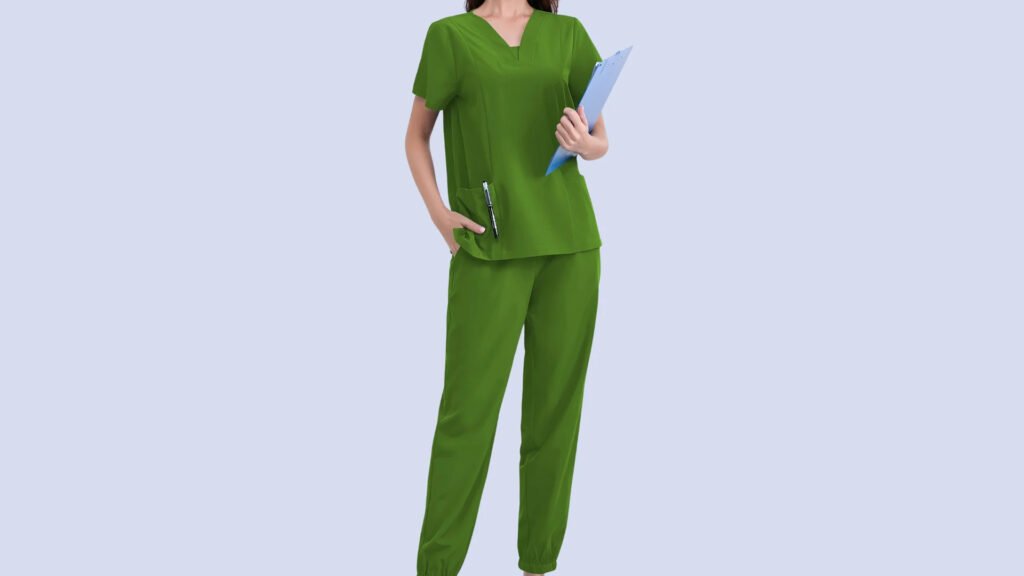
Antimicrobial Scrub Fabric
What Is Antimicrobial Scrub Fabric?
Antimicrobial scrub fabric is fabric treated — at the fiber, yarn, or finished fabric level — with an agent that inhibits the growth of bacteria, fungi, and mildew on the textile surface.
It does not kill viruses (despite marketing claims). It does not sterilize the fabric. And it does not replace hand hygiene, environmental cleaning, or standard infection control protocols.
What it does: reduce the bioburden (live bacteria population) on the fabric surface between washes — making the scrub a less effective vehicle for bacterial transmission.
How It Works
| Technology | Mechanism | Durability | Common In |
|---|---|---|---|
| Silver ion (Silver chloride / Silver zeolite) | Silver ions disrupt bacterial cell membranes and enzyme function | 50–100+ washes | Most common in medical textiles |
| Quaternary ammonium (Silane quats) | Positively charged molecules puncture negatively charged bacterial cell walls | 20–50 washes | Affordable, widely used |
| Copper oxide / Copper-infused | Copper ions damage bacterial DNA and cell membranes | 50+ washes (if embedded in fiber) | Premium scrubs, hospital linens |
| Triclosan / Triclocarban | Blocks bacterial lipid synthesis (older technology) | 20–30 washes | Being phased out — regulatory concerns |
| Chitosan (biopolymer from shellfish) | Positively charged, disrupts bacterial membrane | 10–30 washes | Natural / eco-friendly options |
| Zinc pyrithione | Disrupts fungal and bacterial metabolism | 30–50 washes | Antimicrobial + antifungal |
Silver ion is the dominant technology in medical scrub fabrics for a reason:
- Broad-spectrum activity (gram-positive and gram-negative bacteria)
- Low risk of bacterial resistance
- Heat-stable — survives industrial laundry temperatures
- Non-leaching (stays in the fabric, doesn't migrate to skin)
Antimicrobial Technologies: Applied vs. Embedded
This is the most important distinction in antimicrobial fabric:
1. Topical / Applied Treatment (Finish)
The antimicrobial agent is applied to the fabric surface as a finish — similar to a stain-release or wrinkle-free treatment.
| Pros | Cons |
|---|---|
| Lower cost | Washes off over time (20–50 washes typical) |
| Can be applied to any existing fabric | Effectiveness decreases with each wash |
| Simple manufacturing process | No lab test data beyond initial treatment |
Best for: Budget scrubs, rental linen programs where the uniform is replaced frequently, retail/consumer scrubs where the antimicrobial is a marketing feature.
2. Embedded / Fiber-Level Treatment
The antimicrobial agent is mixed into the polymer before the fiber is extruded (for polyester) or bonded into the cotton fiber structure during manufacturing.
| Pros | Cons |
|---|---|
| Lasts the life of the fabric (50–100+ washes) | Higher cost |
| Cannot wash off — antimicrobial is part of the fiber | Limited to synthetic or blended fabrics |
| Consistent performance over garment lifespan | Requires specialized fiber manufacturing |
Best for: Hospital-owned scrub programs, long-term wearable uniforms, high-turnover industrial laundry environments.
Standards & Testing: What Actually Matters
Not all 'antimicrobial' claims are equal. Here are the standards that separate real performance from marketing:
AATCC 100 — The Standard
AATCC 100 (American Association of Textile Chemists and Colorists) is the primary standard for measuring antibacterial activity on textiles.
| Test Element | What It Measures |
|---|---|
| Inoculation | Fabric is exposed to known concentrations of specific bacteria (S. aureus, K. pneumoniae) |
| Contact time | 24-hour incubation at controlled temperature |
| % Reduction | Percentage of bacteria killed compared to untreated control fabric |
| Pass/fail | Industry standard: >99.9% reduction (3 log reduction) |
AATCC 147 — Parallel Streak (Qualitative)
A simpler, faster test that shows a zone of inhibition — a clear area around the treated fabric where bacteria cannot grow.
Limitation: This test only works for leachable (migrating) antimicrobials. Non-leaching technologies like embedded silver show no zone of inhibition even if they are highly effective — because the silver stays in the fabric instead of leaching out.
ISO 20743 — International Standard
Similar to AATCC 100 but used outside North America. Required for EU-marketed antimicrobial textiles.
Durability Testing: How Many Washes?
| Claim Level | Washes Required | Test Method |
|---|---|---|
| 'Antimicrobial' (basic) | Tested on new fabric only | AATCC 100 |
| 'Durable antimicrobial' | Tested after 20 washes | AATCC 100 + AATCC 135 |
| 'Permanent antimicrobial' | Tested after 50–100 washes | AATCC 100 + accelerated wash protocol |
What to look for in a supplier's spec sheet:
✅ Tested to AATCC 100 ✅ >99.9% reduction against S. aureus and K. pneumoniae ✅ Claims specify durability: 'after 50 washes' ✅ Third-party lab report (not in-house testing)
What Antimicrobial Scrub Fabric Does — and Doesn't Do
✅ Does:
| Capability | Evidence |
|---|---|
| Reduces bacterial bioburden on fabric surface | Well-established — multiple peer-reviewed studies |
| Reduces odor caused by bacterial breakdown of sweat | Effective — bacteria that cause odor are controlled |
| Protects the fabric itself from bacterial/mold degradation | Extends garment life in humid storage |
| Reduces cross-contamination risk (as part of a protocol) | Supports — not replaces — other infection control measures |
| Reduces microbial transfer from scrubs to surfaces | Demonstrated in lab settings |
❌ Does Not:
| Claim | Reality |
|---|---|
| Kills viruses (SARS-CoV-2, flu, etc.) | Most antimicrobial fabrics are tested against bacteria only, not viruses |
| Prevents infection | Infection prevention requires hand hygiene, gloves, isolation — fabric is a minor factor |
| Sterilizes the fabric | Antimicrobial ≠ sterile. The fabric is still contaminated, just at lower levels |
| Eliminates need for laundering | Scrubs still must be washed after each use |
| Protects the wearer from infection | The fabric protects surfaces the scrub touches, not the wearer's skin |
Which Healthcare Settings Actually Need Antimicrobial Scrubs?
| Setting | Need Level | Why |
|---|---|---|
| ICU | Medium | High-acuity patients, invasive lines, frequent contact |
| ED / Trauma | Medium-High | Uncontrolled bleeding, unknown patient status, fast turnover |
| OR / Surgery | Medium | Sterile field is the priority — scrub antimicrobial is secondary |
| Burn unit | High | Immunocompromised patients, highest infection risk |
| Oncology / Chemo | High | Immunosuppressed patients |
| NICU | High | Vulnerable neonates |
| General med-surg | Low-Medium | Standard precautions sufficient |
| Long-term care | Low | Lower acuity, slower turnover |
| Outpatient clinic | Very low | Minimal exposure risk |
| Home health | Low | Single-patient environment |
Reality check: Many healthcare facilities do not require antimicrobial scrubs for most departments. The evidence that antimicrobial fabric reduces hospital-acquired infections (HAIs) is suggestive but not conclusive. It is one tool among many — not a silver bullet.
Antimicrobial vs. Regular Scrub Fabric: Cost Comparison
| Factor | Standard TC 65/35 | Standard CVC | Antimicrobial TC (silver-embedded) | Antimicrobial CVC (topical) |
|---|---|---|---|---|
| Raw fabric cost per meter | $3.50–4.50 | $4.00–5.50 | $7.00–10.00 (fiber-level) | $5.50–8.00 (topical) |
| Finished scrub price (top + pant) | $12–18 | $15–22 | $25–40 | $18–30 |
| Premium vs. standard | — | — | +60–120% markup | +30–60% markup |
| Expected lifespan | 12–18 months | 6–12 months | 12–18 months | 6–12 months (treatment fades faster) |
The value question: For the 60–120% premium, you get reduced bacterial bioburden on the fabric surface between washes. Whether that premium is worth it depends on:
- Patient acuity in your facility
- Infection rate baselines
- Budget allocation for infection control
- Laundry frequency (more frequent washing = less need for antimicrobial between washes)
Antimicrobial Scrub Fabric Checklist for Buyers
If you're sourcing antimicrobial scrubs for a healthcare facility, use this checklist:
- Manufacturer provides AATCC 100 test report (third-party lab)
- >99.9% reduction against both S. aureus (gram-positive) and K. pneumoniae (gram-negative)
- Technology type: embedded (fiber-level) or topical (finish)
- Durability claim: 'effective after X washes' — minimum 50 for embedded, 20 for topical
- Was test performed on new fabric only or after accelerated wash cycles?
- Is the antimicrobial non-leaching? (Relevant for skin safety and zone-of-inhibition test expectations)
- Skin sensitization test available? (ISO 10993 or patch test)
- Does the treatment affect fabric breathability or hand feel?
- Does the treatment affect dye color or colorfastness?
- What is the price premium vs. equivalent non-antimicrobial fabric?
- Is the technology compatible with chlorine bleach? (Many are not — requires oxygen bleach)
Common Misconceptions About Antimicrobial Scrubs
'Antimicrobial scrubs protect me from getting sick.'
No. They reduce bacteria on the fabric surface, which may reduce surface-to-surface transmission. They do not protect the wearer from airborne pathogens, droplets, or bloodborne exposures. That's what PPE — masks, gloves, face shields — is for.
'More antimicrobial is better.'
Not always. High concentrations of some antimicrobial agents (particularly silver and copper) can irritate skin. A properly formulated antimicrobial fabric should be effective (>99.9% reduction) without causing dermatitis or allergic reactions.
'Antimicrobial scrubs don't need to be washed as often.'
False. Antimicrobial activity reduces between washes as bioburden accumulates. Scrubs must be laundered after each use regardless of antimicrobial treatment. The antimicrobial simply keeps the fabric cleaner between wears.
'All antimicrobial fabrics use the same technology.'
Far from it. Silver ion (embedded), silver salt (topical), quaternary ammonium, copper, chitosan, zinc — each has different durability, efficacy spectrum, cost, and safety profile. The $15 antimicrobial scrub and the $40 antimicrobial scrub use very different technologies.
How to Verify a Supplier's Antimicrobial Claims
| Supplier Claim | What to Ask For | Red Flag |
|---|---|---|
| 'Antimicrobial fabric' | AATCC 100 test report with specific bacteria tested | No test report, or 'tested in-house' |
| 'Kills 99.9% of bacteria' | Test report showing log reduction | Claims >99.999% without supporting data |
| 'Lasts 50 washes' | Test report after 50 accelerated washes | Only tested on new/unwashed fabric |
| 'EPA / FDA registered' | Registration number | Cannot provide registration number |
| 'Used in major hospitals' | Client references or case studies | Vague claims without specifics |
About Xingye Textile — Antimicrobial Scrub Fabric
XINGYE TEXTILE manufactures antimicrobial medical scrub fabrics for healthcare facilities, scrub brands, and medical uniform programs. Our antimicrobial treatments are available on both TC 65/35 and CVC scrub fabrics, with third-party AATCC 100 testing for validated efficacy.
Antimicrobial scrub fabric options:
| Fabric | Composition | Weight | Antimicrobial Technology | Durability |
|---|---|---|---|---|
| TC 65/35 + Antimicrobial | 65% polyester / 35% cotton | 200–250 GSM | Silver-ion (embedded in polyester fiber) | 50+ washes |
| CVC 60/40 + Antimicrobial | 60% cotton / 40% polyester | 220–280 GSM | Silver-ion topical treatment | 30+ washes |
| Performance Stretch + Antimicrobial | Poly-cotton-spandex | 180–220 GSM | Quaternary ammonium (finish) | 20+ washes |
| 100% Cotton Twill + Antimicrobial | 100% cotton | 260–360 GSM | Silver-ion topical treatment | 30+ washes |
Our antimicrobial capabilities:
- ✅ AATCC 100 tested — >99.9% reduction against S. aureus and K. pneumoniae
- ✅ AATCC 147 (zone of inhibition) — available on request
- ✅ Durability testing — standard and accelerated wash protocols
- ✅ Third-party lab reports provided
- ✅ Custom Pantone color matching on all antimicrobial fabrics
- ✅ Finished garment manufacturing — scrub tops, pants, lab coats
- ✅ Private labeling for scrub brands and healthcare programs
Sourcing antimicrobial scrubs for a healthcare facility or uniform program? [Contact us] for test reports, samples, and bulk pricing.