Linen is the fabric chefs dream about in August. It's the coolest, most breathable material in the world of professional cooking — the fabric of choice for tropical fine dining, Mediterranean kitchens, and any chef who's ever sweated through a cotton coat during summer service.
Cotton is the fabric chefs actually wear. It's been the kitchen standard for over a century — durable, affordable, and proven.
So why don't all chefs wear linen? And is cotton really the better choice, or just the safer one?
This guide compares linen and cotton chef coats across every dimension that matters — heat performance, durability, cost, maintenance, and appearance — so you can decide which fabric actually belongs in your kitchen.
Linen vs Cotton Chef Coats
First, the Basics
| Linen | Cotton | |
|---|---|---|
| Source | Flax plant (Linum usitatissimum) | Cotton plant |
| Fiber length | Long, smooth, inelastic | Medium, soft, flexible |
| Weave structure | Loose, breathable plain weave | Dense twill or plain weave |
| Feel | Crisp, textured, slightly stiff | Soft, smooth, familiar |
| Weight range (chef coats) | 180–260 GSM | 240–360 GSM |
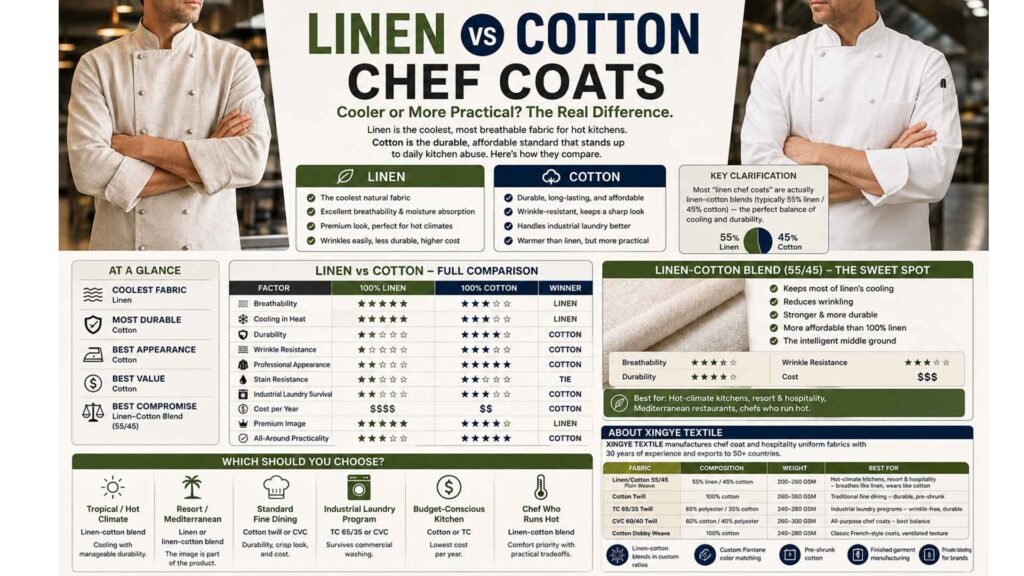
Key clarification: Most 'linen chef coats' sold today are actually linen-cotton blends (typically 55% linen / 45% cotton) — because 100% linen has serious practical problems in a professional kitchen (covered below). This guide compares 100% linen vs. 100% cotton first, then explains why the blend is what most chefs actually end up choosing.
1. Heat & Breathability — The Main Event
This is the #1 reason chefs consider linen at all.
| Factor | 100% Linen | 100% Cotton |
|---|---|---|
| Breathability | ★★★★★ — flax fibers have hollow centers, excellent air circulation | ★★★☆☆ — dense twill traps air |
| Moisture absorption | ★★★★★ — absorbs up to 20% of its weight, dries fast | ★★★★☆ — absorbs up to 8–10%, dries slowly |
| Cooling effect | ★★★★★ — the coolest natural fabric in existence | ★★★☆☆ — moderate |
| Wet feel | Stays cool, dries quickly | Heavy, clingy, stays damp |
| Heat reflection (vs. dark colors) | Depends on color, not fiber | Depends on color, not fiber |
The verdict: Linen is objectively the coolest fabric for hot kitchens. In a 40°C kitchen, a linen coat keeps the chef noticeably cooler than a cotton coat of the same color. This is why linen is standard in tropical fine dining (Singapore, Dubai, Caribbean, Mediterranean resorts).
But there's a catch — the cooling advantage comes with serious tradeoffs (below).
2. Durability — Where Cotton Strikes Back
| Factor | 100% Linen | 100% Cotton |
|---|---|---|
| Abrasion resistance | ★★☆☆☆ — flax fibers break under repeated friction | ★★★★☆ — cotton fibers are more flexible |
| Tear strength | ★★★☆☆ — strong but brittle | ★★★★☆ — tough, forgiving |
| Lifespan (home wash) | 6–12 months | 12–18 months |
| Lifespan (industrial laundry) | 3–6 months — degrades fast | 6–12 months (better with poly blend) |
| Elasticity | ★★☆☆☆ — no stretch, fibers fatigue and break at creases | ★★★☆☆ — more give |
| Resistance to folding wear | ★★☆☆☆ — linen breaks at sharp creases | ★★★★☆ — holds up to folding |
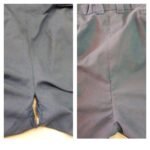
The verdict: Cotton wins durability by a clear margin. Linen's fibers are strong but brittle — they don't flex, so repeated friction (elbows on counters, waist against stainless steel, folding) breaks them down. A linen coat in daily kitchen use wears thin at the elbows and waist in 6–12 months.
3. Wrinkling — Linen's Famous Weakness
| Factor | 100% Linen | 100% Cotton |
|---|---|---|
| Wrinkles during wear | ★☆☆☆☆ — wrinkles within minutes of putting it on | ★★★☆☆ — wrinkles but less severely |
| Wrinkles after washing | ★☆☆☆☆ — needs ironing or heavy steaming | ★★☆☆☆ — needs ironing unless poly-blend |
| Professional appearance mid-shift | ★★☆☆☆ — looks rumpled by hour 2 | ★★★★☆ — stays presentable |
The verdict: Cotton wins the appearance battle. Linen is famous for looking like a bedsheet after 30 minutes of service. In fine dining, where a crisp coat signals professionalism, this is a real problem.
This single factor — more than any other — is why linen never replaced cotton as the kitchen standard. Chefs who love linen's coolness still switch to cotton for service because of how wrinkled linen looks on the pass.
4. Stain Resistance & Cleaning
| Factor | 100% Linen | 100% Cotton |
|---|---|---|
| Oil/grease absorption | ★★☆☆☆ — absorbs and holds oils | ★★☆☆☆ — also absorbs |
| Bleach tolerance | ★★★☆☆ — bleaches but weakens faster | ★★★★☆ — bleaches safely with care |
| Industrial laundry tolerance | ★★☆☆☆ — degrades in hot alkaline wash | ★★★☆☆ — survives better |
| Drying time | ★★★★★ — dries fast | ★★★☆☆ — slow |
| Fading | ★★★☆☆ — fades | ★★★★☆ — holds color better with quality dyes |
The verdict: Neither fabric is stain-resistant (that requires a finish, not a fiber). But cotton survives laundering better, and linen's faster drying is a small comfort compared to its faster degradation.
5. Cost
| Factor | 100% Linen | 100% Cotton |
|---|---|---|
| Raw fabric cost per meter | $$$$ — flax is expensive to grow and process | $$ — cotton is cheap and abundant |
| Finished coat price | $60–150 | $20–60 |
| Cost per year (home wash) | $60–150 (short lifespan) | $20–40 (longer lifespan) |
| Cost per year (industrial laundry) | $120–300 (replaced frequently) | $30–80 |
The verdict: Cotton is 3–5× more cost-effective per year of wear. Linen's premium price plus its shorter lifespan make it one of the most expensive chef coat fabrics per year of service.
6. Appearance & Tradition
| Factor | 100% Linen | 100% Cotton |
|---|---|---|
| Traditional fine dining image | ★★★★★ — Mediterranean/tropical fine dining standard | ★★★★★ — the global standard |
| Crisp professional look | ★★☆☆☆ — wrinkles | ★★★★★ — crisp when pressed |
| Luxury feel | ★★★★★ — premium hand feel | ★★★★☆ |
| Chef perception | 'Tropical fine dining' | 'Classic kitchen' |
The verdict: Linen projects a specific, premium image — resort hotels, Mediterranean restaurants, high-end tropical venues. Cotton is the universal professional standard. Neither is 'wrong' — they signal different kitchen identities.
7. Comfort Over a 12-Hour Shift
| Factor | 100% Linen | 100% Cotton |
|---|---|---|
| Initial feel | Crisp, slightly scratchy (softens after washing) | Soft from day one |
| Mid-shift feel | Cool, breathable | Warmer |
| End-of-shift feel | Wrinkled but cool | Wrinkled and damp |
The verdict: Linen is more comfortable in heat; cotton is more comfortable overall. Linen softens with washing but never becomes as soft as cotton.
Full Comparison Table
| Factor | 100% Linen | 100% Cotton | Winner |
|---|---|---|---|
| Breathability | ★★★★★ | ★★★☆☆ | Linen |
| Cooling in heat | ★★★★★ | ★★★☆☆ | Linen |
| Durability | ★★☆☆☆ | ★★★★☆ | Cotton |
| Wrinkle resistance | ★☆☆☆☆ | ★★★☆☆ | Cotton |
| Professional appearance | ★★☆☆☆ | ★★★★★ | Cotton |
| Stain resistance | ★★☆☆☆ | ★★☆☆☆ | Tie |
| Industrial laundry survival | ★★☆☆☆ | ★★★☆☆ | Cotton |
| Cost per year | $$$$ | $$ | Cotton |
| Premium image | ★★★★★ | ★★★★☆ | Linen |
| Comfort in hot kitchens | ★★★★★ | ★★★☆☆ | Linen |
| All-around practicality | ★★★☆☆ | ★★★★★ | Cotton |
Overall: Cotton is the more practical choice for most kitchens. Linen wins only where heat is the dominant factor — tropical climates, hot climates, and premium venues where the linen look is worth the cost and maintenance.
The Solution Most Chefs Don't Know About: Linen-Cotton Blends
Here's what experienced uniform buyers do: they don't choose 100% linen OR 100% cotton. They choose a linen-cotton blend — typically 55% linen / 45% cotton (or 50/50).
| Factor | 100% Linen | 55/45 Linen-Cotton | 100% Cotton |
|---|---|---|---|
| Breathability | ★★★★★ | ★★★★☆ — keeps most of linen's airflow | ★★★☆☆ |
| Cooling | ★★★★★ | ★★★★☆ | ★★★☆☆ |
| Wrinkle resistance | ★☆☆☆☆ | ★★★☆☆ — cotton content reduces wrinkling | ★★★☆☆ |
| Durability | ★★☆☆☆ | ★★★★☆ — cotton strengthens the weave | ★★★★☆ |
| Cost | $$$$ | $$$ — more affordable than pure linen | $$ |
| Drape & appearance | ★★★★★ | ★★★★☆ — linen texture, better shape | ★★★★☆ |
| Maintenance | Very high | Moderate — less ironing than pure linen | Moderate |
Why 55/45 works:
- The linen (55%) provides most of the cooling, breathability, and premium texture
- The cotton (45%) adds durability, wrinkle recovery, and lowers the cost
- The result: a coat that breathes like linen but survives like cotton — the practical middle ground
Linen-cotton blends are the standard for:
- Resort & hotel kitchens in warm climates
- Mediterranean / tropical fine dining
- Hospitality uniforms (front-of-house and back-of-house)
- Any kitchen where heat is a problem but the coat must still look professional at hour 8
Which Should You Choose?
| Your Situation | Best Choice | Why |
|---|---|---|
| Tropical / hot climate kitchen | Linen-cotton blend | Cooling with manageable durability |
| Premium resort or Mediterranean venue | Linen or linen-cotton blend | The image is part of the product |
| Standard fine dining | Cotton twill or CVC | Durability, crisp look, cost |
| Industrial laundry program (hotel chain) | TC 65/35 or CVC | Survives commercial washing |
| Budget-conscious casual kitchen | Cotton or TC | Lowest cost per year |
| Chef who runs hot in any climate | Linen-cotton blend | Comfort priority with practical tradeoffs |
Linen vs. Cotton Chef Coat — The Bottom Line
Cotton remains the practical kitchen standard: durable, affordable, professional, and forgiving of hard use. If you wash your coats in a commercial laundry and need them to last, cotton (or a cotton-poly blend) is the answer.
Linen is the specialist: the coolest fabric in existence, with a premium look that suits hot climates and high-end venues. If heat is your #1 problem and you have the budget for more frequent replacement, 100% linen is worth it.
The blend is the intelligent compromise: most of linen's cooling with most of cotton's durability, at a price between the two. For most chefs who are torn between linen and cotton, the 55/45 linen-cotton blend is the answer they were looking for.
About Xingye Textile — Linen & Linen-Cotton Chef Coat Fabrics
XINGYE TEXTILE manufactures chef coat and hospitality uniform fabrics, including our Linen/Cotton 55/45 Plain Weave — the practical answer to the linen vs. cotton debate. With 30 years in textile manufacturing and exports to 50+ countries, we supply fabric and finished garments to restaurants, hotels, and uniform programs worldwide.
Our chef coat & hospitality fabric range:
| Fabric | Composition | Weight | Best For |
|---|---|---|---|
| Linen/Cotton 55/45 Plain Weave | 55% linen / 45% cotton | 200–260 GSM | Hot-climate kitchens, resort & hospitality uniforms — breathes like linen, wears like cotton |
| Cotton Twill | 100% cotton | 260–360 GSM | Traditional fine dining — durable, pre-shrunk |
| TC 65/35 Twill | 65% polyester / 35% cotton | 240–280 GSM | Industrial laundry programs — wrinkle-free, durable |
| CVC 60/40 Twill | 60% cotton / 40% polyester | 260–300 GSM | All-purpose chef coats — best balance |
| Cotton Dobby Weave | 100% cotton | 240–280 GSM | Classic French-style coats, ventilated texture |
Our capabilities:
- ✅ Linen-cotton blends in custom ratios (55/45, 50/50, custom)
- ✅ Custom Pantone color matching
- ✅ Pre-shrunk cotton — no surprise shrinkage
- ✅ Finished garment manufacturing — chef coats, hospitality shirts
- ✅ Private labeling for uniform brands
Choosing between linen and cotton for your kitchen uniforms? [Contact us] for fabric samples of both — compare them in your own kitchen before you decide.