A procurement guide to fabric for hotel staff uniforms: front desk, housekeeping, F&B, and management.
Most hotel uniform fabric doesn't fail in the showroom. It fails in the laundry room — and you find out 20 washes too late, when the deep navy blazers come out patchy and your front desk looks like a cheap car rental crew.
We sell uniform fabric to hotels on four continents. Here's the pattern we see every time: procurement buys on price per meter, the GM signs off on the color, and nobody checks what 75°C alkaline wash water does to the fabric. Eight months later, the housekeeping supervisor is asking why the seams split and the collars look like felt.
The fabric is not where your money goes. The laundry cycle is. Read this before you sign the next contract.
Hotel Uniform Fabric
What Hotel Laundry Actually Does to Fabric
A hotel tunnel washer is not a domestic washing machine. It's closer to a small industrial war:
| What the laundry does | What it does to cheap fabric |
|---|---|
| 75–85°C wash temperature | Dyes bleed. Deep navy and black turn patchy by wash 15–20 |
| Alkaline detergent, pH 10+ | Cotton fibers weaken, shrink, and crease permanently |
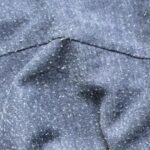
| Mechanical agitation, load after load | Surface fuzz rolls into pills — collars, cuffs, seat areas first |
| Steam pressing / tunnel finishing | Cheap polyester shines and melts at the seams under the iron |
Add it up: a garment that survives 20 hotel washes is cheap fabric. A garment that survives 100+ is engineered fabric. Same cut, same buttons — completely different textile underneath.
Three Ways to Buy. Two of Them Will Cost You.
Option 1: The Cheap Quote (the one that gets approved)
Lowest price per meter. Often a low-grade poly-cotton with loose construction, cheap dye, and no finish worth the name. It passes the touch test in the meeting room because that's where it's designed to pass.
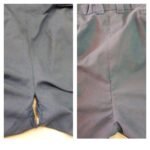
Here's what actually happens: a logistics supervisor told us his warehouse uniforms were splitting at the seams — armholes and seat, every batch, every year. That one line item was costing his company $40,000 a year in replacements and overtime for staff in torn uniforms. Cheap fabric is the most expensive fabric you'll ever buy — you just pay for it with the replacement order, not the first invoice.
Pills by wash 20. Fades patchy. Splits under stress. Replaced every 6–9 months.
Option 2: 100% Cotton (what non-technical decision-makers ask for)
'I want real fabric' usually means cotton. I get it — but look at the numbers. Cotton costs roughly twice as much per meter as polyester, and in a hotel laundry it shrinks, holds every crease, needs labor-intensive ironing, and loses color like a cheap t-shirt.
A cotton blazer in a tunnel washer is a potato sack by month four. You're not buying heritage — you're buying the highest-maintenance fabric in the building, for the staff that works hardest.
Shrinks, creases, fades. The ironing bill alone eats the savings.
Option 3: The Engineered Blend (what actually survives)
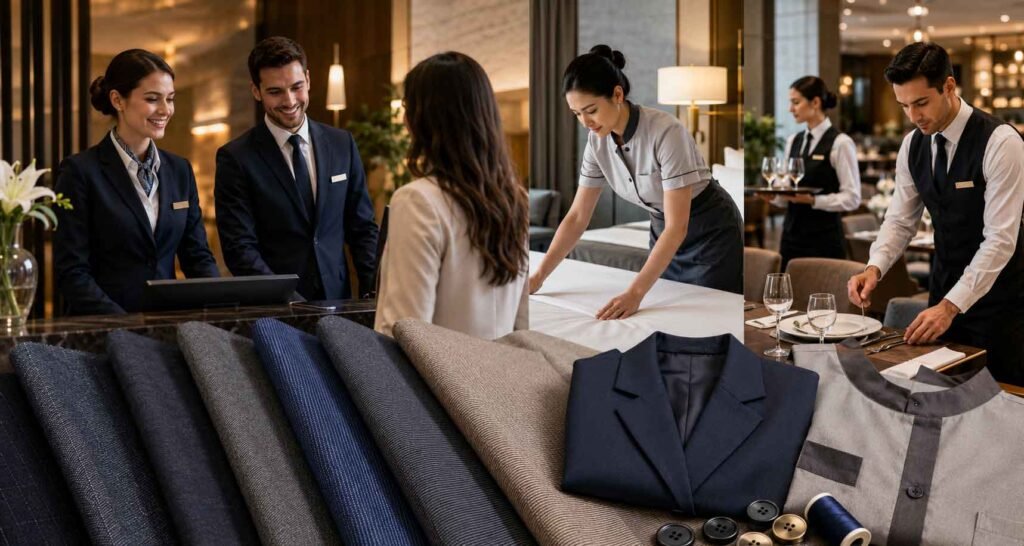
For guest-facing roles — front desk, concierge, management, F&B service — 65/35 T/R (polyester-rayon): polyester gives colorfastness, strength, and quick dry; rayon gives the drape and comfort that make a blazer look like a blazer, not a uniform. For hot-climate properties — Middle East, North Africa, Southeast Asia — this is the tropical suiting your tailors should be cutting.
For operational roles — housekeeping, kitchen, maintenance — 65/35 T/C (polyester-cotton): the workhorse. Abrasion-resistant, breathable, easy-care, survives the tunnel washer for years.
The difference isn't the blend ratio on paper. It's whether the mill actually controls dyeing, construction, and finishing: colorfastness Grade 4–5 (ISO 105), pilling Grade 4 (ISO 12945-2), shrinkage ≤3% (ISO 6330), Martindale abrasion 45,000+ cycles. Those numbers are what 100+ washes look like on a spec sheet.
Survives 100+ industrial washes. Keeps its color. Keeps its shape. Costs less per wear than anything above.
The Cost Table Procurement Should See
| The 'Deal' Set | The Engineered Set | |
|---|---|---|
| Ticket price per set | $12–15 | $28–35 |
| Industrial washes before it dies | ~20 | 100+ |
| Replacements in 3 years | 6–8 sets | 1 set |
| 3-year real cost | 3× the ticket price + ironing labor + guest-facing damage | What you paid. Once. |
| Risk | Patchy uniforms, torn seams, uniform audit failures | None |
The $12 set costs more per wear than the $32 set. That's not marketing. That's arithmetic.
How to Sound Like You've Done This Before
Amateur call: 'How much is your fabric per meter? Can you send samples?'
Pro call: 'What's your colorfastness spec on deep navy after 20 industrial washes? Shrinkage under ISO 6330 — what's your max? Pilling — ISO 12945-2, what grade? Do you test in a tunnel washer or a domestic machine? Can I see your QC lab setup? What hotels is this fabric currently running in?'
The first call gets you a quote for whatever's on the shelf. The second call tells the supplier: this guy has been burned before. Don't waste his time. The second call is the one that gets you the good fabric.
The 8-Point Checklist Before You Order
- Demand specs in writing — composition, GSM, weave. No verbal promises.
- Colorfastness Grade 4+ (ISO 105) on your darkest colors: navy, black, red. Fading is the first thing guests see.
- Pilling: Grade 4 minimum (ISO 12945-2). Collars and cuffs are the tell.
- Shrinkage ≤3% (ISO 6330) after industrial wash — not after one gentle cycle.
- Ask for wash-test results — 20+ cycles, not 5. Any fabric survives 5 washes.
- Order lab dips for deep colors before bulk. Cheap dye looks fine in a lab dip and bleeds in a tunnel washer.
- Check references: where is this fabric actually running in hotels?
- Get a 20-meter cutting sample. Launder it yourself, 20 times. If it dies, walk away.
FAQ
What's the best fabric for hotel staff uniforms? 65/35 T/R for guest-facing roles and management, 65/35 T/C for housekeeping and F&B — engineered for industrial laundry, not for the showroom.
T/R or T/C — which is better for hotels? Front desk needs drape: T/R. Housekeeping needs abrasion: T/C. Pick by the job the uniform does, not by what the swatch book looks like.
Why does navy uniform fabric fade so fast? Cheap mills cut dye costs. Deep colors need heavy dye loading and proper washfastness — test ISO 105 Grade 4–5 before you commit, and get lab dips first.
Can we get a sample before a bulk order? Yes. Email us and we'll send a 20-meter cutting sample within 5 days. No PO needed — you test it first.
Email us for a 20-meter cutting sample. Launder it 20 times. If it doesn't outlast what you're buying now, don't order.
→ [Contact XINGYE's Textile Engineering Team]
By Andy Tian, Export Sales Manager, XINGYE TEXTILE
Andy Tian has 10 years of experience in textile export at XINGYE TEXTILE, covering fabric sourcing, pricing, sampling, and order execution for uniform fabric buyers worldwide.