
A fabric's weave determines how it wears, how it breathes, how it launders, and how long it lasts. The fiber content tells you what the fabric is made of. The weave tells you how it behaves.
I have watched procurement teams spend weeks analyzing fiber blends—polyester vs cotton, T/R vs T/C—only to overlook the weave structure entirely. They order a 65/35 T/C fabric with the right GSM and the right price, then wonder why the elbows blow out after six months. The answer is often in the weave.
This guide compares the three most common weave structures in industrial workwear—Oxford, Twill, and Plain Weave—with the practical question in mind: which one is right for your application?
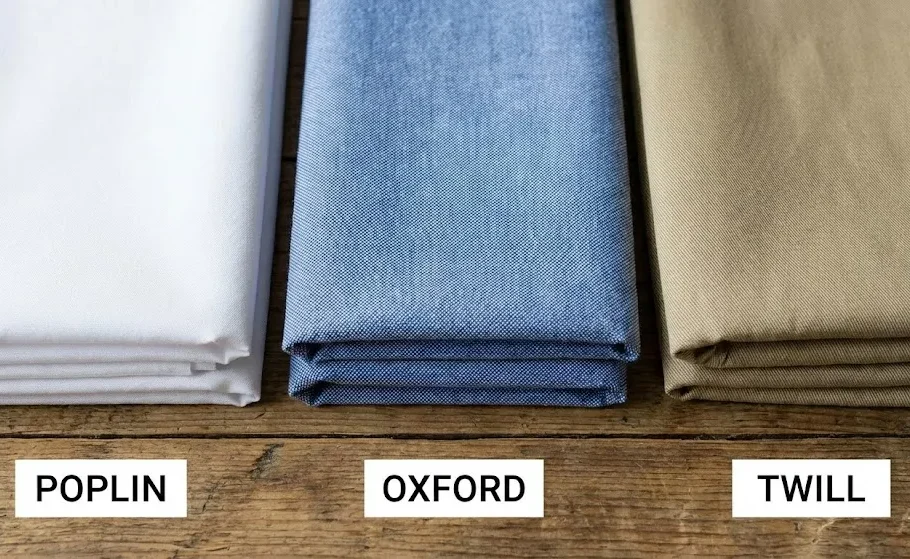
Oxford vs Twill vs Plain Weave
Weave Fundamentals: What Changes When You Change the Pattern
Every woven fabric is constructed by interlacing two sets of yarns: the warp (running lengthwise) and the weft (running crosswise). The pattern of this interlacing determines the fabric's mechanical properties.
| Property | Plain Weave | Twill Weave | Oxford Weave |
|---|---|---|---|
| Interlacing Pattern | Over-one, under-one | Over-two, under-two (or similar) | Multiple warp threads woven as a group |
| Thread Count | Highest density | Moderate density | Lower density |
| Surface Texture | Smooth, flat | Diagonal rib | Basket-like, textured |
| Durability | Good in all directions | Excellent in diagonal direction | Good, with high tear strength |
| Drape | Stiff | Soft, flexible | Moderate |
| Breathability | Lowest | Good | Highest |
| Cost | Lowest | Moderate | Moderate to high |
Each pattern offers a different balance of strength, flexibility, and cost. The right choice depends entirely on what the uniform needs to survive.
Plain Weave: The Baseline Standard
How It Is Constructed
The plain weave is the simplest and oldest fabric structure. Every warp thread crosses over one weft thread, then under the next, in a repeating grid. This creates the highest thread count per unit area of any weave pattern, because the yarns are packed as tightly as geometrically possible.
Strengths
Uniform strength. Because the interlacing points are evenly distributed, plain weave fabrics do not have weak directional zones. The tensile strength is nearly identical in the warp and weft directions. This makes plain weave a reliable choice for applications where the direction of stress is unpredictable.
Dimensional stability. The tight grid structure resists distortion. A plain weave fabric will not sag, stretch, or lose its shape over time. This is why poplin and broadcloth—both plain weave variants—are standard in dress shirts and lightweight uniforms.
Cost efficiency. Plain weave is the fastest weave to produce on a loom, which translates directly into lower fabric cost.
Weaknesses
Low tear strength. Because the yarns are locked in place by frequent interlacing, a tear in a plain weave fabric propagates quickly. There is no slack in the structure to absorb localized stress. A snag on a nail or a sharp corner can turn into a running rip.
Poor drape. The tight grid makes the fabric stiff. Plain weave uniforms do not move with the body as naturally as twill or Oxford weaves.
Low breathability. The dense interlacing leaves minimal air space between yarns. In hot environments, plain weave fabrics trap heat.
Best Applications for Plain Weave
- Budget-friendly dress shirts — where cost matters more than comfort
- Lightweight summer uniforms — in thin yarn counts, the stiffness is less noticeable
- Lining fabrics — where dimensional stability is critical and appearance is secondary
- Disposable or short-life uniforms — replaced frequently, so long-term wear is not a concern
What to Watch For
Low-quality plain weave fabrics often use undersized yarns to reduce cost while maintaining the labeled GSM. The result is a fabric that looks acceptable on the roll but develops pinholing at seam lines after 10 to 15 washes. The threads shift at the stitch holes, creating permanent distortion around every seam.
Twill Weave: The Workwear Industry Standard
How It Is Constructed
In a twill weave, each warp thread passes over two or more weft threads before going under one or more, creating a characteristic diagonal ridge across the fabric surface. The angle and prominence of this diagonal—known as the wale—varies depending on the specific twill construction.
The most common industrial twills are:
- 2/1 Twill — two threads over, one under; the standard for workwear
- 3/1 Twill — three over, one under; creates a steeper, more pronounced diagonal
- Herringbone Twill — the diagonal reverses direction periodically; used for visual interest in suiting
Strengths
Superior abrasion resistance. The diagonal structure distributes wear across multiple yarn intersections rather than concentrating it at individual interlacing points. This is why denim—a 3/1 twill—can survive years of daily use. For industrial workwear, a 2/1 twill in 65/35 T/C typically achieves 25,000 to 30,000 Martindale cycles, compared to 15,000 to 20,000 for a comparable plain weave.
Better drape and flexibility. The longer floats (the sections where yarns travel over multiple opposing threads) allow the fabric to move with the body. A twill work pant bends at the knee without the stiff resistance of plain weave.
Conceals soiling. The diagonal surface texture hides dirt and stains better than a flat plain weave. This is a practical advantage in hospitality and food service, where uniforms are visible throughout the workday.
Higher tear strength. Because the yarns are not locked in place at every intersection, the fabric can absorb localized stress without propagating a tear. Twill fabrics typically have 30–50% higher tear strength than plain weave equivalents.
Weaknesses
Directional weakness. Twill fabrics are strongest along the diagonal of the weave. Stress applied perpendicular to the wale direction can cause preferential wear. This is rarely an issue in practice, but it matters for specialized applications such as safety harness attachment points.
Higher cost. Twill weaving is slower than plain weaving, adding 10–20% to the production cost.
twill construction can snag on sharp objects, pulling a loop of yarn to the surface. This is more common in open twill weaves than in tight constructions.
Best Applications for Twill
- Industrial work pants and coveralls — the standard for durability and mobility
- Chef jackets and kitchen uniforms — conceals stains, withstands high-temperature laundering
- Hospitality staff uniforms — balances professional appearance with practical durability
- Security and service uniforms — twill's diagonal texture adds visual depth that looks more premium than plain weave
What to Watch For
A common downgrade in twill fabrics is reducing the weft yarn count while keeping the warp count the same. The fabric still shows a diagonal pattern, but the reduced weft density cuts abrasion resistance by 30–40%. The uniform may look acceptable on arrival but will wear through at stress points much sooner than expected.
Ask your supplier for the warp and weft thread count separately, not just the total. A true industrial twill should have a balanced thread count—typically 100 × 60 or higher for 250 GSM fabrics.
Oxford Weave: The Heavy-Duty Specialist
How It Is Constructed
The Oxford weave is a variation of the plain weave in which multiple warp threads are woven together as a group. The most common configuration is a 2×1 Oxford: two warp threads woven as one, crossed by a single weft thread. This creates the distinctive basket-like grid that gives Oxford fabrics their textured appearance and high breathability.
Unlike true basket weaves, which use paired threads in both directions, the Oxford weave typically pairs only the warp threads. This keeps the fabric stable while creating larger openings between yarn intersections.
Strengths
Exceptional breathability. The grouped-warp construction creates larger interstitial spaces than either plain or twill weave. Air moves through an Oxford fabric freely, making it the most comfortable choice for hot environments.
High tear strength. The grouped warp threads distribute stress across multiple yarns at each intersection point. An Oxford weave fabric can absorb a snag or puncture without the tear propagating—the damage stays localized. This is why Oxford weave is the standard for heavy-duty outerwear and bags.
Soft handfeel despite heavy weight. The basket-like structure is more flexible than plain weave at the same GSM. A 300 GSM Oxford fabric feels softer and moves more naturally than a 300 GSM plain weave.
Structured texture. The visible grid pattern adds visual interest and a premium appearance that distinguishes Oxford uniforms from standard workwear.
Weaknesses
Lower abrasion resistance. The open structure means fewer yarn intersections per unit area. Under continuous rubbing, Oxford fabrics wear through faster than twill. They are not the right choice for knees, elbows, or other high-friction zones unless reinforced.
Higher cost. Oxford weaving requires more precise loom setup and slower production speeds. The cost premium over plain weave is typically 15–25%.
Yarn shifting. In lower-quality Oxford fabrics, the grouped warp threads can shift apart over time, creating uneven gaps in the weave. This requires careful finishing to stabilize the structure.
Best Applications for Oxford Weave
- Outdoor workwear and utility vests — where breathability and tear resistance matter more than abrasion resistance
- Delivery and logistics uniforms — drivers benefit from the breathability and freedom of movement
- Security jackets and outerwear — the structured texture looks professional while performing well in variable conditions
- Heavy-duty aprons and shop coats — the open weave breathes in hot workshop environments
What to Watch For
The most common quality issue in Oxford fabrics is weft yarn inconsistency. Because the visual appeal of the Oxford weave depends on the contrast between warp groups and individual weft threads, variations in weft yarn thickness create an uneven, patchy appearance. This does not affect performance, but it can make uniforms look inconsistent across different production batches.
Application Map: Choosing the Right Weave for the Job
| Work Environment | Primary Wear Concern | Recommended Weave | Backup Option |
|---|---|---|---|
| Warehouse / logistics | Abrasion at knees and elbows | Twill (2/1, 250–300 GSM) | Oxford for upper-body garments |
| Kitchen / food service | Staining, hot wash, mobility | Twill + DWR coating | Oxford for aprons |
| Outdoor / delivery | Tear resistance, breathability | Oxford (300 GSM+) | Twill for cold-weather layering |
| Corporate / front desk | Appearance, drape, wrinkle resistance | Twill (fine yarn, 180–220 GSM) | Plain weave for dress shirts |
| Security / doorman | Mixed appearance + abrasion | Twill (240–280 GSM) | Oxford for outerwear |
| Light manufacturing | General durability, cost | Twill (balanced choice) | Plain weave for budget programs |
| Heavy industrial / welding | Extreme abrasion, heat | Twill (heavy, 300+ GSM) | Reinforced Oxford |
Weave and Fiber: How They Interact
The weave pattern amplifies or diminishes the properties of the underlying fiber. Understanding these interactions helps avoid mismatches.
T/R (Polyester-Rayon) in Twill. This is the combination used in our T-R Series for executive uniforms. The twill weave gives the fabric enough structure to hold its shape, while the rayon provides drape and softness. The result is a fabric that looks tailored without feeling stiff. It is ideal for blazers, dress trousers, and service uniforms where appearance is the primary metric.
T/C (Polyester-Cotton) in Twill. The most common industrial workwear construction. The twill weave adds the abrasion resistance that T/C needs for warehouse and hospitality use. The cotton component provides breathability, and the polyester ensures wash durability.
Pure Polyester in Oxford. The open weave compensates for polyester's poor breathability, making this combination viable for outdoor workwear where pure polyester would otherwise trap heat. The high tear strength of the Oxford weave also offsets polyester's tendency to propagate tears once damaged.
Cotton in Plain Weave. The lowest-cost option for short-life uniforms. The plain weave provides dimensional stability, and the cotton offers natural comfort. But the combination lacks abrasion resistance and tear strength, making it unsuitable for any application lasting beyond a few months.
How to Evaluate Weave Quality Before Ordering
The Stretch and Recovery Test
Cut a 10 cm × 10 cm sample and stretch it diagonally by hand. A well-constructed weave will return to its original shape with minimal distortion. A loose weave—or one with insufficient thread count—will hold the diagonal stretch, indicating that the yarns are shifting within the structure.
The Backlight Test
Hold the fabric up to a strong light source. The weave pattern should appear uniform across the entire surface. Irregular gaps, thinner patches, or uneven thread spacing indicate quality control issues in the weaving process.
The Seam Slippage Test
Stitch a seam through two layers of the fabric, then pull the layers apart perpendicular to the seam. If the yarns at the seam edge shift significantly—creating visible gaps at the stitch holes—the fabric has low seam slippage resistance. This is a common failure mode in plain weave fabrics with low thread density.
Batch-Specific Weave Analysis
Request a microscope image or pick glass count of your production fabric. The supplier should be able to provide the warp and weft thread count per inch or per centimeter. Compare this to the specification in your purchase order. A discrepancy of more than 5% in either direction suggests the supplier is cutting corners.
Frequently Asked Questions
Can a plain weave be durable enough for industrial use?
Yes, if the yarn count and fiber quality are high enough. A heavy plain weave (300+ GSM) in high-tenacity polyester can perform well in moderate-use environments. But for equivalent weight and fiber content, twill will always outlast plain weave in abrasion-heavy applications.
Which weave is best for hot climates?
Oxford weave offers the best breathability due to its open structure. For lighter uniforms, a fine-yarn twill is a good compromise between breathability and durability. Avoid plain weave in hot environments unless the GSM is very low (under 180).
Does weave affect the effectiveness of DWR coatings?
Yes. DWR coatings are more effective on twill and plain weave fabrics because the coating film is more continuous across the surface. On Oxford weaves, the larger interstitial spaces create gaps where moisture can penetrate before the coating beads it away. For maximum water repellency, use a tight twill weave with a DWR finish.
Is there a weave that resists pilling better?
Twill weaves pill less than plain weaves at equivalent fiber quality, because the longer floats create less fiber-to-fiber friction during wear. The tightest constructions—2/1 twill and 3/1 twill—offer the best pilling resistance among these three weave types.
How do I specify the weave in my purchase order?
Be explicit: state the weave type, the desired thread count (warp × weft per inch or cm), and the intended end use. For example: '2/1 Twill, 110 × 60 threads per inch, 250 GSM, 65/35 Polyester-Cotton, for industrial work pants.'
Making the Final Decision
The weave is not a secondary specification. It is a primary engineering decision that determines how your uniform will perform under real working conditions.
Choose twill when durability and mobility are both priorities. It is the most balanced weave for industrial workwear and the safest default choice for most applications.
Choose Oxford weave when breathability and tear resistance matter more than abrasion resistance. It excels in outdoor, delivery, and hot-environment roles where the uniform does not face continuous friction.
Choose plain weave when budget is the primary constraint and the uniform has a short expected lifespan. It is also appropriate for dress shirts and lightweight garments where dimensional stability is critical and abrasion is minimal.
At XINGYE TEXTILE, we produce all three weave constructions in our own facility, using yarn counts and densities matched to each client's operating conditions. Our technical team can help you specify the weave, thread count, and finishing treatments that match your specific workwear requirements.
For weave specification sheets, swatch comparisons, or a consultation:





1 comment
Pingback: How to Stop Wool Work Trousers From Pilling at the Thighs: Fabric Analysis