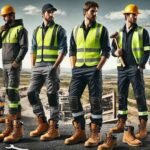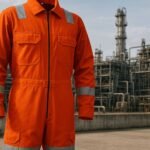
Construction is the most demanding uniform environment in the workwear world — and the most regulated. One crew might need FR protection for electrical work while the crew next to them only needs durable denim for framing. Every role on a construction site has different fabric requirements, and getting them wrong means either unsafe workers or wasted budget.
This guide breaks down construction uniform fabric by role and risk — what each crew needs, which fabrics deliver, and how to outfit a compliant, comfortable, cost-effective construction workforce.
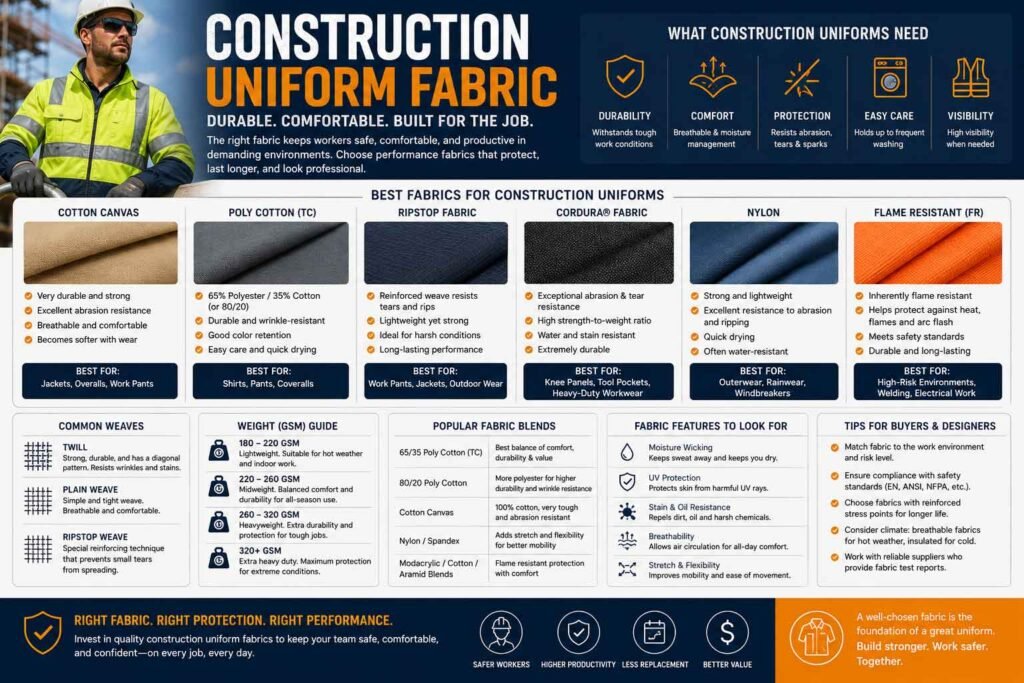
Construction Uniform Fabric
What Construction Does to Fabric
Construction uniforms face a unique combination of abuse:
| Threat | Where It Happens |
|---|---|
| Abrasion | Concrete, rebar, lumber, scaffolding, drywall |
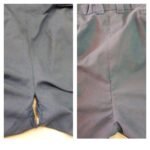
| Tearing/snagging | Rebar, edges, equipment, nails |
| Heat & sparks | Welding, grinding, torch work, hot asphalt |
| Sun exposure | 8–12 hours outdoors, reflected UV from surfaces |
| Staining | Concrete slurry, oil, tar, paint, dust |
| Washing | Often industrial laundry for contractor programs |
The fabric must survive all of this while keeping the worker comfortable through 10-hour days in every season.
The Construction Fabric Arsenal
| Fabric | Role on Site | Key Property |
|---|---|---|
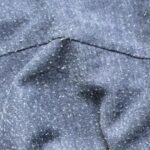
| Cotton twill / denim | General labor, framing, carpentry | No melt + durability |
| CVC 60/40 | All-purpose shirts and pants | Comfort + easy care |
| TC 65/35 | Contractor uniform programs | Industrial laundry durability |
| FR cotton / FR blends | Electrical, welding, hot work | NFPA 70E compliance |
| Nylon-cotton ripstop | Demolition, heavy rough work | Tear resistance |
| Hi-vis fabric | Roadside, near traffic/equipment | ANSI visibility |
| Heavy canvas | Welding aprons, knee pads, heavy prep | Max abrasion |
| Performance stretch | Foremen, equipment operators | Mobility |
Role-by-Role Fabric Guide
General Laborer
Fabric: Cotton twill or denim pants, CVC or cotton shirt Why: Durability for scraping against materials, no-melt safety near sparks, breathability in the sun. Heavyweight denim (14 oz+) for pants, 260–320 GSM cotton twill for shirts.
Carpenter / Framer
Fabric: Denim or cotton twill pants with knee reinforcement, CVC work shirt Why: Kneeling wear is the #1 failure point — reinforced knees extend life. Cotton twill handles nails, splinters, and abrasion without melting.
Electrician
Fabric: FR cotton or FR cotton-nylon (NFPA 70E) Why: Arc flash is a lethal risk. FR clothing is mandatory — standard cotton twill is NOT FR-rated, regardless of what anyone says. No synthetic blends near electrical work (melt risk).
Welder
Fabric: FR cotton / FR blend + leather or canvas welding apron Why: Molten metal, sparks, and UV radiation. FR base layer with heavy protective overlays. Never polyester near welding.
Roofer
Fabric: Cotton twill or CVC, hi-vis vest overlay, FR for torch-on work Why: Extreme sun (reflected UV from membranes), kneeling on abrasive shingles, hot materials. Torch-applied roofing requires FR-rated clothing.
Equipment Operator
Fabric: CVC or cotton twill shirt, TC pants, hi-vis vest Why: Long shifts in cabs and near moving equipment. Comfort matters, visibility is mandatory, and durable but not heavy fabric is best.
Concrete Worker
Fabric: Cotton twill or denim (heavyweight), waterproof boots Why: Concrete slurry is caustic — heavy cotton protects skin and resists the alkali. Pants that dry reasonably fast matter for wet-pour days.
Road Crew / Flaggers
Fabric: Hi-vis Class 2 or 3 (ANSI/ISEA 107) Why: Visibility is a life-or-death requirement near traffic. Class 2 for most road work, Class 3 for high-speed exposure. Often hi-vis shirt or vest over cotton base.
Demolition Crew
Fabric: Nylon-cotton ripstop Why: Maximum tear resistance — demolition materials snag and tear constantly. Ripstop stops small tears from becoming ruined garments.
Foreman / Supervisor
Fabric: CVC or cotton twill shirt, sometimes performance stretch Why: Moves between all crews, needs durability + presentable appearance + mobility. Often distinguishable by embroidered company shirt.
Compliance Requirements by Role
| Risk | Standard | Required Fabric |
|---|---|---|
| Arc flash (electrical) | NFPA 70E | FR-rated (ATPV ≥ 8 cal/cm² for most work) |
| Flash fire (oil & gas) | NFPA 2112 | FR-rated |
| Flame spread | ASTM D6413 | Passes vertical flame test |
| Hi-vis (roads/traffic) | ANSI/ISEA 107 Class 2/3 | Certified fluorescent + reflective |
| Hi-vis (EU) | EN ISO 20471 | Class 1/2/3 |
| General PPE | OSHA 29 CFR 1926 | Standard workwear + PPE |
The critical distinction: Cotton doesn't melt (a safety advantage) but is NOT automatically FR. Only certified FR fabric meets NFPA 70E. Check labels, not assumptions.
Fabric Selection by Construction Season & Climate
| Condition | Fabric Choice | Why |
|---|---|---|
| Hot, dry climate | CVC 60/40 or lightweight cotton twill (240–280 GSM) | Breathability, moisture absorption |
| Hot, humid climate | CVC or cotton — lightweight | Sweat management, no polyester-heavy knits |
| Cold climate | Layered: cotton twill base + fleece + hi-vis shell | Insulation without synthetic melt risk |
| Rainy climate | Cotton twill with DWR finish + hi-vis rainwear | Water repellency + visibility |
| All-season contractor program | CVC 60/40 core with seasonal overlays | One fabric, layered by weather |
Contractor Uniform Program: What Actually Works
For construction companies issuing uniforms to crews:
| Program Element | Best Practice |
|---|---|
| Core fabric | CVC 60/40 twill (240–300 GSM) — comfort + durability + easy care |
| Laundry | In-house or rental — CVC handles both reasonably |
| FR zones | Separate FR uniforms for electrical/welding crews — never mix |
| Hi-vis layer | Vest or shirt over the core uniform — easy compliance per task |
| Pants | Heavyweight cotton twill or denim with reinforced knees |
| Seasonal layer | Fleece (cotton or CVC) for cold, DWR cotton for wet |
| Replacement cycle | 12–18 months for core, 6–12 months for high-wear roles |
Construction Uniform Fabric Comparison
| Fabric | Abrasion | Tear | No-Melt | Breathability | Industrial Laundry | Cost | Best Role |
|---|---|---|---|---|---|---|---|
| Denim (14 oz+) | ★★★★☆ | ★★★★☆ | ★★★★★ | ★★★☆☆ | ★★☆☆☆ | $$ | General labor, framing |
| Cotton twill | ★★★★☆ | ★★★☆☆ | ★★★★★ | ★★★★★ | ★★☆☆☆ | $$ | General, shirts, pants |
| CVC 60/40 | ★★★★☆ | ★★★★☆ | ★★★★☆ | ★★★★☆ | ★★★☆☆ | $$ | Contractor programs |
| TC 65/35 | ★★★★★ | ★★★★☆ | ★★☆☆☆ | ★★★☆☆ | ★★★★★ | $ | Rental programs |
| Ripstop nylon-cotton | ★★★★★ | ★★★★★ | ★★☆☆☆ | ★★★☆☆ | ★★★★☆ | $$$ | Demolition, rough work |
| FR cotton | ★★★★☆ | ★★★☆☆ | ★★★★★ | ★★★☆☆ | ★★★★☆ | $$$$ | Electrical, welding |
| Hi-vis | ★★★★☆ | ★★★☆☆ | ★★☆☆☆ | ★★★☆☆ | ★★★★☆ | $$$ | Road, traffic |
Buyer's Checklist for Construction Uniform Fabric
- FR rating matches job risk (NFPA 70E for electrical — not assumed cotton)
- Hi-vis certification matches exposure (Class 2 vs. 3)
- Tear strength ≥ 2.5 lbs warp (ASTM D1424)
- Abrasion ≥ 20,000 cycles for pants (ASTM D4966)
- Shrinkage ≤ 3% after 5 washes (AATCC 135) — pre-shrunk cotton
- Color fastness Grade 4 (AATCC 61)
- Reinforced knees for kneeling roles
- Laundry system matched to fabric (industrial vs. home wash)
- Seasonal layering plan included
About Xingye Textile — Construction Uniform Fabric
XINGYE TEXTILE supplies construction uniform fabric to workwear brands, contractor uniform programs, and safety PPE distributors in 50+ countries. With 30 years in textile manufacturing, we cover every construction role from one factory.
Our construction fabric range:
| Fabric | Weight | Role |
|---|---|---|
| Cotton twill (pre-shrunk) | 260–360 GSM | General labor, shirts, pants |
| Denim (pre-shrunk) | 340–450 GSM | Framing, carpentry, general |
| CVC 60/40 twill | 240–300 GSM | Contractor programs, all-purpose |
| TC 65/35 twill | 200–300 GSM | Rental uniform programs |
| Nylon-cotton ripstop | 200–280 GSM | Demolition, heavy work |
| FR cotton & blends | 280–360 GSM | Electrical, welding — NFPA 70E |
| Hi-vis fabric | 200–280 GSM | Road crews — ANSI Class 1–3 |
| Cotton canvas | 320–400 GSM | Welding aprons, heavy prep |
Outfitting a construction workforce? [Contact us] for role-by-role fabric recommendations, samples, and compliance documentation.
By Andy Tian, Export Sales Manager, XINGYE TEXTILE
Andy Tian has 10 years of experience in textile export at XINGYE TEXTILE, covering fabric sourcing, pricing, sampling, and order execution for uniform fabric buyers worldwide.