A logistics supervisor told me about a recurring problem that was costing his company $40,000 per year. Their warehouse uniforms kept splitting at the inner thigh seam—usually around the third month of service. He had tried every stitching configuration his tailor could suggest: double-needle lockstitch, triple-chain stitch, reinforced bartacking at stress points. Nothing solved it.
The problem was not the stitching. It was the fabric.
The uniforms were made from a 200 GSM plain weave cotton-polyester blend with a loose thread count. The fabric itself lacked the structural integrity to hold the seam under tension. No amount of reinforcement at the needle could compensate for the yarns pulling apart under load.
This is a mistake I see repeated across industries. When a seam fails, the instinct is to blame the sewing. But in the majority of workwear seam failures, the fabric is the root cause. The stitching is merely the weakest link in a system where the fabric was already underspecified.
This guide explains the mechanics of seam performance, how fabric properties determine seam strength, and what specifications to include in your purchase order to prevent blowouts before they happen.
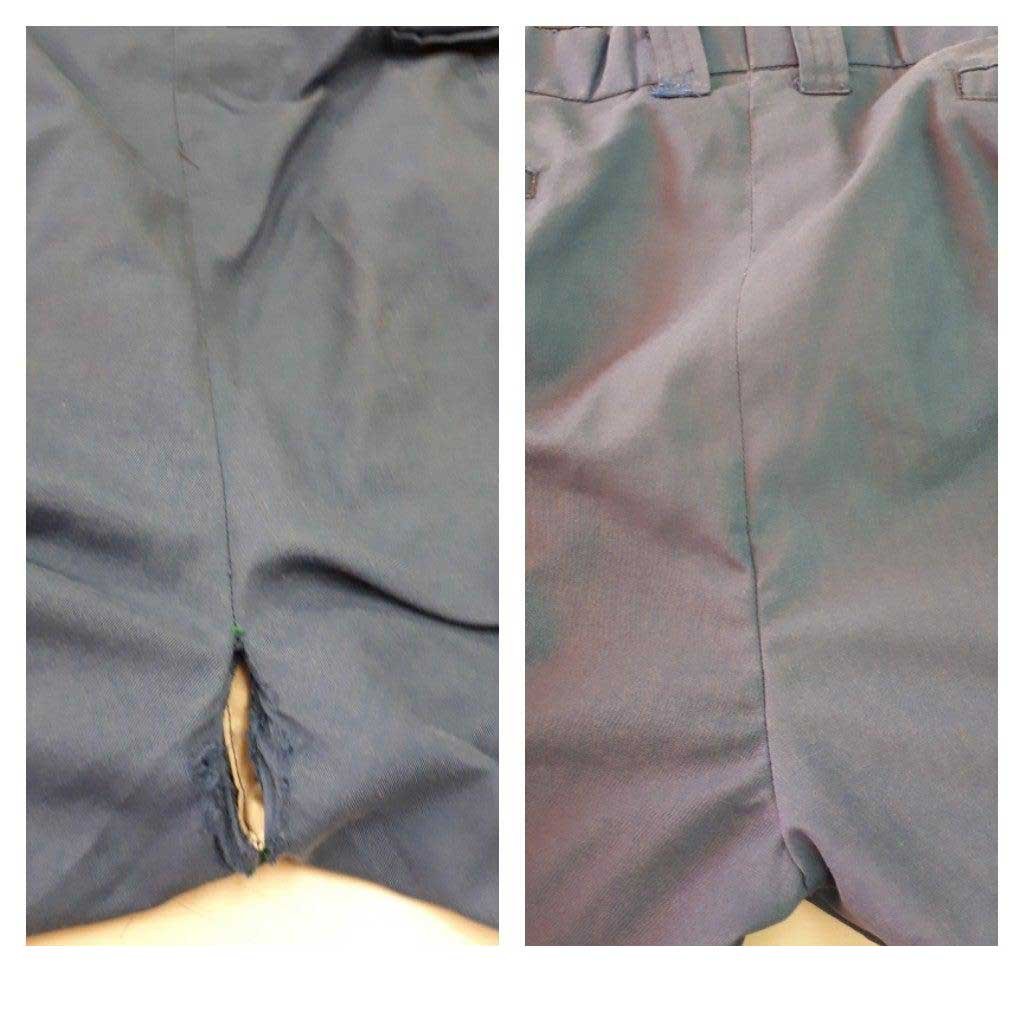
Seam Blowouts in Workwear
Section 1: Understanding Seam Failure
A seam is not a simple bond between two pieces of fabric. It is a mechanical system where the fabric, the thread, the stitch type, and the needle penetration interact under load.
The Three Modes of Seam Failure
Mode 1: Thread Breakage
The thread itself snaps under tension. This is the rarest form of seam failure in properly constructed workwear. Industrial sewing threads (typically bonded nylon or polyester, Tex 40 to Tex 70) have breaking strengths of 3,000 grams and above—far higher than the loads most workwear seams encounter in normal use.
When thread breakage does occur, it is usually caused by:
- Incorrect thread tension during sewing
- A needle that has damaged the thread during penetration
- Chemical degradation of the thread from industrial laundering
Mode 2: Fabric Yarn Breakage
The yarns in the fabric break at the seam line. This happens when the fabric's tensile strength is lower than the thread's breaking strength. The thread survives, but the fabric yarns snap under the concentrated load at each needle penetration point.
This mode typically appears as a clean break along the stitch line. The seam opens, but the thread remains intact and visible on both sides of the separation.
Mode 3: Seam Slippage (The Most Common Culprit)
The yarns in the fabric do not break—they simply slide apart. The weave structure is not tight enough to hold the yarns in place under the lateral load applied at the seam. The warp yarns shift away from the stitch line, creating a visible gap between the seam and the fabric.
Seam slippage is characterized by:
- A gap that appears between the stitch line and the fabric edge
- No broken threads or yarns
- Progressive widening over time, not sudden failure
- Most common in low-density weaves and smooth-yarn fabrics
For industrial workwear, seam slippage accounts for over 70% of seam failures in our analysis of returned garments. It is the mode that is most directly tied to fabric selection—and the easiest to prevent through proper specification.
Section 2: How Fabric Properties Determine Seam Strength
Thread Count and Weave Density
The most critical fabric property for seam performance is thread count—the number of warp and weft yarns per inch or centimeter.
When a seam is stitched, the needle passes between yarns in the weave. The thread then exerts lateral force on the adjacent yarns when the seam is placed under tension. If the yarns are densely packed, they resist this lateral movement through inter-yarn friction. If they are loosely packed, the yarns slide apart.
| Thread Count (Warp × Weft per inch) | Seam Slippage Resistance | Typical Application |
|---|---|---|
| Below 80 × 50 | Poor—high risk of slippage | Budget workwear, lightweight shirts |
| 100 × 60 | Moderate—acceptable for light duty | Hospitality uniforms, office attire |
| 120 × 70 | Good—suitable for medium workwear | Industrial uniforms, warehouse wear |
| 140 × 80+ | Excellent—lowest slippage risk | Heavy workwear, cargo and tactical |
The rule of thumb: For any workwear application involving significant load on seams (bending, lifting, squatting), specify a minimum thread count of 120 × 60 per inch at the woven stage.
Fabric GSM and Yarn Thickness
Heavier fabrics naturally resist seam slippage better than lighter fabrics of equivalent weave density, because the individual yarns are thicker and generate more inter-yarn friction. However, increasing GSM alone without increasing thread count is not a reliable solution—a 300 GSM fabric with a 60 × 40 thread count will still slip at the seams because the yarns are too far apart.
The right approach: Specify both minimum GSM and minimum thread count. For industrial workwear, 250 GSM with 120 × 70 thread count provides a dependable baseline.
Yarn Twist
High-twist yarns are more compact and generate greater inter-yarn friction than low-twist yarns. A fabric woven from yarns with 18–20 twists per inch will resist seam slippage significantly better than an otherwise identical fabric using 12–14 TPI yarns.
The trade-off is handfeel. Higher twist produces a crisper, less soft fabric. For workwear, this is generally acceptable. The performance benefit of reduced seam slippage outweighs the marginal loss of softness.
Fiber Type and Surface Finish
Smooth fibers slide past each other more easily than textured fibers. This is why:
| Fiber | Surface Characteristic | Seam Slippage Tendency |
|---|---|---|
| Polyester (filament) | Smooth, continuous | Higher—low inter-yarn friction |
| Polyester (spun) | Textured, fuzzy | Lower—higher inter-yarn friction |
| Cotton (long-staple) | Naturally textured | Low—good friction |
| Rayon (filament) | Smooth | Higher—needs tight weave |
| Nylon | Smooth | Higher—needs tight weave |
Blended fabrics such as 65/35 T/C or T/R benefit from the textured surface of the cotton or rayon component, which increases inter-yarn friction even when the polyester component is smooth. This is one reason why blended workwear fabrics consistently outperform pure synthetics in seam performance.
The Role of Fabric Finishing
Certain finishing processes affect seam performance:
- Calendering (pressing the fabric between heated rollers to create a smooth surface) reduces inter-yarn friction and increases seam slippage risk. Calendered fabrics should be used only for garments where seam loads are minimal.
- Resin finishing (applied for wrinkle resistance) can stiffen the yarns and reduce their tendency to shift, but it also makes the fabric more brittle at the stitch line. Resin-treated fabrics require careful needle selection to avoid yarn damage.
- Sanforization (compaction for shrinkage control) does not affect seam performance directly, but the reduced shrinkage prevents tension on the seam over time, reducing long-term failure risk.
Section 3: Common Seam Failure Points and Their Fabric-Related Causes
Inner Thigh Seams (Crotch Blowouts)
The most common seam failure in work pants. The inner thigh seam experiences both high tension (from squatting, bending, and climbing) and continuous abrasion (from leg movement).
Fabric-related root cause: Insufficient weft thread count. In most woven fabrics, the weft (crosswise) yarns are less numerous than the warp (lengthwise) yarns. When the inner thigh seam is placed under tension, the weft yarns shift along the warp direction, opening the seam.
Solution: Specify a balanced thread count where the weft count is at minimum 60% of the warp count. For example, 120 × 72 is better than 120 × 58.
Underarm Seams (Armhole Blowouts)
Armhole seams fail under tension from reaching, lifting, and overhead movement. These seams are also subject to moisture and friction from the arm rubbing against the torso.
Fabric-related root cause: Low overall thread count combined with smooth yarns that allow slippage in both warp and weft directions.
Solution: Increase the minimum thread count to 130 × 70 for any garment with armhole seams in active workwear. Consider a twill weave for its superior yarn-locking properties.
Shoulder Seams
Shoulder seams bear the weight of the garment itself plus any tools or equipment carried on the shoulders. They fail gradually as repeated loading causes incremental yarn slippage.
Fabric-related root cause: Insufficient fabric weight (GSM) for the load being carried. A lightweight fabric simply does not have enough yarn mass per unit area to resist the sustained tension at the shoulder.
Solution: For any garment with shoulder loads (safety vests, tool belts, backpacks), specify a minimum of 280 GSM with a tight twill weave.
Seat Seams
Seat seams fail from a combination of tension (sitting and standing) and abrasion (the rubbing motion of shifting position in a chair or vehicle seat).
Fabric-related root cause: Low abrasion resistance in the fabric surrounding the seam, which causes the yarns to thin and weaken before the seam itself fails. The seam may appear intact, but the fabric around it has lost structural integrity.
Solution: Specify minimum 30,000 Martindale cycles for the base fabric. The seat area should be reinforced with a heavier fabric panel in high-wear applications.
Section 4: Weave Structure and Seam Performance
The weave pattern directly affects how well the fabric holds its yarns in place under the lateral load of a seam.
| Weave Type | Seam Slippage Resistance | Why |
|---|---|---|
| Plain weave (dense) | Best | Maximum interlacing points per unit area—each warp yarn crosses every weft yarn, creating the highest inter-yarn friction |
| Twill (2/1, 3/1) | Very good | The diagonal float structure creates longer yarn segments that lock together under tension |
| Oxford weave | Moderate | The grouped warp threads create larger interstitial spaces where yarns can shift |
| Plain weave (loose) | Worst | Low thread count with maximum interlacing points means yarns shift easily under load |
The practical recommendation: For workwear seams that will experience significant load, specify 2/1 or 3/1 twill at a dense thread count. The twill structure provides the best balance of seam holding power, flexibility, and abrasion resistance.
Section 5: The Right Way to Specify Seam-Ready Fabric
Seam performance depends on the interaction between fabric and stitching. The specification must address both.
Fabric Specifications for Seam Performance
| Parameter | Minimum Specification | Best Practice |
|---|---|---|
| Thread count | 120 × 60 per inch | 130 × 70 per inch |
| Weave | Twill (2/1 or 3/1) | Twill with balanced warp/weft ratio |
| GSM | 240 GSM | 260–300 GSM |
| Yarn twist | 16 TPI minimum | 18–20 TPI |
| Seam slippage test | ASTM D434 / ISO 13936 | ≤3 mm slippage at 200 N load |
Stitching Considerations (Fabric-Informed)
Even with the best fabric, incorrect stitching choices can cause failure. The fabric's properties should guide the stitching specification:
For high-density twill (130 × 70+):
- Needle size: 90/14 to 100/16 (larger needle to penetrate dense weave without breaking yarns)
- Stitch type: Two-needle lockstitch (401) for main seams
- Stitches per inch: 8–10 (lower density for dense fabrics to avoid yarn damage)
For medium-density fabrics (100 × 60):
- Needle size: 80/12 to 90/14
- Stitch type: Three-thread overlock (504) with safety stitch on high-stress seams
- Stitches per inch: 10–12
For loose weaves (below 100 × 60):
- These fabrics should not be used for workwear where seam loads are significant
- If unavoidable, use wider seam allowances (1.5 cm minimum) and reinforcement tape
Section 6: The XINGYE Approach to Seam-Ready Fabric
At XINGYE TEXTILE, we engineer our T-R and T/C Series fabrics with seam performance as a primary design parameter, not an afterthought.
Our T-R Series (65/35 Polyester-Rayon)
| Parameter | Our Specification | Why It Matters for Seams |
|---|---|---|
| Thread count | 130 × 70 per inch | High density prevents yarn slippage |
| Weave | 2/1 Twill | Diagonal structure locks yarns under load |
| Yarn twist | 20 TPI | Maximum inter-yarn friction |
| Rayon quality | High-tenacity, wet strength >80% | Prevents yarn weakening during laundering |
| Seam slippage | ISO 13936: <2.5 mm at 200 N | Guarantees seam integrity |
| Finishing | No heavy calendering | Preserves inter-yarn friction |
Our T/C Series (65/35 Polyester-Cotton)
| Parameter | Our Specification | Why It Matters for Seams |
|---|---|---|
| Thread count | 120 × 64 per inch | Dense enough for heavy workwear |
| Weave | 2/1 Twill | Standard workwear construction |
| Cotton quality | Long-staple (28 mm+) | Textured fiber surface increases friction |
| Yarn twist | 18 TPI | Good balance of strength and handfeel |
| Seam slippage | ISO 13936: <3.0 mm at 200 N | Meets industrial workwear requirements |
Section 7: Procurement Checklist for Seam Failure Prevention
What to Include in Your Purchase Order
- Thread count: 'Minimum 120 warp × 60 weft per inch, verified by pick glass on delivery.'
- Seam slippage specification: 'Maximum 3 mm seam slippage per ISO 13936 at 200 N load. Batch-specific test report required.'
- Weave structure: '2/1 Twill weave for all workwear garments. No plain weave for high-stress applications.'
- Fabric weight: 'Minimum 250 GSM for pants and coveralls; minimum 220 GSM for shirts and light jackets.'
- Finishing restrictions: 'No heavy calendering. Fabric not to be resin-finished without seam impact assessment.'
Verification Tests on Delivery
The 5 cm Seam Slippage Test (Field Method):
- Cut a 10 cm × 10 cm fabric sample
- Draw a reference line 2 cm from one edge
- Stitch a seam along this line using the same thread and stitch type as the production garment
- Clamp the seam edge in one hand and the fabric body in the other
- Pull firmly and steadily—do not jerk
- Measure any gap that opens between the stitch line and the fabric
| Gap | Assessment |
|---|---|
| <2 mm | Excellent—fabric will hold seams under heavy use |
| 2–4 mm | Acceptable for moderate workwear |
| 4–6 mm | Marginal—expect failures in active use |
| >6 mm | Reject—fabric is not suitable for workwear |
This test is not a substitute for ISO 13936 laboratory testing. But it takes 30 seconds and can be performed on any fabric sample without specialized equipment. We recommend it as a first-line quality check on every delivery.
Red Flags to Watch For
'Our fabric has always performed well in seams' — This statement provides no verifiable data. Request the seam slippage test report.
Seam slippage data from a different fabric weight — Seam slippage is directly related to thread count and GSM. Data from a 300 GSM fabric does not apply to a 220 GSM fabric.
Low thread count with high GSM — This combination usually means thick yarns that are widely spaced. The yarns are strong, but they will slide past each other under seam load. High GSM does not compensate for low thread count in seam performance.
Frequently Asked Questions
Can seam tape reinforce a fabric with high slippage?
Seam tape can temporarily reinforce a seam, but it treats the symptom, not the cause. If the base fabric yarns are sliding apart, the tape will eventually delaminate under repeated washing and wear. The correct solution is to specify a fabric with adequate thread count and weave density.
Does seam slippage get worse with washing?
Yes. Industrial laundering causes yarn relaxation, which reduces inter-yarn friction over time. A fabric that passes the seam slippage test when new may develop slippage after 20–30 wash cycles. Extended testing (after 30 washes) reveals the long-term behavior.
Is seam slippage the same as seam pucker?
No. Seam pucker is a wavy distortion of the fabric along the seam line, caused by differential feed between the fabric layers during sewing. It is a cosmetic issue, not a structural failure. Seam slippage is a progressive opening of the seam that leads to garment failure.
Which blend is best for seam strength?
Our 65/35 T/R (Polyester-Rayon) in 2/1 twill at 130 × 70 thread count offers the best seam performance among our fabric families. The rayon component provides natural fiber friction, the polyester provides tensile strength, and the high thread count locks the yarns in place. For heavy industrial use, 100% polyester in a dense twill weave is the strongest option, though it compromises breathability and handfeel.
Does bartacking prevent seam blowouts?
Bartacking reinforces a specific stress point, such as a pocket corner or belt loop attachment. It prevents thread breakage at that point. It does not prevent seam slippage along the length of a seam. If the fabric is sliding apart at the inner thigh, bartacking every few centimeters will not solve the problem—the fabric itself needs to be replaced with a higher-density construction.
Making the Final Decision
Seam blowouts are not a sewing problem. They are a fabric specification problem that manifests at the stitch line. No amount of stitching reinforcement can compensate for a fabric that lacks the structural integrity to hold its yarns in place under load.
The correction is straightforward: specify a minimum thread count of 120 × 60, a 2/1 twill weave, minimum 250 GSM, and seam slippage testing per ISO 13936 with a maximum of 3 mm at 200 N. If your supplier cannot meet these specifications, your workwear will continue to fail at the seams regardless of how well the garments are constructed.
At XINGYE TEXTILE, every meter of our workwear fabric is tested for seam slippage before shipment. Our T-R and T/C Series are engineered with thread counts and weave densities that guarantee seam performance under industrial working conditions.
For seam slippage test reports, fabric specification sheets, or to discuss your specific workwear requirements: