Let me guess what happened.
Your company needs executive uniforms. Management team. Client-facing roles. Maybe a dozen VPs, a few directors, the regional heads. The brief said 'professional, sharp, appropriate for client meetings.'
Someone in procurement found a polyester suit at $89 per set. It looked fine on the hanger. You ordered 200 sets for the leadership team.
Three months in, here's what you're hearing: 'This feels like wearing a raincoat.' 'The pants are shiny at the knees.' 'My wife asked if I got a new job at a car rental counter.'
You're not wrong to be frustrated. And you're not wrong to not want to spend $800 per set on wool.
There's a middle ground, and most of the market ignores it. A proper 65/35 polyester-viscose suiting fabric — engineered to the right spec — delivers 85% of the look and hand feel of a mid-range wool suiting at 15% of the cost. The catch: you have to know what to look for, because most polyester suiting on the market is garbage.
I've been in textile manufacturing for over 15 years, supplying suiting fabrics to corporate uniform programs across 14 countries. This article is the short version of what I tell every procurement team I work with.
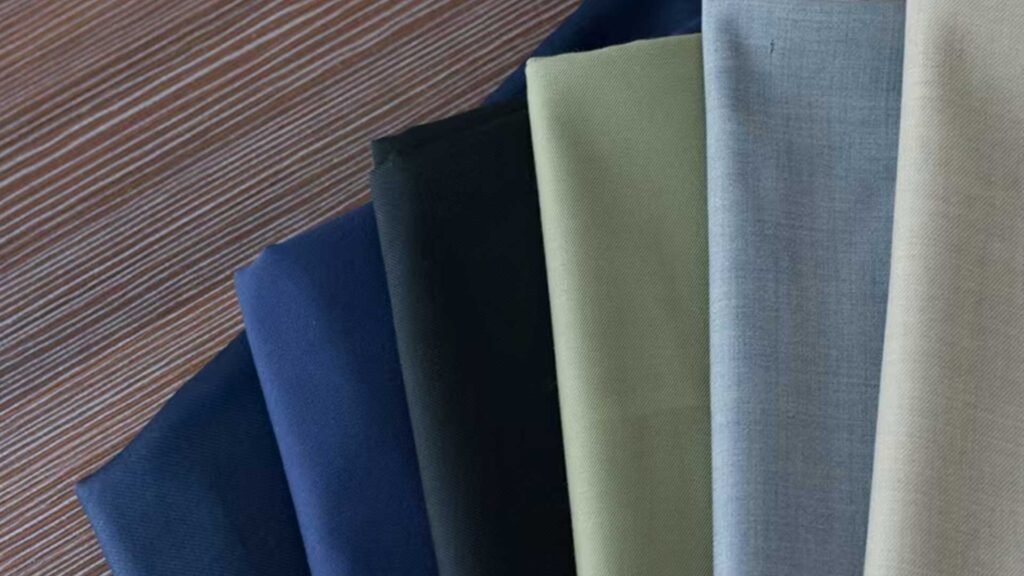
65 35 poly viscose executive suit fabric for management uniforms
Why Cheap Polyester Suiting Looks Cheap
Before we talk about what works, let's be clear on why most polyester suit fabric fails the 'executive' test.
Problem #1: The shine problem
Standard textured polyester — the kind used in $49 department store suits and rental tuxedos — has a round cross-section fiber that reflects light like a plastic rod. Under office lighting (fluorescent overheads, LED panels) it creates a sheen that reads as 'synthetic.' The higher the denier, the worse the sheen. A 150-denier textured poly woven in a plain weave will shine at the knees, elbows, and seat after two wears.
Problem #2: The hand feel
Polyester has no natural crimp. Textured yarns get their bulk from air-jet or false-twist processing, which creates a springy, 'squeaky' feel when you pinch the fabric between your fingers. It doesn't drape like a natural fiber. It tent-poles. It holds creases where you don't want them and drops them where you do.
Problem #3: Breathability (or lack thereof)
Hydrophobic fibers don't wick moisture the way rayon or wool does. An executive sitting through a two-hour client presentation in a sealed poly suit will be visibly sweating by minute 45. That's not an exaggeration — I've sat in those meetings.
Problem #4: Pilling is structural, not cosmetic
When short-staple polyester yarns rub against a jacket lining or chair upholstery, the loose fiber ends ball up. On a cheap poly suit, pilling starts around the inner collar and seat area by wear 10. On a well-constructed poly-viscose, it's negligible through 50+ wears. The difference is fiber length, twist, and blend ratio — not something you can fix after the fabric is woven.
What 65/35 Poly-Viscose Actually Does Different
A 65/35 poly-viscose (also called T-R, Tetron-Rayon, or poly-rayon) is not a 'polyester suit.' It's a hybrid fabric designed specifically to solve the problems above.
Here's what the viscose (rayon) brings that polyester alone can't:
Drape. Viscose fibers are irregular in cross-section, with serrated edges that scatter light rather than reflect it. That's the technical reason T-R fabric looks matte rather than shiny. Drape is measured by bending length — a good T-R suiting at 280gsm has a bending length of 3.2–3.8cm, compared to 2.0–2.5cm for a plain polyester of the same weight. That extra stiffness-with-flow is what makes a jacket hang properly.
Moisture regain. Viscose has a moisture regain of 11–13% at standard conditions. Polyester sits at 0.4%. That means a T-R suit fabric absorbs sweat vapor from the microclimate between shirt and jacket, rather than trapping it. For an executive sitting in a 22°C conference room, that's the difference between comfortable for two hours and damp after 30 minutes.
Surface luster control. By adjusting the viscose denier and the weave structure, you can dial the luster from 'matte wool-like' to 'subtle sheen.' A 2/1 twill at 300gsm with a 1.2-denier viscose weft produces the same visual depth as a 280g wool worsted. I've put swatches side by side with a Super 120s and had experienced garment manufacturers mistake the T-R for the wool.
And here's what the polyester brings:
Tensile strength. Polyester breaks at 4.5–6.0 g/denier. Viscose breaks at 2.0–2.5 g/denier. The 65/35 ratio ensures the fabric has enough polyester to resist seam tearing at stress points. In a properly constructed T-R suit, seam slippage is zero through 100+ wears.
Wrinkle recovery. Polyester recovers from bending deformation almost instantly. Viscose takes longer. At 65/35, the fabric has a wrinkle recovery angle of 270–290° (warp + weft). For reference, a 100% cotton dress shirt recovers at about 180°. A good wool suiting recovers at 300–320°. The T-R is close enough that an executive can stand up from a two-hour meeting with no visible creasing on the jacket back.
Color fastness. Disperse dyes on polyester are among the most wash-fast in the textile industry. A piece-dyed T-R fabric retains 90%+ of its depth of shade after 30 commercial launderings. That matters for corporate programs where color consistency across a management team is non-negotiable.
The Spec Sheet Matters More Than the Name
Not all 65/35 poly-viscose is the same. Here's what separates a fabric that belongs in an executive program from something you'd find on a commodity trading floor.
Fabric Weight
| Use case | Recommended weight | Why |
|---|---|---|
| Executive jacket + trouser (year-round) | 300–320gsm | Enough substance for proper jacket drape, light enough for 4-season wear |
| Summer-weight suit (Middle East, SE Asia) | 240–260gsm | Lighter but still maintains useful wrinkle recovery; pair with half-lined jacket |
| Trouser-only programs | 280–320gsm | Higher abrasion resistance at seat and knees |
| Women's suiting | 260–300gsm | Better drape for skirt suits; avoid above 320gsm for feminine silhouettes |
Stay away from anything below 220gsm for executive suiting. It looks and feels like a cheap blazer from a discount retailer.
Weave
2/1 twill is the right choice for 90% of executive programs. It gives you the diagonal weave structure that reads as 'suiting' rather than 'shirting,' better drapability than a 3/1 twill, and better opacity than a plain weave.
Plain weave (1/1) only works for lightweight summer suiting. Avoid it for year-round programs.
Herringbone or birdseye are available from better mills but add 15–25% to fabric cost and increase MOQ significantly. Nice-to-have, not necessary.
Yarn Spec
The yarn count tells you whether the mill put real engineering into the fabric or just wove whatever was on the bobbin.
| Quality tier | Typical yarn spec | Expected performance |
|---|---|---|
| Commodity | 1/30Nm – 1/40Nm single ring-spun | Adequate for basic uniforms; pilling by wear 20 in high-friction areas |
| Mid-grade | 2/60Nm – 2/50Nm two-ply warp + 1/40Nm weft | Good balance of cost and performance; minimal pilling through 50+ wears |
| Premium | 2/80Nm two-ply warp and weft | Excellent for executive programs; wool-like hand feel; negligible pilling |
| Top-tier 'imitation wool' | 2/100Nm two-ply + finishing treatments | Matches entry-level wool suiting (Super 90–100) in appearance and feel; premium pricing |
For a management-level uniform program, the mid-grade spec is the sweet spot. Below that, you're buying problems. Above that, you're approaching wool prices and should just buy wool.
Cost Comparison: What You Actually Pay For
Let's put hard numbers on this. All prices are FOB, CIF, or landed as noted.
| Option | Fabric cost (per meter) | Fabric cost per suit | Garment cost (cut + make + trim) | Total landed per suit (estimate) | Expected life (wears) | Cost per wear |
|---|---|---|---|---|---|---|
| Commodity poly (1/30Nm, 200gsm) | $2.20–$2.80/m | $3.30–$4.20 | $18–$25 | $21–$29 | 50–80 wears | $0.26–$0.58 |
| Mid-grade 65/35 T-R (2/60Nm, 300gsm) | $4.20–$5.20/m | $6.30–$7.80 | $22–$30 | $28–$38 | 150–200 wears | $0.14–$0.25 |
| Entry-level wool (Super 100s, 280gsm) | $14–$20/m | $21–$30 | $30–$45 | $51–$75 | 200–300 wears | $0.17–$0.38 |
| Premium wool (Super 120s, 260gsm) | $28–$45/m | $42–$68 | $40–$60 | $82–$128 | 300+ wears | $0.27–$0.43 |
Notice the cost per wear on the mid-grade T-R: $0.14–$0.25. That's cheaper than the commodity poly suit, because the T-R lasts 2–3x longer before showing unacceptable wear. The procurement team that buys the $21 suit actually pays more per wear than the team that buys the $33 suit.
The line that matters: for a management-level uniform program, the mid-grade 65/35 T-R at $4.20–$5.20/meter is the cheapest option on a cost-per-wear basis, period. Below that spec, you trade durability for low upfront cost and pay for it in year two. Above that spec, you're paying for aesthetics improvements that matter — but only if your budget allows.
Five Red Flags That Tell You the Fabric Isn't Executive-Grade
1. The mill can't tell you the yarn count.
If they say 'it's 65/35 poly-viscose suiting' and can't specify whether it's 1/30Nm or 2/60Nm, they don't know what they're selling. Walk away.
2. The swatch feels 'squeaky.'
Pinch the fabric between thumb and forefinger and rub. If you feel a rubbery resistance or hear a faint squeak, the polyester content is low-grade textured yarn. A proper T-R should feel dry and soft, not plastic.
3. The fabric shines under direct light.
Hold the swatch under a desk lamp at a 45° angle. If you see a uniform glare across the surface, the fiber cross-section is round — commodity poly. A quality T-R should look matte, with a subtle warm tone from the viscose.
4. The price is below $3.50/meter FOB.
At that price, the mill is cutting corners on yarn quality, dye quality, or both. You can make a basic student uniform or school blazer at $3.00/m. You cannot make an executive-quality suit fabric at that price. Physics doesn't care about your budget.
5. The supplier says 'no minimum' with no hesitation.
Legitimate mills have standard production minimums — typically 1,500–3,000 meters per color per run. A supplier with 'no minimum, any quantity' is either a trader who buys excess stock (and can't guarantee color consistency on reorder) or a mill running dead stock that may not be reproducible. For a management uniform program that will need reorders in 12–18 months, that's a problem.
What an Executive Program Actually Needs
A management uniform program isn't like a production worker program. The expectations are different:
- Fit is the first filter. A $300 suit in cheap fabric that's well-tailored will look better than a $1,000 suit in premium fabric that fits poorly. Allocate your budget accordingly.
- Color consistency across batch runs matters. You can't have the VP of Sales wearing a different navy than the Regional Director. Mill-direct sourcing with documented dye lot traceability is the only way to guarantee this over multi-year programs.
- The jacket gets the most scrutiny. A jacket hangs in the office. It's seen from all angles. Invest in the jacket fabric spec (higher weight, better drape) and you can use a slightly lighter trouser fabric without anyone noticing.
- Dry cleaning is the default, but industrial laundry is creeping in. More corporate uniform programs are moving to machine-washable formulations for cost reasons. If this matters, specify sanforized or compressive-shrinkage-controlled fabric from the start. Retrofitting is expensive.
The Bottom Line
If you're running a management-level uniform program and someone in procurement tells you to 'just buy the cheap polyester and save money,' show them the cost-per-wear table above. The $28–$38 landed suit in a proper 65/35 T-R twill will outperform the $21 suit on every measurable dimension: appearance, comfort, durability, and total cost.
And if your executive team complains that the uniform looks cheap? That's not a tailoring problem. That's a fabric problem. A 300gsm 2/60Nm 65/35 poly-viscose twill in a matte navy or charcoal doesn't look like a cheap suit. It looks like a $600 suit that someone got a good deal on.
That's the gap this fabric fills. Nothing else in the market hits this intersection of cost, performance, and appearance for volume corporate programs.
XINGYE TEXTILE supplies 65/35 polyester-viscose executive suiting fabrics from our mill in Hebei, China — in 2/60Nm mid-grade and 2/80Nm premium specs, 280–320gsm, 2/1 twill, standard corporate colors (navy, charcoal, medium grey, black). We ship cutting samples in 5–7 days. If you're evaluating fabric for a management uniform program, contact us at fabricforuniform.com with your color requirements and estimated volumes.