I got a call from a PPE importer in Houston. He buys FR coveralls from China, sells to oilfield service companies in Texas and Oklahoma. Standard business.
He found a Chinese FR fabric supplier. $5.20/meter. The mill sent a test report showing compliance with EN ISO 11612. 'Flame retardant.' 'Passes international standards.' He ordered 10,000 meters.
His client asked: 'Is it NFPA 2112 certified?'
The mill's reply: 'What's NFPA 2112?'
The container sat in Houston for six weeks while the importer paid for retesting at a US lab. The fabric passed EN 11612 A1 but failed NFPA 2112. The after-flame time on the 3-second flash fire test exceeded 2 seconds. Thermal shrinkage hit 12% — NFPA caps it at 10%.
$5,000 in retesting fees. $7,500 in warehousing. Client went elsewhere.
This story plays out in oil and gas PPE procurement every year. Mills that know European standards cold have never run a fabric through the NFPA 2112 protocol. The tests are different. The pass criteria are different. The certification process is more expensive.
I've been in FR fabric manufacturing for 15 years, supplying to both EN and NFPA programs. Here's the real difference between fabric that passes a European test and fabric that passes a North American oilfield test.
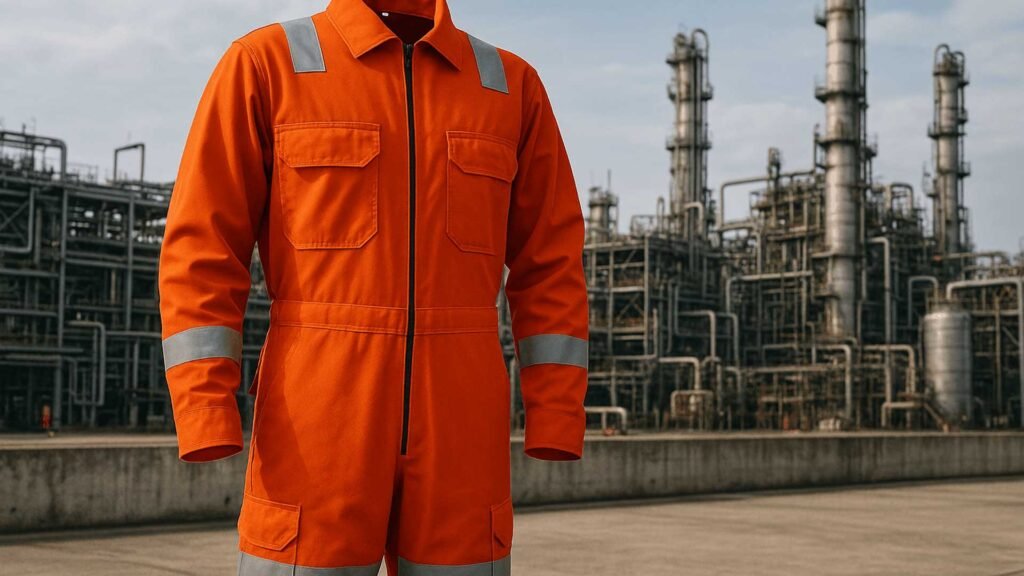
FR Fabric for Oil & Gas Coveralls
NFPA 2112 vs. EN ISO 11612: The Four Differences That Matter
Both standards test flame resistance. They test it differently. Here's where NFPA 2112 is harder:
1. The flash fire test
| EN ISO 11612 | NFPA 2112 | |
|---|---|---|
| Test method | ISO 15025 (small flame, 10-second exposure) | ASTM F1930 (3-second flash fire engulfment, full mannequin) |
| What happens | A lab burner applies flame to the bottom edge of a fabric sample for 10 seconds | A full garment is placed on an instrumented mannequin and exposed to a 3-second propane flash fire |
| What's measured | After-flame time, after-glow time, hole formation | Predicted body burn (% of second- and third-degree burns), after-flame time, melting/dripping |
| Pass threshold | After-flame ≤ 2 seconds, no hole | Predicted body burn ≤ 50%, after-flame ≤ 2 seconds, no melting or dripping |
The mannequin test is expensive ($3,000–$8,000 per test). Most Chinese mills have never run one. They test to ISO 15025, which uses a small open flame on a fabric strip — much less demanding.
The trap: A fabric that passes ISO 15025 easily can fail ASTM F1930 because the full garment exposure reveals issues with seam construction, zipper heat transfer, and fabric shrinkage under 3 seconds of flame.
2. Thermal shrinkage
EN 11612 measures dimensional change after exposure to convective heat at 180°C. NFPA 2112 measures thermal shrinkage after actual flame exposure.
The NFPA 2112 limit: ≤ 10% shrinkage in both directions after the flash fire test.
I've tested fabrics that showed 2% shrinkage in the EN oven test. In the NFPA flash fire test, the same fabric shrank 14%. The difference is heat intensity and duration — 3 seconds of 2,000°F propane flame is more aggressive than 180°C oven air.
Above 10% shrinkage, the garment pulls tight against the body. Tight fabric transfers heat more efficiently to the skin. The burn injury gets worse, not better.
3. Heat transfer (HTI)
EN 11612 measures heat transfer index (HTI) for convective and radiant heat. NFPA 2112 doesn't have a standalone HTI requirement — the mannequin test accounts for heat transfer as part of the predicted body burn calculation.
But some buyers also require ASTM F2703 (heat transfer performance) alongside NFPA 2112. This adds another $1,500–$3,000 in testing.
4. Certification process
EN standards: Self-certification or test-house certification. The mill sends fabric to a lab, gets a test report, declares compliance.
NFPA 2112: Third-party certification required. The fabric must be tested by an accredited lab (UL, SGS, Intertek, etc.). The lab must witness the full protocol. The certification is specific to the fabric construction — if the mill changes the weight or weave, the certification is invalid.
This is the biggest blocker for Chinese mills. EN testing can be done locally in China at CNAS-accredited labs for $500–$1,500 per test. NFPA 2112 testing requires a US-based lab with ASTM F1930 mannequin capability. Cost: $3,000–$8,000. The mill has to ship fabric to the US, pay for the test, wait for results, and potentially re-test after adjustments.
Many mills look at the cost and decide to skip it.
What Happens When Fabric Fails NFPA 2112
Here's what the test actually catches. I've seen it happen:
Failure mode 1: After-flame time > 2 seconds
The fabric sample catches fire from the flash fire. After the 3-second gas exposure stops, the fabric continues burning for 3–4 seconds. NFPA 2112 allows ≤ 2 seconds of after-flame.
This happens when:
- The FR finish is not durable enough for the fiber blend
- Cotton-rich fabrics (80/20 T/C) have higher after-flame times than polyester-rich
- The fabric weight is below 250gsm — too thin, burns through faster than it self-extinguishes
Failure mode 2: Thermal shrinkage > 10%
The fabric shrinks more than 10% during the 3-second exposure. The garment tightens. Burn severity increases.
This happens when:
- Untreated cotton or high-cotton content — cotton shrinks dramatically under high heat
- The fabric hasn't been sanforized (compressive shrinkage control)
- The polyester content is too low to provide thermal dimensional stability
Failure mode 3: Melting and dripping
Any fabric that melts and drips during the flash fire test fails immediately. This disqualifies:
- 100% polyester (melts at 250°C)
- Low-quality poly-cotton with textured polyester yarns
- Any garment with plastic zippers, buttons, or trim that melts
Failure mode 4: Predicted body burn > 50%
The mannequin sensors show >50% second- and third-degree burns. The fabric ignites, shrinks, and transfers heat to the mannequin faster than the allowable limit.
This is the hardest failure to diagnose because it's a systems failure — fabric + seam + closure + fit. A fabric that passes all component tests can still fail the mannequin test because the seams fail or the closure melts.
What Does Pass NFPA 2112?
For oil and gas coveralls, the proven fabric spec for NFPA 2112 is:
| Property | Recommended spec | Why |
|---|---|---|
| Fiber blend | 65/35 or 60/40 cotton-polyester (CPC) | Cotton provides FR treatment compatibility and charring behavior. Polyester provides dimensional stability and strength. |
| FR treatment | Durable FR finish (phosphorus-based, reactant type) | Must survive 100+ industrial washes. Non-durable finish fails after 25 washes. |
| Fabric weight | 270–320gsm (8–9.5 oz/yd²) | Heavy enough for thermal protection, light enough for worker mobility |
| Weave | 2/1 twill | Better thermal barrier than plain weave. More durable for oilfield use. |
| Shrinkage control | Sanforized or compressive shrinkage treated | Must show ≤ 10% thermal shrinkage in NFPA 2112 flash fire test |
| Seam thread | Nomex or FR-treated polyester | Standard polyester thread melts in flash fire, creating seam failure path |
| Hardware | FR-compatible zippers + buttons | Plastic zippers melt. Standard metal zippers transmit heat. Use heat-shielded or covered closure systems. |
Coverall requirement: The complete garment must be tested under NFPA 2112, not just the fabric. A fabric that passes standalone testing can fail as a garment because of zipper heat transmission, thread failure, or seam construction.
Cost of Testing and Certification
This is the part most buyers don't know to ask about.
| Test | Standard | Cost | Lab type | Turnaround |
|---|---|---|---|---|
| Flash fire mannequin | ASTM F1930 | $5,000–$8,000 | Specialized (US only, ~5 labs) | 4–8 weeks |
| Thermal shrinkage | NFPA 2112 sec 8.3 | $500–$1,500 | Standard (any accredited lab) | 1–2 weeks |
| Heat transfer | ASTM F2703 | $1,500–$3,000 | Specialized | 2–4 weeks |
| Tensile/tear | Various | $300–$600 each | Standard | 1 week |
| Full garment certification | NFPA 2112 complete | $8,000–$15,000 | Specialized | 8–16 weeks |
A mill that hasn't done NFPA 2112 certification needs 4–6 months and $15,000+ to get certified on one fabric construction. Most small mills won't invest.
When a supplier says 'we can make FR fabric, we'll figure out the certification,' translate that to 'we have no certification and you'll be the one paying for the retesting when the container arrives.'
How to Verify a Supplier Has Real NFPA 2112 Capability
Step 1: Ask for their NFPA 2112 certificate by name.
Not 'FR certificate.' Not 'EN 11612.' A certificate that says NFPA 2112 on it, issued by UL, SGS, Intertek, or QAI within the past 24 months.
If they send a general ISO 9001 certificate or an EN test report as proof — they don't have it.
Step 2: Verify the fabric construction matches the certificate.
NFPA 2112 certification is construction-specific. The certificate lists: fiber blend, weight (gsm or oz/yd²), weave, color, and FR treatment type. If the fabric you're ordering is 320gsm but the certificate is for 280gsm, the certification doesn't cover your fabric.
Step 3: Check the wash cycle count.
NFPA 2112 requires testing at 0 and 100 washes (or the manufacturer's declared wash limit). If the certificate only shows data at 0 washes, it's incomplete. The fabric needs to pass the flash fire test after 100 industrial wash cycles, not just when new.
Step 4: Confirm which components are covered.
NFPA 2112 certification can cover:
- Fabric only (you still need to certify the garment)
- Fabric + specific trim (thread, zippers, reflective tape)
- Complete garment
If you're buying fabric to have coveralls made elsewhere, you need the fabric certification AND you need to certify the complete garment assembly. The fabric certification alone won't protect your end customer.
Cost of Compliant vs. Non-Compliant Fabric
For a program supplying 2,000 sets of oil and gas coveralls per year:
| EN 11612 only fabric ($4.50–$6.50/m) | NFPA 2112 certified fabric ($7.00–$9.50/m) | |
|---|---|---|
| Fabric cost per coverall | $7.00–$10.00 | $10.50–$14.25 |
| Total landed per coverall | $18–$26 | $28–$38 |
| Certification validity | Self-certified (lab report only) | Third-party certified (UL/Intertek) |
| Client acceptance (North America) | Rejected by most oil & gas buyers | Required by NFPA 2112 specs |
| Customs risk | Low (not a regulated fabric import) | Low |
| Annual fabric cost (2,000 sets) | $36,000–$52,000 | $56,000–$76,000 |
| Cost of one container rejection | $15,000–$30,000 (retesting + storage + lost sale) | $0 |
| Risk-adjusted 3-year cost | $123,000–$186,000 | $168,000–$228,000 |
The NFPA 2112 fabric costs $20,000–$42,000 more per year upfront. One container rejection at $15,000–$30,000 almost wipes out a year's savings. Two rejections and the cheap fabric costs more.
And that's without counting the lost client relationship. Oil and gas PPE buyers who require NFPA 2112 won't accept a second shipment of EN-only fabric. You lose the account.
One Sentence to Sound Like You've Done This Before
Amateur: 'Do you have FR fabric for oil and gas coveralls?'
Pro: 'I need CPC 65/35, 300gsm, 2/1 twill, NFPA 2112 certified with ASTM F1930 mannequin testing at 0 and 100 washes, third-party cert by UL or Intertek. Send me your current certification and CIF Houston pricing for 5,000 meters.'
The first call gets you an EN 11612 test report that's worthless for the North American market.
The second call gets you either a real NFPA 2112 quote or an honest 'we don't have that certification yet.'
The Bottom Line
If you're selling FR coveralls into the North American oil and gas market, NFPA 2112 is not optional. It's the minimum entry requirement. No certification = no sale.
The hard truth: most Chinese FR mills don't have NFPA 2112 certification. It costs $8,000–$15,000 and takes 4–6 months to obtain for a single fabric construction. Many mills won't invest because their existing EN-certified fabrics sell well enough in other markets.
The few mills that do carry NFPA 2112 certification can charge a premium and will deliver every time. The fabric costs 30–50% more per meter. Over three years, with the container rejection risk factored in, it's cheaper.
The right spec for NFPA 2112 oil and gas coveralls: CPC 65/35 cotton-polyester, 270–320gsm, 2/1 twill, durable FR finish, with third-party NFPA 2112 certification covering fabric and garment assembly at 100 washes.
XINGYE TEXTILE produces NFPA 2112 certified FR fabric for oil and gas coveralls — CPC 65/35, 270–320gsm, 2/1 twill, with durable FR treatment, tested through 100 industrial washes. Third-party certified. Mill-direct from Hebei, China. Contact fabricforuniform.com for certification documents, 20-meter swatches, and FOB/CIF pricing.