Poly cotton is the most widely used uniform fabric in the world. Walk through any hospital, hotel, school, or restaurant, and the odds are high you're looking at poly cotton — the shirts, the scrubs, the chef coats, the school uniforms, the workwear pants.
But 'poly cotton' is not one fabric. It's a family of blends, each with different ratios, different weaves, and different performance characteristics. Knowing the difference between TC 65/35, CVC 60/40, and 50/50 can save a uniform buyer thousands of dollars a year — or cost them, if they choose wrong.
This guide explains what poly cotton fabric is, how the blends differ, what each one is best for, and how to choose the right blend for your uniforms.
What Is Poly Cotton Fabric
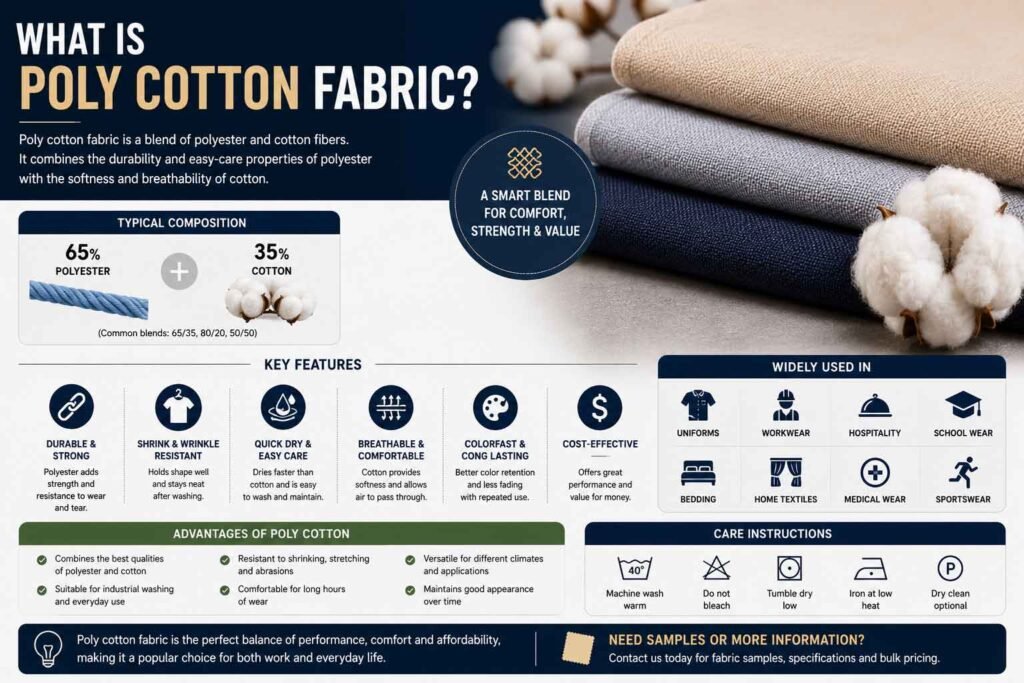
What Is Poly Cotton?
Poly cotton is a blended fabric made from two fibers:
| Fiber | Source | Key Properties |
|---|---|---|
| Polyester (poly) | Petroleum-based synthetic | Strong, wrinkle-free, quick-drying, colorfast, cheap |
| Cotton | Natural plant fiber | Breathable, soft, comfortable, absorbent |
The two fibers are blended during yarn spinning, then woven or knitted into fabric. The result combines the strengths of both:
| What Polyester Brings | What Cotton Brings |
|---|---|
| Strength & durability | Softness & comfort |
| Wrinkle resistance | Breathability |
| Color fastness | Moisture absorption |
| Shrinkage control | Natural feel |
| Lower cost | Familiar texture |
The Poly Cotton Blends You'll Actually See
There is no single 'poly cotton.' The ratio determines the fabric's personality:
| Blend Name | Ratio (Poly:Cotton) | Nickname | Cotton Feel | Durability | Best For |
|---|---|---|---|---|---|
| TC 65/35 | 65% poly / 35% cotton | TC (Terylene-Cotton) | Low — poly dominates | ★★★★★ | Industrial laundry uniforms, schools, hotels |
| TC 50/50 | 50% poly / 50% cotton | 50/50 | Medium | ★★★★☆ | Casual uniforms, T-shirts, work shirts |
| CVC 60/40 | 40% poly / 60% cotton | CVC (Chief Value Cotton) | High — cotton dominates | ★★★★☆ | Premium uniforms, chef coats, scrubs |
| CVC 55/45 | 45% poly / 55% cotton | CVC | High | ★★★★☆ | Comfort-first uniforms |
| CVC 35/65 | 35% poly / 65% cotton | Cotton-rich CVC | Very high | ★★★☆☆ | High-comfort, home-washed uniforms |
Rule of thumb: The first number in the ratio is the larger component. TC 65/35 = 65% polyester. CVC 60/40 = 60% cotton.
How Poly Cotton Is Made
The manufacturing process determines quality more than the ratio:
1. Fiber Blending
Polyester staple fibers and cotton fibers are blended in the exact ratio during the spinning process. The blend must be uniform — inconsistent blending causes visible streaks and uneven dyeing.
2. Spinning
Blended fibers are twisted into yarn. Ring-spun yarn is higher quality (softer, stronger); open-end yarn is cheaper and rougher.
3. Weaving or Knitting
The yarn becomes fabric:
- Woven (twill, poplin, oxford, plain) — for shirts, uniforms, pants
- Knitted (jersey, pique, fleece) — for polos, T-shirts, sportswear
4. Dyeing
Two approaches:
| Method | How It Works | Quality |
|---|---|---|
| Piece dyeing | Dye applied to finished fabric | Standard, good color consistency |
| Yarn dyeing | Yarn dyed before weaving | Premium, pattern possibilities (stripes, checks) |
5. Finishing
Treatments that change performance:
- Wrinkle-free / easy-care finish
- Stain-release finish
- Antimicrobial treatment
- Moisture-wicking finish
- Anti-pilling finish
- Water-repellent (DWR) finish
Poly Cotton vs. 100% Cotton vs. 100% Polyester
| Property | Poly Cotton (TC 65/35) | 100% Cotton | 100% Polyester |
|---|---|---|---|
| Comfort | ★★★☆☆ | ★★★★★ | ★★☆☆☆ |
| Breathability | ★★★☆☆ | ★★★★★ | ★★☆☆☆ |
| Durability | ★★★★★ | ★★★☆☆ | ★★★★★ |
| Wrinkle resistance | ★★★★★ | ★★☆☆☆ | ★★★★★ |
| Shrinkage control | ★★★★★ | ★★☆☆☆ (5-8%) | ★★★★★ |
| Color fastness | ★★★★★ | ★★★☆☆ | ★★★★★ |
| Stain resistance | ★★★★☆ | ★★☆☆☆ | ★★★★★ |
| Cost | $ | $$ | $ |
| Melting risk near heat | ★★★☆☆ (melts) | ★★★★★ (no melt) | ★★☆☆☆ (melts) |
| Environmental | ★★★☆☆ | ★★★★★ | ★★☆☆☆ |
| Best overall value | ✓ Best | Premium feel | Budget |
Key insight: Poly cotton's advantage isn't being the best at anything — it's being good enough at everything at the lowest cost. That's why it dominates the uniform industry.
Poly Cotton by Weave Type
The same blend in different weaves serves different purposes:
| Weave | Characteristics | Common Uses |
|---|---|---|
| Twill | Diagonal rib, durable, drapes well | Uniform pants, chef coats, work shirts |
| Poplin | Fine, smooth, crisp | Dress shirts, school shirts, hotel uniforms |
| Oxford | Basket texture, casual | Casual shirts, sport shirts |
| Plain weave | Simple, flat, versatile | T-shirts, lining, general apparel |
| Ripstop | Reinforced grid, tear-resistant | Workwear, tactical, outdoor uniforms |
| Herringbone | V-shaped twill pattern | Classic workwear, chef coats |
| Jersey knit | Soft, stretchy, casual | Polos, T-shirts, sports uniforms |
| Pique knit | Textured, breathable | Golf shirts, polo uniforms |
Poly Cotton GSM (Weight) Guide
| Weight | Feel | Best For |
|---|---|---|
| 120–150 GSM | Light, sheer | Summer shirts, lining |
| 150–200 GSM | Lightweight | Dress shirts, blouses, school shirts |
| 200–250 GSM | Medium | Standard uniform shirts, polos |
| 250–300 GSM | Medium-heavy | Work shirts, chef coats, pants |
| 300–360 GSM | Heavy, substantial | Workwear, jackets, heavy pants |
| 400+ GSM | Very heavy | Outerwear, canvas-type workwear |
Which Industries Use Poly Cotton?
| Industry | Typical Poly Cotton Use | Common Blend |
|---|---|---|
| Healthcare | Scrubs, lab coats | TC 65/35, CVC 60/40 |
| Hospitality | Server shirts, aprons, hotel uniforms | TC 65/35, TC 50/50 |
| Education | School uniforms | TC 65/35, TC 50/50 |
| Food service | Chef coats, kitchen uniforms | CVC 60/40, TC 65/35 |
| Industrial workwear | Work shirts, pants, coveralls | TC 65/35, ripstop blends |
| Corporate | Office uniforms, dress shirts | TC 65/35 poplin |
| Security / police | Duty shirts, uniforms | TC 65/35, CVC |
| Sports / school teams | Polos, tracksuits | Knit poly cotton, 50/50 |
Choosing the Right Poly Cotton Blend — Decision Guide
| Your Priority | Recommended Blend | Why |
|---|---|---|
| Maximum durability + industrial laundry | TC 65/35 | Survives 85°C commercial washing, holds shape |
| Staff comfort (worn 10+ hrs/day) | CVC 60/40 or 55/45 | More cotton = more breathable and comfortable |
| Budget uniforms | TC 50/50 | Good balance at lowest cost |
| Premium appearance | CVC 60/40 twill or poplin | Cotton-rich drapes better, richer color |
| Hot climate | CVC 60/40 (cotton-rich) | Breathability matters most |
| Wrinkle-free dress shirts | TC 65/35 poplin | Crisp, professional, no ironing |
| Workwear that gets torn | Poly cotton ripstop | Grid reinforcement stops tear spread |
Poly Cotton Fabric Care
| Care Item | Best Practice |
|---|---|
| Washing temperature | 40–60°C (home); industrial up to 85°C for TC blends |
| Bleach | Oxygen bleach preferred; chlorine yellows polyester |
| Drying | Tumble dry low; polyester melts above ~150°C |
| Ironing | Low-medium heat; polyester can melt or shine under high heat |
| Washing frequency | Same as any uniform — after each use |
| Color separation | Wash darks and lights separately to prevent dye transfer |
Poly Cotton Quality Checks for Buyers
| Check | Test Standard | What to Verify |
|---|---|---|
| Blend ratio | Fiber analysis (e.g., burn test, chemical dissolution) | Actual ratio matches spec |
| Shrinkage | AATCC 135 | ≤ 3% after 5 washes |
| Color fastness | AATCC 61 | Grade 4 minimum |
| Tear strength | ASTM D1424 | 2.5+ lbs warp (workwear) |
| GSM | Weighing | Actual weight matches spec |
| Pilling | ASTM D4970 | Grade 3–4 after 50 washes |
| Wrinkle recovery | AATCC 128 | Test after finish application |
Common Misconceptions About Poly Cotton
'Poly cotton is cheap and looks cheap.' Not necessarily. CVC 60/40 with a good finish drapes and feels close to pure cotton — at 60% of the price, with better durability. Quality is in the manufacturing, not the fiber ratio alone.
'All poly cotton wrinkles.' TC blends (poly-dominant) are the most wrinkle-resistant uniform fabrics available — that's their main selling point.
'Poly cotton can't be ironed.' It can — at low-medium heat. High heat melts polyester.
'Poly cotton is bad for hot weather.' Cotton-rich CVC is actually a reasonable hot-climate choice. The worst hot-weather choice is high-polyester knit with no cotton.
'Poly cotton is just cheap cotton.' It's a distinct engineered fabric with deliberately balanced properties — not a downgraded version of cotton.
About Xingye Textile — Poly Cotton Uniform Fabric Manufacturer
XINGYE TEXTILE manufactures poly cotton fabrics — TC 65/35, TC 50/50, and CVC blends — for uniform manufacturers, workwear brands, and uniform programs in 50+ countries. With 30 years in textile manufacturing, we supply poly cotton in every standard weave and weight.
Our poly cotton range:
| Fabric | Blend | Weight | Best For |
|---|---|---|---|
| TC 65/35 Poplin | 65/35 | 120–240 GSM | Dress shirts, school uniforms — crisp, wrinkle-free |
| TC 65/35 Twill | 65/35 | 200–300 GSM | Work shirts, uniform pants — durable, industrial laundry safe |
| TC 50/50 Twill | 50/50 | 200–280 GSM | Casual uniforms, budget programs |
| CVC 60/40 Twill | 60/40 | 240–300 GSM | Chef coats, scrubs, premium uniforms — cotton-rich comfort |
| Poly Cotton Ripstop | 65/35 or 50/50 | 200–280 GSM | Workwear, tactical, outdoor uniforms — tear-resistant |
| Poly Cotton Oxford | 65/35 | 200–260 GSM | Casual uniform shirts |
Our capabilities:
- ✅ Custom blend ratios available
- ✅ Custom weight, weave, and color development
- ✅ Pantone color matching with spectrophotometer verification
- ✅ Finishes: wrinkle-free, stain-release, antimicrobial, DWR, anti-pilling
- ✅ Single-dye-lot production for uniform programs
- ✅ Finished garment manufacturing — from fabric to finished uniform
- ✅ Private labeling for uniform brands
Sourcing poly cotton fabric for uniforms or workwear? [Contact us] for samples, spec sheets, and bulk pricing.
By Andy Tian, Export Sales Manager, XINGYE TEXTILE
Andy Tian has 10 years of experience in textile export at XINGYE TEXTILE, covering fabric sourcing, pricing, sampling, and order execution for uniform fabric buyers worldwide.