There is no single 'good' GSM — the right fabric weight depends entirely on what you're using it for. Lightweight fabrics (100–150 GSM) suit summer clothing and dress shirts; mid-weight fabrics (150–220 GSM) work for everyday t-shirts and casual wear; heavyweight fabrics (250 GSM and up) suit hoodies, denim, and outerwear. Anyone telling you a single GSM number is universally 'good' is selling you something. Here's how to actually figure out what's right for your specific project.
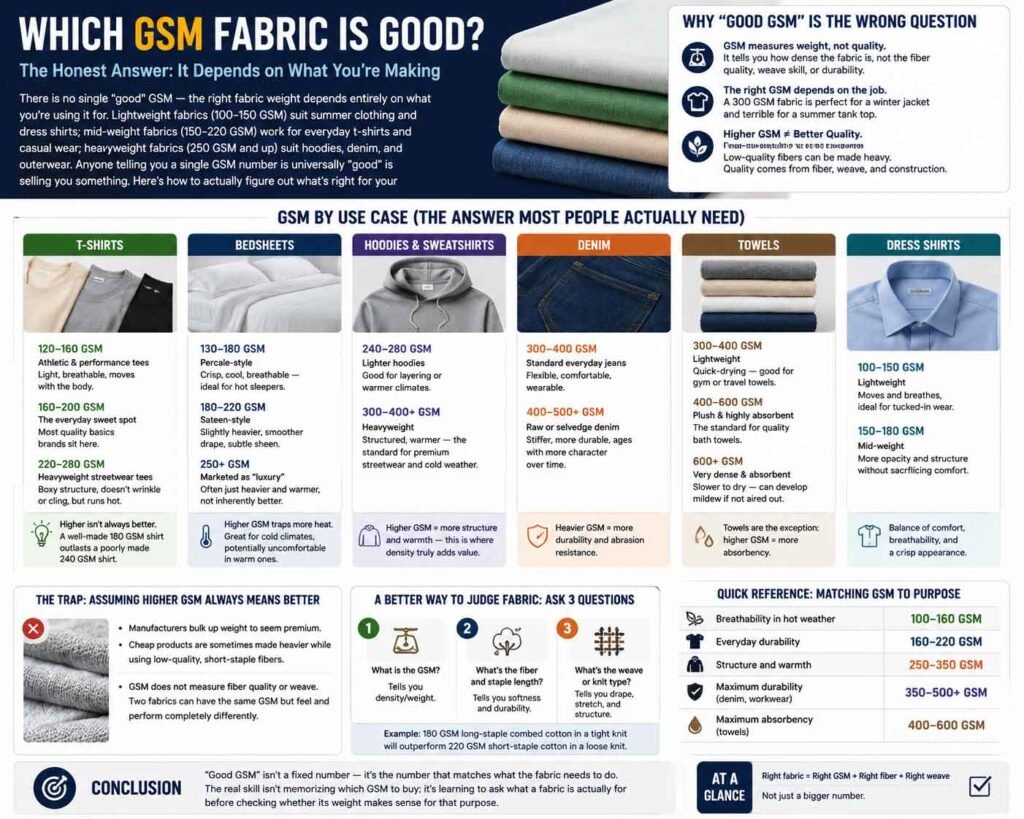
Which GSM Fabric Is Good
Why 'Good GSM' Is the Wrong Question
Searching 'which GSM is good' usually means one of two things: you're buying clothing and want to know if a listed GSM signals quality, or you're sourcing fabric for a project and don't know what number to ask for. Either way, the honest answer is that GSM alone can't tell you if a fabric is 'good' — it can only tell you if a fabric is dense, and density is only valuable when it matches the job.
A 300 GSM fabric is objectively 'better' for a winter jacket and objectively 'worse' for a summer tank top. The number isn't the judgment — the fit is.
GSM by Use Case (The Answer Most People Actually Need)
For T-Shirts
- 120–160 GSM: Athletic and performance tees — light, breathable, moves with the body.
- 160–200 GSM: The everyday sweet spot — most quality basics brands sit here.
- 220–280 GSM: Heavyweight streetwear tees — boxy structure, doesn't wrinkle or cling, but runs hot.
If someone tells you 'always buy the highest GSM t-shirt,' they're describing streetwear preference, not quality. A well-made 180 GSM shirt from good cotton will outlast a poorly made 240 GSM shirt from cheap fiber.
For Bedsheets
- 130–180 GSM (percale-style): Crisp, cool, breathable — ideal for hot sleepers.
- 180–220 GSM (sateen-style): Slightly heavier, smoother drape, subtle sheen.
- 250+ GSM: Marketed as 'luxury,' but often just heavier and warmer, not inherently better — great for cold climates, potentially uncomfortable in warm ones.
This is the category where 'higher GSM = luxury' marketing does the most damage. GSM measures weight, not thread quality — a heavy sheet made from poor cotton is still a poor sheet.
For Hoodies and Sweatshirts
- 240–280 GSM: Lighter hoodies, good for layering or warmer climates.
- 300–400+ GSM: Heavyweight, structured, warmer — the standard for premium streetwear and cold-weather wear.
Here, higher GSM genuinely correlates with a feeling of quality, because hoodie fabric benefits from density and structure in a way t-shirts don't.
For Denim
- 300–400 GSM: Standard everyday jeans — flexible, wearable.
- 400–500+ GSM: Raw or selvedge denim — stiffer, more durable, ages with more character over time.
Denim is one of the few categories where heavier genuinely does mean more durable, since abrasion resistance scales with density.
For Towels
- 300–400 GSM: Lightweight, quick-drying — good for gym or travel towels.
- 400–600 GSM: Plush, highly absorbent — the standard for quality bath towels.
- 600+ GSM: Very dense and absorbent, but slower to dry — can develop a mildew smell if not aired out properly.
The Trap: Assuming Higher GSM Always Means Better Quality
This is the single biggest misunderstanding driving searches like this one. Manufacturers know 'high GSM' sounds premium, so cheap products are sometimes bulked up in weight specifically to seem more valuable — while using low-quality, short-staple fibers that pill and wear out fast regardless of density.
The two things that actually determine quality — fiber length and weave tightness — aren't captured by GSM at all. A fabric's GSM can be identical whether it's made from premium long-staple cotton or scratchy low-grade fiber, because GSM only measures how much a square meter weighs, not what it's made of or how well it's constructed.
A Better Way to Judge Fabric: GSM + Two Other Questions
Instead of asking 'is this GSM good,' ask three questions together:
- What is the GSM? (Tells you density/weight)
- What's the fiber and staple length? (Tells you softness and durability)
- What's the weave or knit type? (Tells you drape, stretch, and structure)
A 180 GSM fabric made from long-staple combed cotton in a tight single-jersey knit will outperform a 220 GSM fabric made from short-staple cotton in a loose knit — even though the second one 'sounds heavier and better' on a spec sheet.
Quick Reference: Matching GSM to Purpose
| If you want... | Look for... |
|---|---|
| Breathability in hot weather | 100–160 GSM |
| Everyday durability | 160–220 GSM |
| Structure and warmth | 250–350 GSM |
| Maximum durability (denim, workwear) | 350–500+ GSM |
| Maximum absorbency (towels) | 400–600 GSM |
Conclusion
'Good GSM' isn't a fixed number — it's the number that matches what the fabric needs to do. The real skill isn't memorizing which GSM to buy; it's learning to ask what a fabric is actually for before checking whether its weight makes sense for that purpose. Once you're asking that question, the 'right' GSM becomes obvious almost every time.