A chef coat goes through more abuse in one service than most garments see in a month. It's pulled from the dryer at 80°C, splashed with hot oil, pressed against a 250°C stove, soaked in sweat, and bleached nightly. By the time a chef's coat has been through 50 industrial washes, most fabrics are done for.
The difference between a coat that lasts 6 months and one that lasts 18 months is almost entirely the fabric.
This guide breaks down the fabrics chef coats are made of — what each one does well, where it fails, and what to look for whether you're buying one coat or outfitting a 200-seat restaurant.
what fabric are chef coats made of
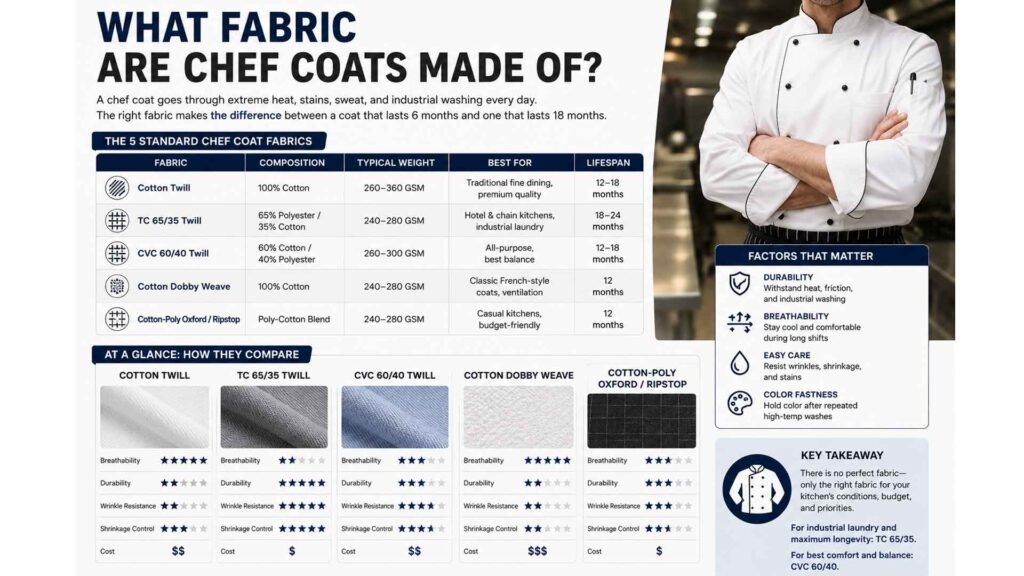
The 5 Standard Chef Coat Fabrics
| Fabric | Composition | Typical Weight | Best For | Lifespan |
|---|---|---|---|---|
| Cotton Twill | 100% cotton | 260–360 GSM | Traditional fine dining, premium quality | 12–18 months (home wash) |
| TC 65/35 Twill | 65% polyester / 35% cotton | 240–280 GSM | Hotel & chain kitchens, industrial laundry | 18–24 months |
| CVC 60/40 Twill | 60% cotton / 40% polyester | 260–300 GSM | All-purpose, best balance | 12–18 months |
| Cotton Dobby Weave | 100% cotton | 240–280 GSM | Classic French-style coats, ventilation | 12 months |
| Cotton-Poly Oxford / Ripstop | Poly-cotton blend | 240–280 GSM | Casual kitchens, budget-friendly | 12 months |
1. Cotton Twill — The Classic
What it is: 100% cotton, woven in a diagonal twill pattern (the same construction as denim, but lighter).
Why chefs wore it for a century:
- Breathable — cotton absorbs and releases sweat, keeps the chef cooler near ovens
- No melt/drip risk — cotton chars instead of melting against hot surfaces
- Natural feel — comfortable for 12–14 hour shifts
Where it fails:
- Shrinks — 100% cotton can shrink 5–8% without proper pre-shrink treatment
- Wrinkles — comes out of the dryer wrinkled, needs ironing
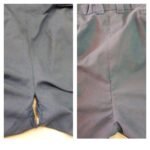
- Dies in industrial laundry — hospital/hotel-grade washers at 85°C with strong chemicals degrade cotton fast
- Fades — dark colors lose depth after repeated washing
| Property | Rating |
|---|---|
| Breathability | ★★★★★ |
| Comfort | ★★★★★ |
| Industrial laundry durability | ★★☆☆☆ |
| Wrinkle resistance | ★★☆☆☆ |
| Shrinkage control | ★★★☆☆ (with pre-shrink) |
| Cost | $$ |
Best for: Fine dining, small independent restaurants, kitchens with in-house or home washing. Chefs who value comfort and tradition over convenience.
2. TC 65/35 Twill — The Industrial Workhorse
What it is: 65% polyester / 35% cotton twill — the most common chef coat fabric in the world.
Why it dominates:
- Survives industrial laundry — polyester content handles 85°C wash temperatures and strong chemicals
- Wrinkle-free — comes out of the dryer ready to wear, no ironing
- Holds shape — less shrinkage, keeps its structure through hundreds of washes
- Stain release — polyester resists oil absorption better than cotton
- Color fast — disperse dyes hold color better in industrial washing
Where it fails:
- Less breathable — polyester doesn't absorb sweat; hot kitchens can feel clammy
- Melt risk — high polyester content melts near extreme heat sources (a real concern near open flames)
- Plasticky feel — less natural than cotton against the skin
| Property | Rating |
|---|---|
| Breathability | ★★☆☆☆ |
| Comfort | ★★★☆☆ |
| Industrial laundry durability | ★★★★★ |
| Wrinkle resistance | ★★★★★ |
| Shrinkage control | ★★★★★ |
| Cost | $ |
Best for: Hotels, catering companies, chain restaurants, uniform rental services — anywhere the coats go through commercial laundering daily.
3. CVC 60/40 Twill — The Best Compromise
What it is: 60% cotton / 40% polyester — 'Chief Value Cotton,' meaning cotton is the majority fiber.
Why it's the sweet spot:
- Cotton feel, poly durability — 80% of the comfort of pure cotton with most of the durability of TC
- More breathable than TC — the higher cotton content absorbs sweat better
- Still wrinkle-resistant — enough polyester for easy care
- Still industrial-laundry tolerant — survives commercial washing, just with a shorter lifespan than TC
Where it fails:
- Shorter industrial life than TC — 6–12 months under harsh commercial laundering vs. 18–24 months for TC
- Slightly higher cost than TC — cotton is more expensive than polyester
| Property | Rating |
|---|---|
| Breathability | ★★★★☆ |
| Comfort | ★★★★☆ |
| Industrial laundry durability | ★★★☆☆ |
| Wrinkle resistance | ★★★★☆ |
| Shrinkage control | ★★★★☆ |
| Cost | $$ |
Best for: Independent restaurants with occasional commercial washing, premium uniform brands, kitchens that want the best balance of comfort and care.
4. Cotton Dobby Weave — The French Classic
What it is: 100% cotton woven with a dobby pattern — a decorative weave with raised geometric motifs (often small diamonds or rice grain patterns).
Why it's traditional:
- Ventilation — the dobby pattern creates micro-texture that lifts the fabric slightly off the skin, allowing air to circulate
- Classic appearance — the textured pattern is the traditional French chef coat look
- Absorbency — full cotton absorbs sweat and heat better than any blend
Where it fails:
- Same cotton problems — shrinks, wrinkles, fades in industrial laundry
- More expensive — the dobby loom pattern costs more to weave than plain twill
| Property | Rating |
|---|---|
| Breathability | ★★★★★ (best) |
| Comfort | ★★★★★ |
| Industrial laundry durability | ★★☆☆☆ |
| Wrinkle resistance | ★★☆☆☆ |
| Shrinkage control | ★★★☆☆ |
| Cost | $$$ |
Best for: Classic French-trained chefs, fine dining, culinary schools teaching tradition. The look says 'I studied classical technique.'
5. Cotton-Poly Oxford / Ripstop — The Modern Casual
What it is: Poly-cotton blends in oxford weave (basket-like texture) or ripstop construction (reinforced grid pattern).
Why it's growing:
- Tear resistance — ripstop's reinforced grid stops small tears from spreading
- Easy care — wrinkle-free like TC
- Modern look — oxford texture reads casual, popular in gastropubs and modern casual dining
- Lower cost — competitive pricing for staff coats
Where it fails:
- Less traditional — doesn't have the fine-dining authority of dobby or twill
- Texture can look casual — wrong for formal dining rooms
| Property | Rating |
|---|---|
| Breathability | ★★★☆☆ |
| Comfort | ★★★☆☆ |
| Industrial laundry durability | ★★★★☆ |
| Wrinkle resistance | ★★★★☆ |
| Shrinkage control | ★★★★☆ |
| Cost | $ |
Best for: Casual dining chains, gastropubs, catering staff, back-of-house support roles.
What About Linen and Other Fabrics?
Linen
Genuine linen chef coats exist but are rare:
- Pros: Coolest possible fabric, beautiful drape, premium appearance
- Cons: Wrinkles instantly, expensive, shrinks, high maintenance
Linen is more common in hospitality uniforms (hotel front desk, resort staff) than actual kitchen coats. For kitchen use, linen-cotton blends (55/45) offer a compromise, but most professional kitchens skip it.
100% Polyester
Avoid for chef coats. It's cheap, but:
- Melts near high heat — dangerous in a kitchen
- Traps heat — unbearable over a stove
- Looks cheap — plastic sheen
FR (Flame-Resistant) Fabrics
For kitchens with open-flame cooking (wok stations, flambé work, charcoal grills), FR-treated cotton or FR blends add protection. Not required in most kitchens, but worth considering for high-risk stations.
Chef Coat Fabric Comparison — All 5 Side by Side
| Feature | Cotton Twill | TC 65/35 | CVC 60/40 | Dobby Weave | Oxford/Ripstop |
|---|---|---|---|---|---|
| Breathability | ★★★★★ | ★★☆☆☆ | ★★★★☆ | ★★★★★ | ★★★☆☆ |
| Comfort | ★★★★★ | ★★★☆☆ | ★★★★☆ | ★★★★★ | ★★★☆☆ |
| Industrial laundry | ★★☆☆☆ | ★★★★★ | ★★★☆☆ | ★★☆☆☆ | ★★★★☆ |
| Wrinkle resistance | ★★☆☆☆ | ★★★★★ | ★★★★☆ | ★★☆☆☆ | ★★★★☆ |
| Shrinkage control | ★★★☆☆ | ★★★★★ | ★★★★☆ | ★★★☆☆ | ★★★★☆ |
| Color retention | ★★★☆☆ | ★★★★★ | ★★★★☆ | ★★★☆☆ | ★★★★☆ |
| Heat protection (no melt) | ★★★★★ | ★★★☆☆ | ★★★★☆ | ★★★★★ | ★★★☆☆ |
| Cost | $$ | $ | $$ | $$$ | $ |
| Traditional look | ★★★★☆ | ★★★☆☆ | ★★★★☆ | ★★★★★ | ★★☆☆☆ |
How to Choose: A Decision Guide
| Your Situation | Best Fabric | Why |
|---|---|---|
| Fine dining, traditional kitchen, in-house wash | Cotton twill or dobby | Comfort, tradition, appearance — you control the washing |
| Hotel kitchen, uniform rental service | TC 65/35 | Survives industrial laundry, wrinkle-free, long lifespan |
| Independent restaurant, occasional commercial wash | CVC 60/40 | Best balance of comfort and durability |
| Casual dining chain, budget staff coats | Oxford or TC | Cost-effective, easy care |
| Open flame / wok station | Cotton (any) or FR cotton | No melt risk — never polyester-heavy near open flame |
| Hot, poorly ventilated kitchen | Cotton-rich (cotton twill, CVC, dobby) | Breathability is the priority |
Key Fabric Specifications to Verify
Whatever fabric you choose, verify these specs with your supplier:
| Specification | Standard | Minimum for Chef Coats |
|---|---|---|
| Weight (GSM) | — | 240–320 GSM (lighter = cooler, heavier = more durable) |
| Tear strength | ASTM D1424 | 2.5 lbs warp / 2.0 lbs fill |
| Shrinkage | AATCC 135 | ≤ 3% after 5 washes |
| Washfastness | AATCC 61 | Grade 4 minimum |
| Lightfastness | AATCC 16 | Grade 4 minimum (dark colors) |
| Color change after 50 washes | Visual gray scale | ≤ 1-step change |
| Pre-shrunk | — | Required for 100% cotton |
Chef Coat Care: Making Fabric Last
| Care Step | Why It Matters |
|---|---|
| Wash at 60°C max (home) | Hotter degrades cotton fibers faster |
| Use oxygen bleach, not chlorine | Chlorine yellowes polyester and weakens cotton |
| Tumble dry low, remove promptly | Prevents heat damage and deep wrinkles |
| Iron cotton coats slightly damp | Easier pressing, crisp finish |
| Never wash black/white together | Color transfer ruins both |
| Replace at first sign of thinning | A worn coat has no thermal or stain protection left |
About Xingye Textile — Chef Coat Fabric Manufacturer
XINGYE TEXTILE manufactures chef coat fabrics and finished chef uniforms for restaurants, hotels, uniform rental services, and culinary schools worldwide. With 30 years in textile manufacturing and exports to 50+ countries, we supply every standard chef coat fabric from one source.
Our chef coat fabric range:
| Fabric | Composition | Weight | Best For |
|---|---|---|---|
| Cotton Twill | 100% cotton | 260–360 GSM | Traditional fine dining, pre-shrunk, bleach-safe |
| TC 65/35 Twill | 65% polyester / 35% cotton | 240–280 GSM | Industrial laundry programs — wrinkle-free, durable |
| CVC 60/40 Twill | 60% cotton / 40% polyester | 260–300 GSM | All-purpose chef coats — cotton comfort, easy care |
| Cotton Dobby Weave | 100% cotton | 240–280 GSM | Classic French-style coats with ventilated texture |
| Linen/Cotton 55/45 | 55% linen / 45% cotton | 200–260 GSM | Hospitality uniforms, resort & premium dining |
Our capabilities:
- ✅ Custom Pantone color matching (including double-breasted white)
- ✅ Pre-shrunk cotton — no surprise shrinkage
- ✅ Single-dye-lot production for uniform programs
- ✅ Finished garment manufacturing — single & double-breasted chef coats
- ✅ Custom development — weight, weave, finish
- ✅ Private labeling for uniform brands
Sourcing chef coats for a restaurant group, hotel, or uniform program? [Contact us] for fabric samples, spec sheets, and bulk pricing.