Most people shop for shirts backwards. They fall in love with a color, a silhouette, a brand — and only think about the fabric once it's already itchy, pilling, or sweat-stained by 10 a.m. But the truth is simpler and a little inconvenient: a shirt is only as good as the cloth it's cut from. The best tailoring in the world can't rescue a fabric that wasn't right for the job in the first place.
So instead of ranking fabrics from 'best' to 'worst' — which is a little like ranking shoes without asking what you're doing in them — let's think about shirts the way a good tailor does: by what the shirt needs to survive.
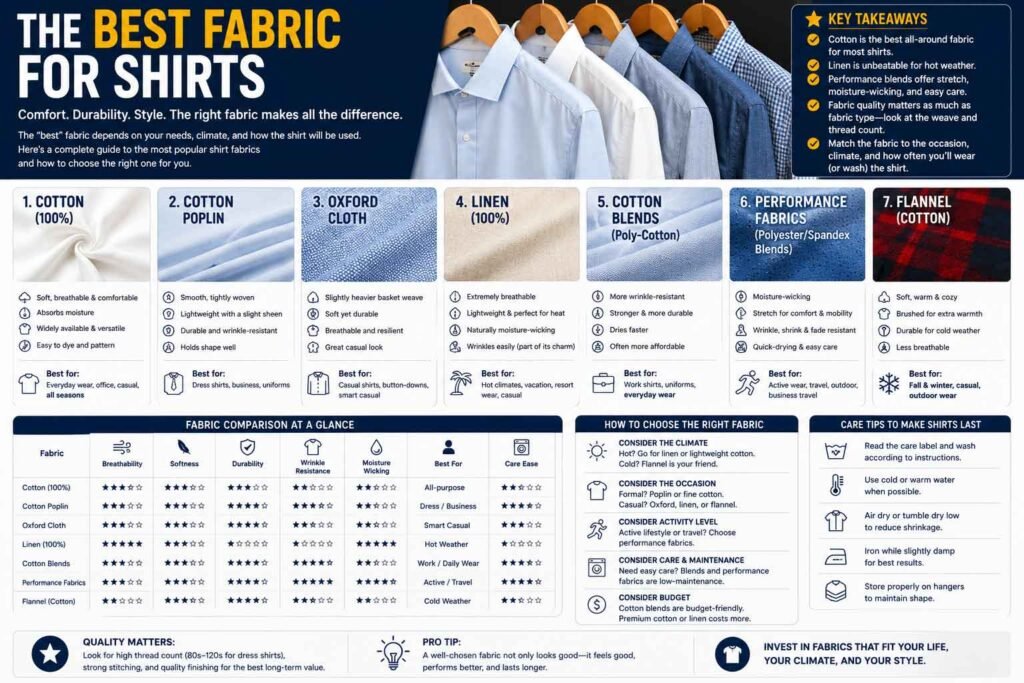
best fabric for shirts
The Everyday Workhorse: Cotton, But Not All Cotton
Cotton gets recommended constantly, and for good reason — it breathes, it takes dye beautifully, and it feels like nothing else against skin. But 'cotton' is doing a lot of quiet lying on clothing tags. Cheap, short-staple cotton pills and sags within a season. Long-staple cotton — the kind grown in places like the Nile Delta or the Sea Islands — spins into finer, smoother yarns that resist wrinkling and hold their shape wash after wash.
This is why two shirts can both say '100% cotton' and feel like they came from different planets. If you've ever wondered why a $200 shirt drapes differently from a $30 one, the staple length is often the real answer, not the stitching.
Where it shines: daily wear, office shirts, anything that needs to breathe in humid climates.
Where it struggles: it wrinkles honestly, and it holds onto sweat rather than moving it away from the body.
The Understated Overachiever: Linen
Linen has an image problem. People associate it with wrinkles, as if that's a flaw rather than the whole personality of the fabric. Made from flax fibers, linen is stronger than cotton when wet, dries faster, and actually gets softer with every wash — a rare textile that improves with age instead of degrading.
The wrinkles aren't a defect; they're linen refusing to pretend it's something stiffer and more artificial. In hot, humid weather, nothing beats it for airflow.
Where it shines: heat, humidity, warm-weather travel, anyone who's made peace with a lived-in look.
Where it struggles: formal settings that demand a crisp, ironed silhouette all day.
The Quiet Technical Marvel: Merino Wool
Most people think of wool as a winter sweater fabric, not shirt material — which is a shame, because fine merino wool is one of the most underrated shirting fabrics that exists. It regulates temperature in both directions, resists odor almost supernaturally (you can wear a merino shirt for days of travel without it smelling), and wicks moisture while staying soft against skin.
Merino shirts have quietly become a favorite among frequent travelers and outdoor professionals for exactly this reason: it's the fabric equivalent of packing light.
Where it shines: travel, variable climates, multi-day wear without laundry access.
Where it struggles: cost, and it's not built for tropical heat the way linen is.
The Practical Compromise: Cotton-Poly Blends
Purists dismiss synthetic blends, but there's a reason they dominate mass-market dress shirts: they solve cotton's biggest weakness — wrinkling — without sacrificing too much breathability. A well-made 60/40 or 80/20 cotton-poly blend holds a crisp collar through a twelve-hour workday and survives a hundred washes without losing its shape.
The trade-off is subtle but real: synthetic fibers trap heat and moisture more than natural ones, so blends can feel warmer and less 'alive' against the skin, especially in humidity.
Where it shines: travel-friendly dress shirts, uniforms, anything that needs to look pressed without an iron.
Where it struggles: hot, sweaty environments where breathability matters more than wrinkle resistance.
The Fabric Nobody Talks About Enough: Tencel (Lyocell)
If cotton and silk had a quieter, more sustainable child, it would be Tencel. Made from wood pulp through a closed-loop manufacturing process, it drapes with a slight sheen, feels almost silky, and manages moisture better than cotton. It's also one of the more environmentally responsible fabric choices on this list, since the solvents used in production are recycled at high rates.
Where it shines: smart-casual shirts, warm weather, anyone prioritizing sustainability without sacrificing feel.
Where it struggles: durability under heavy, frequent industrial laundering — it's better suited to personal wardrobes than institutional use.
So What's Actually 'Best'?
Here's the uncomfortable answer: there isn't one best fabric — there's a best fabric for what you're about to do in the shirt. A merino shirt on a five-day work trip will outperform cotton in every practical sense. A cotton-poly blend will out-crisp linen in a boardroom. And linen will make a humid Bangkok afternoon bearable in a way no other fabric can.
The real skill in choosing shirt fabric isn't memorizing a hierarchy — it's asking the right question before you buy: What is this shirt going to have to survive? Once you know that, the fabric picks itself.