When it comes to military, tactical, or outdoor operations, the choice of fabric for camouflage uniforms is critical. The right fabric not only ensures effective concealment but also provides durability, comfort, and protection in diverse environments. Selecting the appropriate fabric involves understanding fiber composition, dye compatibility, durability, and multispectral concealment capabilities. This comprehensive guide will walk you through how to choose the right fabric for camouflage uniforms, integrating the latest research and practical insights to help you make informed decisions.
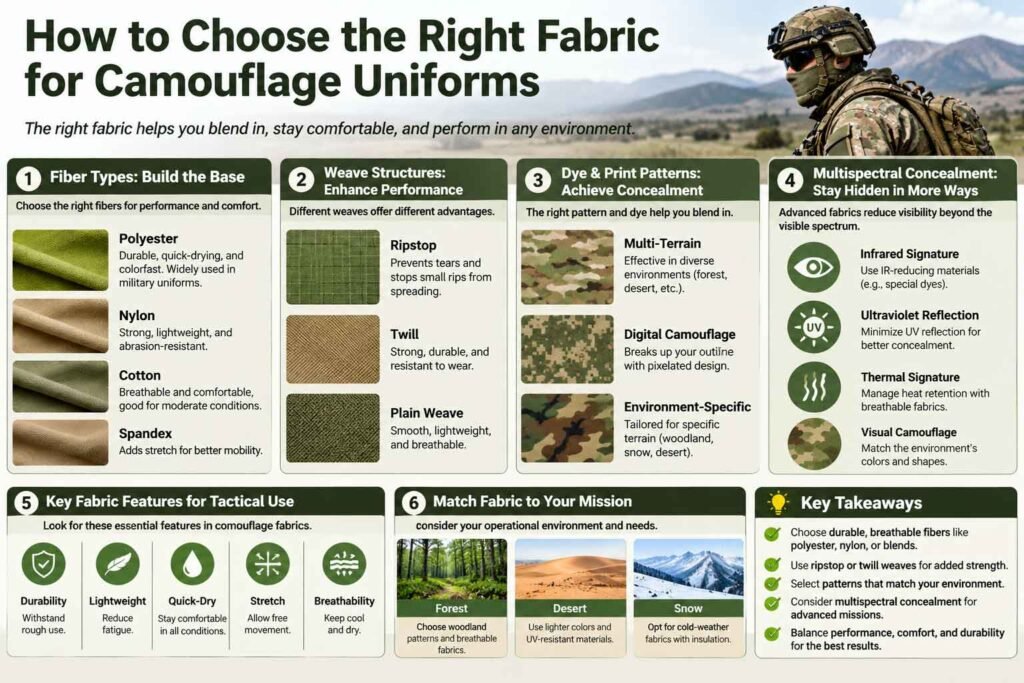
How to Choose the Right Fabric for Camouflage Uniforms
Why Fabric Choice Matters in Camouflage Uniforms
Camouflage uniforms serve the essential purpose of blending personnel seamlessly into their operational environment, reducing detectability by both the human eye and advanced surveillance technologies such as night vision and thermal imaging devices. The fabric used impacts:
- Visual concealment through color and pattern fidelity.
- Infrared (IR) and near-infrared (NIR) stealth by controlling spectral reflectance.
- Durability and comfort under harsh field conditions.
- Compatibility with dyes and pigments to maintain camouflage effectiveness after repeated use and laundering.
Key Factors to Consider When Choosing Camouflage Fabric
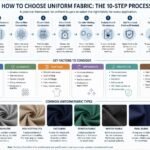
1. Fiber Composition and Fabric Type
The fiber composition determines the fabric’s durability, comfort, and compatibility with camouflage dyes.
- Cotton: Offers natural comfort and breathability but has lower durability and tends to crease easily. Often dyed with vat dyes for excellent wash fastness and IR reflectance control.
- Polyester: Highly durable with excellent color stability, often dyed with disperse dyes for synthetic fibers. However, pure polyester can melt under extreme heat, posing safety risks.
- Nylon: Often blended with cotton (known as NyCo) to combine durability with comfort. Acid dyes and metal-complex dyes are preferred for nylon to achieve multispectral camouflage.
- Blends (NyCo, PolyCo): Provide balanced performance; widely used in military uniforms. NyCo blends meet the critical “no melt, no drip” safety standards essential for combat wear.
2. Weave Structure: Ripstop vs. Twill
- Ripstop: Features a reinforced grid structure that prevents tear propagation, offering superior tear resistance (45-50 Newtons). Lightweight yet durable, ripstop fabrics are ideal for combat uniforms requiring high tenacity and damage control.
- Twill: Known for its diagonal weave and smooth surface, twill provides excellent abrasion resistance (50,000+ cycles in Martindale test) and a soft hand feel. It is heavier and more suitable for garrison or ceremonial uniforms.
NyCo ripstop is the most common fabric type for modern camouflage uniforms, combining the tear resistance of ripstop with the fiber benefits of nylon-cotton blends.
3. Camouflage Dye Compatibility and Multispectral Concealment
Effective camouflage requires fabrics that can be dyed or printed with colorants that perform well across multiple spectral regions:
- Visible Spectrum (VIS, 400-700 nm): Colors must match the operational environment (e.g., greens and browns for woodland, tans for desert).
- Near-Infrared (NIR, 700-1100 nm): Many fabrics reflect more strongly in NIR than visible light, which can betray the wearer under night vision devices.
- Thermal Infrared (TIR, 8,000-14,000 nm): Thermal imaging detects heat signatures; fabric treatments can reduce thermal contrast.
Vat dyes are preferred for cotton components due to their durability and ability to control NIR reflectance, ensuring fabrics do not “glow” under night vision. Disperse dyes suit synthetic fibers like polyester, offering tunable IR absorption, while acid dyes and metal-complex dyes are ideal for nylon and wool blends.
4. Durability and Abrasion Resistance
Military uniforms must withstand rigorous use, including exposure to UV radiation, moisture, and mechanical wear.
- Abrasion resistance is measured by Martindale cycles; military-grade fabrics should exceed 55,000 cycles.
- Tear strength (ASTM D1424) should be at least 40 Newtons.
- Reinforced stitching, ripstop weave, and fabric weight (grammage) between 200-230 g/m² optimize durability without sacrificing comfort.
5. Comfort and Breathability
- Breathability is critical for moisture management and thermal comfort.
- Ripstop fabrics generally offer better air permeability (80-120 dm³/s/m²) compared to twill (40-60 dm³/s/m²).
- Cotton content enhances moisture absorption, while synthetic fibers aid rapid drying.
- Weight selection should match climate: lightweight (160-200 g/m²) for hot environments, midweight (200-220 g/m²) for temperate zones, and heavyweight (240-280 g/m²) for cold climates.
6. Water Resistance and Finishing Treatments
- Durable Water Repellent (DWR) coatings provide surface water repellency without compromising breathability.
- DWR treatments typically last 20-30 wash cycles and can be reapplied.
- Waterproof fabrics with membranes (e.g., Gore-Tex) offer higher protection but reduce breathability.
Insights from Research and Industry Standards
The U.S. Woodland Battle Dress Uniform Case Study
The development of the U.S. Woodland Battle Dress Uniform (BDU) exemplifies the integration of fabric choice with camouflage effectiveness. The uniform uses a nylon-cotton twill blend dyed with vat and acid dyes to achieve:
- A color palette optimized for temperate woodland terrain.
- Infrared reflectance profiles matching natural backgrounds, reducing detectability by night vision devices.
- A 60% pattern size expansion to extend effective camouflage range up to 150 meters.
- Fabrics meeting military specifications for durability and IR performance.
Advanced Camouflage Textile Technologies
Recent advancements emphasize multispectral camouflage that conceals across visible and IR bands. Innovations include:
- Use of metal-complex dyes and nanocomposite pigments to regulate IR emissivity.
- Smart textiles with thermochromic and photochromic materials that adapt to environmental changes.
- Incorporation of graphene and liquid metal composites for tunable optical properties.
These technologies require fabrics compatible with specialized dyeing and finishing processes, underscoring the importance of selecting the right base fabric.
Practical Tips for Choosing Camouflage Fabric
| Factor | Recommendation |
|---|---|
| Fiber Composition | NyCo (50/50 nylon-cotton blend) for balance of durability and comfort |
| Weave Type | Ripstop for tear resistance; Twill for abrasion resistance and comfort |
| Fabric Weight (g/m²) | 200-230 g/m² for most combat environments; adjust for climate |
| Dye Compatibility | Vat dyes for cotton; Disperse dyes for polyester; Acid/metal-complex dyes for nylon |
| Finishings | DWR coating for water repellency; ensure breathability is maintained |
| Durability Testing | Martindale abrasion >55,000 cycles; Tear strength >40 Newtons |
| Camouflage Pattern Match | Select fabric that maintains color fidelity and IR reflectance after dyeing |
Conclusion
Choosing the right fabric for camouflage uniforms is a complex but vital decision that impacts operational effectiveness, user safety, and durability. By understanding the interplay of fiber composition, weave structure, dye compatibility, and environmental requirements, military and tactical personnel can select fabrics that provide superior concealment across visible and infrared spectra while ensuring comfort and resilience in the field.
For manufacturers and procurement specialists, aligning fabric selection with military standards such as MIL-DTL-44436 and NATO STANAGs guarantees interoperability and quality assurance.
Take Action
Explore our detailed guides on camouflage fabric types, dye technologies, and uniform selection criteria to make informed choices tailored to your mission needs. Whether you are outfitting a military unit, tactical team, or outdoor enthusiasts, the right fabric choice will enhance stealth, durability, and comfort—key factors in achieving mission success.