When it comes to military and tactical uniforms, fabric choice is not just about appearance—it’s a critical decision that impacts durability, comfort, and operational effectiveness. Two of the most prevalent fabric weaves used in this arena are ripstop and twill. Understanding the distinctions between these fabrics can help military personnel, manufacturers, and tactical enthusiasts select the optimal material for their specific needs.
In this comprehensive guide, we delve into ripstop vs twill for military and tactical uniforms, unpacking their weave structures, performance characteristics, and ideal applications to help you make an informed choice.
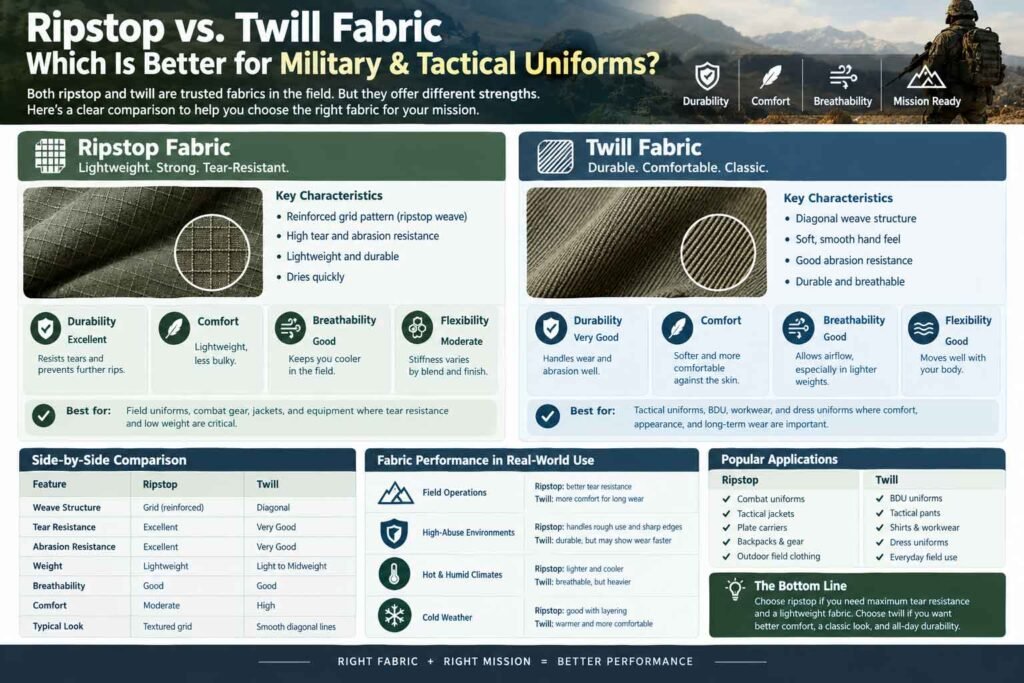
Ripstop vs Twill for Military and Tactical Uniforms
What Are Ripstop and Twill Fabrics?
Ripstop Fabric Explained
Ripstop is a specialized weave technique designed to prevent tears from spreading. It features a unique grid pattern of thicker, high-tenacity reinforcement threads woven at regular intervals (typically every 5 to 8 millimeters). This grid acts as a mechanical barrier, arresting the propagation of rips and punctures. Originally developed during World War II for parachutes, ripstop has become a staple in tactical gear due to its lightweight nature, high tear resistance, and durability.
Key characteristics of ripstop fabric include:
- Lightweight with high strength-to-weight ratio
- Tear resistance due to reinforced grid
- Low packing volume, ideal for compact gear
- Quick drying and good breathability
- Common fiber types: nylon, polyester, cotton blends (NyCo)
Twill Fabric Explained
Twill is a classic weave characterized by diagonal ribs or lines created by the weft thread passing over one or more warp threads and then under two or three. This weave structure provides a dense, durable fabric known for its abrasion resistance and soft hand feel. Twill fabrics are heavier than ripstop and offer better wind resistance and warmth, making them suitable for cooler environments or roles requiring a more formal appearance.
Key characteristics of twill fabric include:
- Dense diagonal weave for abrasion resistance
- Soft, comfortable hand and good drape
- Higher weight and thermal insulation
- Common fiber types: cotton, polyester, blends (e.g., poly-cotton)
Ripstop vs Twill: Key Performance Comparisons
| Property | Ripstop | Twill |
|---|---|---|
| Tear Resistance | High — grid stops tear propagation | Moderate — no specific reinforcement |
| Abrasion Resistance | Moderate — depends on base yarn | High — diagonal weave distributes friction |
| Weight | Lightweight (70-230 g/m² depending on type) | Heavier (180-280 g/m²) |
| Breathability | Higher air permeability (80-120 dm³/s/m²) | Lower air permeability (40-60 dm³/s/m²) |
| Comfort | Slightly stiff hand feel | Softer, better drape |
| Water Resistance | Often treated with DWR coatings | Also treated, but heavier and less breathable |
| Colorfastness | Excellent with polyester blends | Good, especially with poly-cotton blends |
| Cost | Higher production cost due to complex weave | Generally more economical |
Durability: Tear Resistance vs Abrasion Resistance
One of the most critical considerations in military and tactical uniforms is durability—but durability is multifaceted. Ripstop excels in tear resistance due to its reinforced grid, effectively preventing small tears from escalating into large rips. ASTM D2261 tongue-tear tests show ripstop fabrics require significantly more force to propagate tears compared to twill.
Conversely, twill fabric shines in abrasion resistance. Its diagonal weave distributes friction evenly across the fabric, allowing it to withstand repeated mechanical stress without wearing through. Martindale abrasion tests reveal twill fabrics endure 50,000+ cycles, outperforming many ripstop variants in resisting surface wear.
In essence:
- Choose ripstop when tear resistance and puncture containment are paramount.
- Choose twill when resistance to daily abrasion and surface wear is critical.
Weight, Breathability, and Comfort
Military uniforms must balance protection with wearer comfort. Ripstop fabrics typically weigh between 200-230 g/m² for combat uniforms, offering a lighter and more breathable option. Their structure allows better airflow and faster drying times (2-3 hours), crucial in hot or humid climates.
Twill fabrics, weighing between 220-280 g/m², provide better thermal insulation and wind resistance, making them ideal for cooler climates or garrison duties. The softer hand feel and better drape also increase comfort during prolonged wear, although twill takes longer to dry (4-6 hours).
NyCo blends (nylon-cotton) combine the best of both worlds, often woven using either ripstop or twill techniques, offering balanced durability, comfort, and moisture management.
Fiber Compositions and Hybrid Advantages: NyCo Fabrics
NyCo fabric blends nylon and cotton fibers (typically 50/50), combining nylon’s toughness with cotton’s breathability and comfort. This hybrid fabric is widely used in military uniforms, benefiting from:
- Balanced tear resistance and abrasion durability
- Improved moisture management
- “No melt, no drip” safety compliance under NATO standards
- Compatibility with flame retardant treatments
NyCo fabrics can be woven in ripstop or twill patterns, allowing customization based on mission requirements.
Application Guide: Where Each Fabric Excels
| Application | Ripstop | Twill | NyCo (Ripstop/Twill) |
|---|---|---|---|
| Combat Uniforms | Ideal — lightweight, tear-resistant | Less common — heavier, less tear-resistant | Preferred — balanced durability and comfort |
| Garrison/Tactical Training | Sometimes used — lighter option | Common — comfort and abrasion resistance | Used — depends on mission and budget |
| Outdoor & Hot Climate Ops | Excellent — breathability and quick drying | Less ideal — heavier and slower drying | Good — versatile for various climates |
| Cold Weather/Indoor Use | Less ideal — lower insulation | Excellent — warmth and wind resistance | Good — depending on weave and treatment |
| Tactical Gear (Pants, Jackets) | Popular — tear resistance and weight savings | Used — abrasion resistance and appearance | Widely used — mission-specific selection |
Care, Colorfastness, and Long-Term Performance
Ripstop fabrics, especially synthetic blends, are generally low-maintenance, resisting color fading and shrinkage over multiple wash cycles. However, cotton-rich ripstop and twill require careful laundering to maintain dimensional stability.
Colorfastness is typically excellent in polyester ripstop fabrics due to superior dye absorption, while twill fabrics dyed with vat dyes also maintain good UV resistance and pattern stability. Durability in appearance is crucial for uniforms that undergo frequent washing and exposure to harsh environments.
Cost Considerations
Ripstop fabrics tend to be 15-25% more expensive to produce due to the complex weave and reinforcement threads. NyCo blends, involving fiber mixing and specialized finishing, also command higher prices. Twill fabrics are generally more economical, benefiting from simpler weaving processes and widespread availability.
However, lifecycle cost analysis often favors ripstop, especially NyCo ripstop, due to longer operational life and reduced uniform replacement frequency.
Conclusion: Making the Right Choice for Military and Tactical Uniforms
Both ripstop and twill fabrics bring unique strengths to military and tactical uniforms. Ripstop leads in tear resistance, lightweight performance, and breathability, making it ideal for combat and hot-weather operations. Twill offers superior abrasion resistance, comfort, and thermal insulation, suitable for garrison duties and cooler environments.
The hybrid NyCo fabric, especially in ripstop weave, combines these advantages, offering a balanced solution for varied operational demands.
Choosing the right fabric depends on mission requirements, climate, durability needs, and budget considerations. For those seeking a versatile, durable, and comfortable uniform fabric, NyCo ripstop stands out as the modern standard.