In the dynamic world of textile sourcing, understanding Fabric MOQ (Minimum Order Quantity) is crucial for B2B buyers aiming to balance cost, flexibility, and quality. Whether you're a startup brand testing new designs or an established fashion house scaling production, MOQ directly impacts your cash flow, inventory risk, and speed to market. This comprehensive guide dives deep into Fabric MOQ essentials, drawing from industry benchmarks, buyer feedback, and supplier insights to help you make informed sourcing decisions.
Fabric MOQ
What is Fabric MOQ and Why Does It Matter?
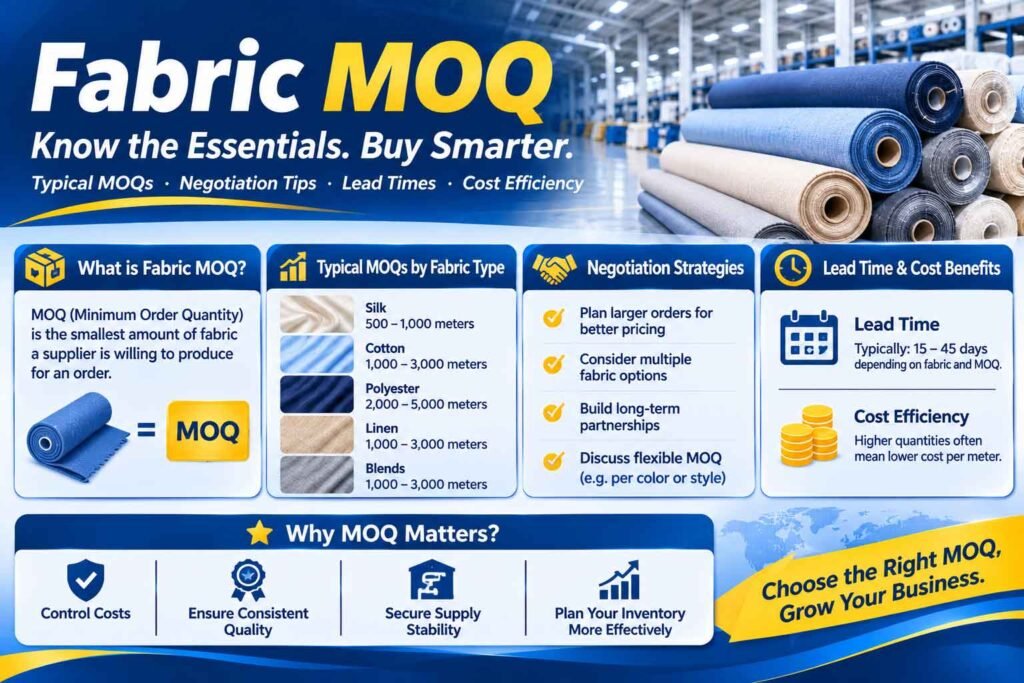
MOQ refers to the smallest quantity of fabric a supplier is willing to sell or manufacture in a single order. It’s a critical economic threshold ensuring manufacturers cover fixed setup costs such as loom threading, dyeing vessel preparation, and labor for machine changeovers.
- Measured in: meters, kilograms, or pieces depending on fabric type and supplier.
- Typical ranges:
- Low MOQ: 100–500 pcs or meters — favored by startups and test launches
- Traditional bulk MOQ: 1,000–5,000+ meters — suited for established brands with high-volume needs
MOQs protect supplier profitability but can pose challenges for buyers with limited capital or niche product lines.
Typical Fabric MOQ Ranges and Use Cases
| MOQ Range | Use Case | Price Premium* | Lead Time | Upfront Investment |
|---|---|---|---|---|
| Ultra-low (<50 pcs) | Sample testing, prototypes | 30–50% | 5–15 days | $200–$500 |
| Low (100–500 pcs) | Startups, limited editions | 15–25% | 15–30 days | $500–$2,000 |
| Medium (500–1,000 pcs) | Growing brands, seasonal lines | 5–15% | 20–35 days | $2,000–$5,000 |
| Traditional (1,000+) | Bulk production, established | Baseline | 30–60 days | $10,000+ |
*Price premiums are relative to traditional bulk pricing.
This balance allows buyers to choose configurations aligning with their business model and risk tolerance.
Lead Time Explained: What to Expect for Fabric MOQ Orders
Lead time — the duration from order confirmation to shipment readiness — varies based on MOQ and customization:
- Stock fabric: 5–10 days
- MOQ 100–500 pcs: 15–30 days typical turnaround
- Complex custom orders: up to 35 days or more
Factors influencing lead time:
- Fabric availability: Stock vs. custom-dyed or woven fabric
- Order quantity: Smaller orders generally ship faster
- Customization level: Labels, packaging, special finishes add time
- Seasonal capacity: Peak seasons can extend timelines
- Supplier location: Regional suppliers may offer quicker delivery than overseas
A competitive 15–30 day lead time for MOQ 100–500 pcs is increasingly standard, especially on platforms like Alibaba.com.
Economic Realities Behind MOQ: Why Suppliers Set Minimums
MOQ is not arbitrary. It reflects the economies of scale and manufacturing physics:
- Machine setup costs: Loom warping, dye bath preparation, and knitting adjustments require significant time and resources.
- Dyeing vessel capacity: Industrial dye machines need minimum loads for color uniformity and chemical efficiency.
- Raw material procurement: Yarn suppliers impose their own MOQs that cascade down the supply chain.
- Operational efficiency: High-volume production maximizes machine utilization, reducing per-unit costs.
Understanding these factors helps buyers appreciate MOQ as a necessary economic safeguard rather than a mere sales tactic.
Negotiating Fabric MOQ: Proven Strategies for B2B Buyers
MOQ is often negotiable, especially on competitive sourcing platforms. Here are effective tactics:
- Fabric deposit strategy: Pay upfront for fabric to reduce supplier risk and lower MOQ.
- Consolidate SKUs: Order multiple styles/colors using the same fabric to meet total MOQ without excess inventory per SKU.
- Flexibility on customization: Accept standard labels, packaging, or finishes to reduce setup costs.
- Long-term partnership: Commit to repeat orders to gain supplier trust and better MOQ terms.
- Order off-peak: Place orders during low production seasons for increased negotiation leverage.
Example: One Reddit user shared they lowered MOQ by agreeing to use supplier’s fabric stock and limiting customization.
Is Low MOQ Worth the Price Premium?
Low MOQ production typically commands a 15–25% price premium compared to bulk orders. For example:
| MOQ Type | Unit Price (per meter) | Order Quantity | Total Investment | Inventory Risk |
|---|---|---|---|---|
| Low MOQ (100–500) | $11.50–$12.50 | 200 meters | $2,300–$2,500 | Low |
| Bulk MOQ (1,000+) | $10.00 | 2,000 meters | $20,000 | High |
Why pay more per unit?
- Lower upfront capital: Reduces investment by 85–90%, freeing cash flow.
- Reduced inventory risk: Avoid deadstock and markdowns from unsold bulk fabric.
- Faster time-to-market: Accelerates production from 3–5 months to 4–6 weeks, enabling quick trend response.
For startups and agile brands, these benefits often outweigh the higher unit cost.
Fabric Types and MOQ Variations
MOQ varies by fabric type, dyeing complexity, and region:
- Silk: MOQ ranges 100–500 meters; digital prints allow lower MOQ (20–100 meters).
- Cotton: Typically 300–1,000 meters; organic cotton may have higher MOQ due to certification constraints.
- Polyester & synthetics: MOQs around 300–1,000 meters; more stable yields and lower shrinkage.
- Specialty fabrics (lyocell, bamboo, wool): Higher MOQs due to processing complexity.
Regional MOQ Insights
- China & Southeast Asia: MOQs typically 300–1,000 meters; highly competitive with negotiation flexibility especially in Fujian and Guangdong provinces.
- Europe (Italy, Turkey, Portugal): MOQs 300–500 meters; focus on premium, small-batch, and fast lead times.
- USA & Japan: Lower MOQs (100–500 meters) but at higher prices, emphasizing quality and sustainability.
Common Buyer Challenges and How to Overcome Them
- MOQ economics: Factories need volume to cover setup costs; orders under 100 units are often unprofitable.
- Supplier reliability: Buyers often try multiple suppliers before finding consistent partners.
- Coordination complexity: Misaligned MOQ, lead time, and communication can cause inventory issues or delays.
Tips: Build strong supplier relationships, factor buffer time into lead times, and always request samples before bulk orders.
Leveraging Alibaba.com for Fabric MOQ Sourcing
Alibaba.com offers unique advantages for buyers seeking MOQ 100–500 pcs with 15–30 days lead time:
- Supplier diversity: Thousands of verified silk and cotton fabric suppliers.
- Transparent communication: Direct messaging enables MOQ negotiation and lead time clarification.
- Trade assurance: Payment protection and quality guarantees reduce risk.
- Market intelligence: Buyer reviews and search trends help identify reliable suppliers.
- Access to growth markets: Reach buyers in the US, India (+287.5% growth), Pakistan (+166.67%), and Southeast Asia.
Actionable Recommendations for Buyers and Sellers
For Buyers:
- Clearly define MOQ, lead time, quality, and budget requirements before supplier engagement.
- Request samples with 5–10 day lead times to validate quality.
- Negotiate MOQ using deposit, SKU consolidation, and customization flexibility.
- Build long-term supplier relationships for better terms.
- Include buffer time in lead time expectations.
For Sellers:
- Offer multiple MOQ tiers (e.g., 100, 300, 500 pcs) with clear price points.
- Under-promise and over-deliver on lead times.
- Highlight MOQ flexibility and production capacity in listings.
- Use Alibaba tools to showcase certifications and reviews.
- Target high-growth regions with tailored marketing.
Conclusion
Understanding Fabric MOQ is essential for B2B buyers navigating the complex textile sourcing landscape. The MOQ 100–500 pcs with 15–30 days lead time strikes a practical balance between flexibility and cost efficiency, especially for startups and agile brands. While low MOQ production carries a price premium, the benefits of reduced upfront investment, lower inventory risk, and accelerated time-to-market often justify the extra cost.
By mastering MOQ negotiation strategies, leveraging platforms like Alibaba.com, and choosing the right MOQ configuration for your business model, you can optimize sourcing outcomes and position your brand for sustainable growth.
Ready to Optimize Your Fabric Sourcing?
Explore verified suppliers offering flexible MOQ options today on Alibaba.com and take the first step toward smarter, more agile fabric procurement.