When it comes to outfitting your team, organization, or business, the quality of your uniforms speaks volumes. Beyond aesthetics, uniforms must deliver durability, comfort, and safety tailored to the specific demands of your industry. But how do you ensure you partner with a reliable uniform fabric manufacturer who can meet these expectations consistently? This guide will walk you through the essential steps and considerations on how to find a reliable uniform fabric manufacturer — empowering you to make an informed decision that benefits your brand and workforce alike.
How to Find a Reliable Uniform Fabric Manufacturer
Why Choosing the Right Uniform Fabric Manufacturer Matters
Uniform fabrics are the foundation of any quality garment. The right fabric impacts:
- Durability: Ensures uniforms withstand daily wear, washing, and environmental factors.
- Comfort: Supports employee productivity through breathability, moisture management, and flexibility.
- Safety: Incorporates protective features like flame retardancy or chemical resistance when required.
- Brand Image: Maintains consistent color and texture, reinforcing professionalism.
Selecting a manufacturer who understands these factors and delivers consistently high-quality fabric is crucial to avoid costly mistakes, such as uneven fabric weight, color mismatch, or early garment failure.
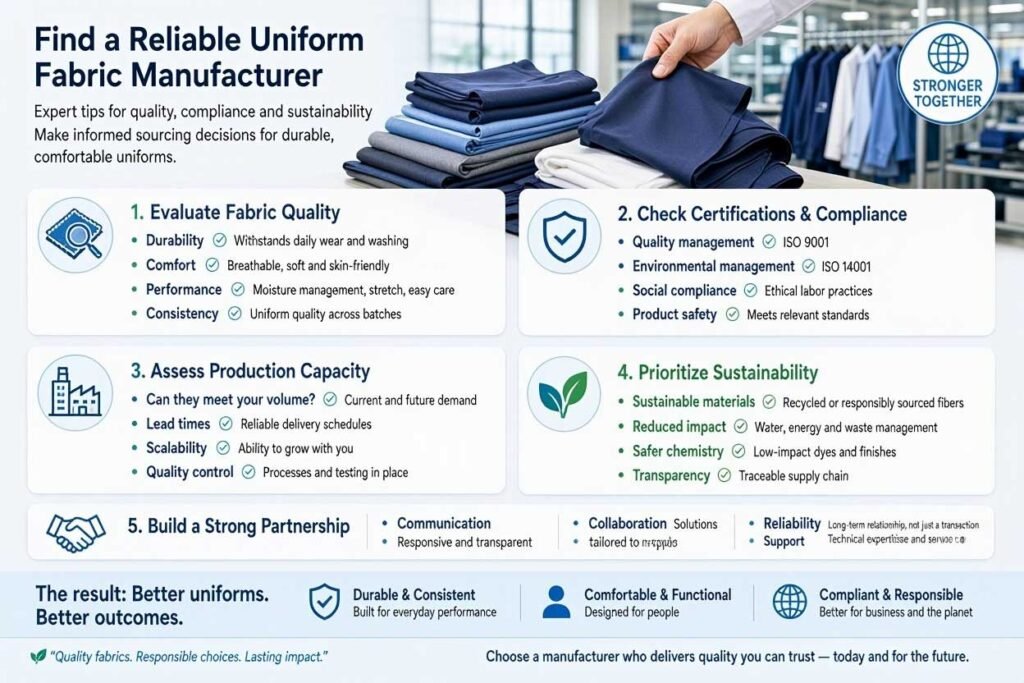
Key Factors to Consider When Finding a Reliable Uniform Fabric Manufacturer
1. Fabric Quality and Consistency
One of the most critical aspects is the consistency of fabric quality. According to a detailed guide by Aura Workwear, fabric weight measured in GSM (grams per square meter) directly affects durability and comfort. Reliable manufacturers provide:
- Batch-level GSM certificates to ensure each roll matches the approved sample.
- Shrinkage and colorfastness test results to avoid sizing issues and fading.
- Consistent weave quality, whether poly-cotton blends or twill fabrics, tailored to your uniform needs.
Pro Tip: Ask for detailed technical datasheets and third-party test certificates (e.g., ISO, OEKO-TEX) to validate fabric claims.
2. Material Expertise and Range
A reliable manufacturer should offer expertise in various fabric types suited for different uniform applications:
- Poly-cotton blends (e.g., 65/35 or 80/20): Ideal for corporate shirts and daily wear due to wrinkle resistance and breathability.
- Twill fabrics: Denser weave for industrial workwear requiring abrasion resistance.
- Advanced technical fabrics: Including flame-retardant, moisture-wicking, or antimicrobial textiles for specialized industries.
Manufacturers like Milliken & Company and DuPont have pioneered innovations in flame-resistant and high-performance fabrics, underscoring the importance of partnering with suppliers who invest in R&D.
3. Certifications and Compliance
Uniform fabrics often need to comply with industry-specific standards, such as:
- NFPA and ISO certifications for flame resistance and safety.
- OEKO-TEX Standard 100 for harmful substance testing.
- REACH compliance for chemical safety in the EU.
Choosing a manufacturer with these certifications ensures your uniforms meet legal and safety requirements, protecting your employees and brand.
4. Production Capacity and Lead Times
Evaluate the manufacturer’s ability to meet your order volume and timelines:
- Confirm minimum order quantities (MOQs) and whether they align with your needs.
- Assess their production scalability for future growth.
- Verify on-time delivery rates and logistics capabilities.
Manufacturers with integrated supply chains, like Shijiazhuang Changshan Textile, offer advantages in quality control and faster lead times through vertical integration.
5. Sustainability Practices
Sustainability is increasingly important. Leading fabric manufacturers are adopting:
- Use of recycled fibers and organic materials.
- Closed-loop recycling programs (e.g., Teijin Aramid’s aramid recycling).
- Reduction of harmful chemicals like PFCs in waterproof treatments (e.g., Gore’s PFC-free membranes).
Partnering with sustainable manufacturers aligns your brand with environmental responsibility and may meet customer or regulatory expectations.
How to Evaluate Potential Uniform Fabric Manufacturers
Step 1: Request Samples and Test Reports
Always request fabric swatches and verify:
- GSM consistency across samples.
- Shrinkage behavior after washing.
- Color accuracy and fastness.
- Fabric hand feel and breathability.
Consider real-world testing by having employees wear samples under typical working conditions.
Step 2: Verify Manufacturing Transparency
Reliable manufacturers provide:
- Factory tours (virtual or in-person).
- Clear documentation of sourcing and production processes.
- Third-party audit reports or certifications.
Avoid suppliers unwilling to share this information, as it may indicate quality control issues.
Step 3: Check Customer References and Reviews
Seek feedback from existing clients in your industry to understand:
- Product quality consistency.
- Responsiveness and communication.
- Problem resolution efficiency.
- Repeat order rates.
Platforms like Accio and Alibaba often provide verified reviews and ratings.
Common Red Flags to Avoid
- No GSM or quality certificates provided.
- Vague answers about fabric origin or production processes.
- Inconsistent pricing or hidden fees.
- Lack of sample availability or refusal to allow inspections.
- Poor communication or delays in response.
Bonus Tips: Leveraging Industry Innovations
- Explore advanced fabrics like Gore-Tex for breathable waterproofing or DuPont’s Kevlar and Nomex for protective uniforms.
- Consider nonwoven materials for insulation and reinforcement, as highlighted by Boshida Nonwoven’s analysis of advanced uniform textiles.
- Discuss custom fabric blends and finishes with manufacturers who offer OEM/ODM services for tailored performance.
Conclusion: Make an Informed Choice for Long-Term Success
Finding a reliable uniform fabric manufacturer requires careful evaluation of quality, certifications, capacity, and sustainability. By prioritizing consistency in fabric properties, verifying compliance, and choosing partners who innovate and communicate transparently, you ensure your uniforms not only look professional but also deliver comfort, safety, and durability.
Take Action Now: Start by compiling a shortlist of manufacturers with proven track records, request detailed samples and certifications, and engage in open dialogue about your uniform requirements. Your investment in quality fabric sourcing today will pay dividends in employee satisfaction, brand reputation, and cost savings tomorrow.