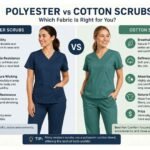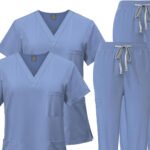
Scrubs have to do several things at once: stay comfortable through long shifts, hold up to frequent hot washing, keep their color, and be easy to care for. Which fabric does that best depends on who is buying. An individual nurse choosing two sets for personal use cares most about comfort and stretch. A hospital or uniform brand buying thousands of sets cares about how the fabric survives institutional laundering year after year. This guide covers the fibers, the common blends, and what to check for each type of buyer.

What Are Scrubs Made Of
The Main Fibers
Cotton
A natural fiber that is soft, breathable, and absorbent.
- Strengths: comfortable against the skin, good moisture absorption
- Limits: wrinkles and shrinks more, dries slowly, and can feel clammy when saturated. Stain release depends on the finish.
Polyester
A synthetic fiber valued for durability and shape retention.
- Strengths: strong, resists wrinkling and shrinking, dries quickly, and holds dye well, so color lasts through repeated washing
- Limits: less breathable than cotton, can hold odors if the fabric isn't finished for it, and attracts oily soils unless finished to release them. Some finishes may bother sensitive skin.
Spandex (Elastane)
A stretch fiber used in small amounts, typically a few percent, blended with other fibers to give flexibility and shape recovery. It isn't used alone. Too much heat can damage it, so follow the care label.
Rayon (Viscose)
A regenerated cellulose fiber made from wood pulp, with a soft, smooth feel and good drape.
- Strengths: soft, breathable, takes color well
- Limits: weaker than polyester, especially when wet, which makes it less suited to hard institutional laundering. It can pill and lose shape with heavy use. See our comparison of T/R and T/C fabrics.
'Bamboo' Fabrics
Most so-called bamboo scrub fabric is bamboo pulp turned into viscose, which makes it a type of rayon. Claims of natural antibacterial or odor-resistant properties don't reliably survive that processing, so ask for test reports rather than relying on the label.
Common Blends
| Blend | Typical Feel and Performance | Typical Use |
|---|---|---|
| Polyester / cotton (e.g., 65/35, T/C) | Durable, holds color, low shrinkage, easy care, crisp handfeel | Hospital and institutional programs that launder at high temperatures |
| Cotton-rich (e.g., CVC, 60/40 cotton/poly) | Softer, more cotton-like comfort, with some wrinkle and shrinkage trade-offs | Premium scrubs and comfort-focused programs |
| Polyester / rayon / spandex | Soft, stretchy, good drape, softer hand than polyester alone | Retail and premium stretch scrubs |
| Polyester / spandex (commonly a high polyester share with a few percent spandex) | Stretch, quick-drying, wrinkle-resistant | Performance and retail stretch scrubs |
| 100% cotton | Soft and breathable, but shrinks and wrinkles more | Warm climates, settings with special requirements |
Blend ratios differ between brands and products, so check the actual fabric label rather than assuming a standard formula.
Knit or Woven?
- Woven fabrics (twill, plain weave) are crisper and tend to be more durable under industrial laundering. A 65/35 polyester-cotton twill is a common institutional choice.
- Knit fabrics (jersey, interlock) are softer and stretchier, and are common in retail scrubs.
Features Worth Asking About
| Feature | What to check |
|---|---|
| Breathability and moisture management | Fiber content, knit or woven structure, and finish |
| Stretch | Whether it's mechanical stretch (from the construction) or spandex, and how much |
| Durability and colorfastness | Test results after repeated washing at your facility's temperature (ISO 105-C06) |
| Shrinkage | Test results after repeated washing (ISO 6330 or equivalent) |
| Pilling | ISO 12945-2 rating |
| Antimicrobial finish | See below |
| Skin safety | Certification such as OEKO-TEX Standard 100, if the supplier holds it |
Antimicrobial Scrubs: What They Do
Some scrubs are treated with an antimicrobial finish. Treated fabric can reduce bacterial growth on the fabric surface, tested to methods such as AATCC 100, but this doesn't replace hand hygiene, protective equipment, or proper laundering. Ask whether the claim is backed by a test report, and whether the effect holds up after repeated washes. See our guide to antimicrobial scrub fabric.
Scrubs Are Not Surgical Gowns
Standard scrubs are daily clinical wear. They aren't rated for liquid barrier protection. Surgical and isolation gowns carry an ANSI/AAMI PB70 barrier level. See our scrubs and surgical gowns page.
Caring for Scrubs
- Follow your employer's laundering policy. Facility laundering typically uses hot water and disinfectants, and the fabric should be chosen to survive it.
- For personal washing, follow the care label and your facility's infection-control guidance.
- Turn scrubs inside out to reduce pilling.
- Avoid fabric softener, which can reduce moisture wicking.
- Tumble dry at moderate heat to protect stretch fibers.
- Treat stains promptly.
What Institutional Buyers Should Specify
If you're buying scrubs for a hospital, clinic network, or uniform brand, a fabric description isn't enough. Specify:
- Composition, weave or knit, and weight (GSM)
- Colorfastness to washing at your facility's temperature and cycle count
- Shrinkage after repeated industrial washing
- Pilling resistance
- Finish requirements (antimicrobial test method, skin-safety certification)
- Batch-specific test reports matched to your shipment
See our guides on choosing a medical scrub fabric supplier, uniform shrinkage after industrial laundry.