'First Class' Isn't a Marketing Label. It's a Production Spec.
Most uniform suppliers call their shirts 'premium' or 'first class' and expect you to nod along. The reality is that 80% of those shirts share the same spec sheet — 60s cotton, 12 stitches per inch, plastic buttons, fused collar that delaminates after 10 washes.
A genuine first class uniform shirt is defined by four measurable things: fabric quality, construction density, component durability, and industrial laundry tolerance. If your current supplier can't tell you the thread count, SPI (stitches per inch), and shrinkage test results for the shirt you're buying, you're not buying first class. You're buying whatever they had in stock.
This guide is written from the factory floor — 20 years of making uniform shirts for airlines, hotels, corporate fleets, and government agencies across 50 countries. Here's what first class actually looks like in production.
What Fabric Makes a Shirt 'First Class'?
The floor for first class is 80s two-ply cotton or a premium polyester-cotton blend with equivalent hand feel.
Here's the scale most suppliers won't show you:
| Grade | Thread Count | Typical Use | Who Sells It |
|---|---|---|---|
| Economy | 40s – 50s single ply | Promotional shirts, one-event wear | Everyone |
| Standard | 60s single or two-ply | Mid-range hotel, basic corporate | Most uniform suppliers |
| First Class | 80s – 100s two-ply | Airline crew, executive corporate, luxury hotel | Specialist OEMs |
| Ultra-Premium | 120s+ two-ply | High-end hospitality, presidential staff | Very few (and overpriced) |
For poly-cotton blends (which most uniform programs need for industrial laundry durability), first class means:
- TC 65/35 or CVC 60/40 at minimum — not 50/50 cheap blend that pills after 5 washes
- Yarn-dyed or piece-dyed with reactive dyes — not pigment-dyed that fades in stripes after 20 washes
- Anti-pill rating of 4+ — tested per ASTM D4970 or ISO 12945
- Shrinkage under 3% — tested per AATCC 135 after 5 industrial wash cycles
How to spot a downgrade: If your supplier says 'premium poly-cotton' but can't tell you the blend ratio or yarn count, they're selling you economy fabric in a nicer bag.
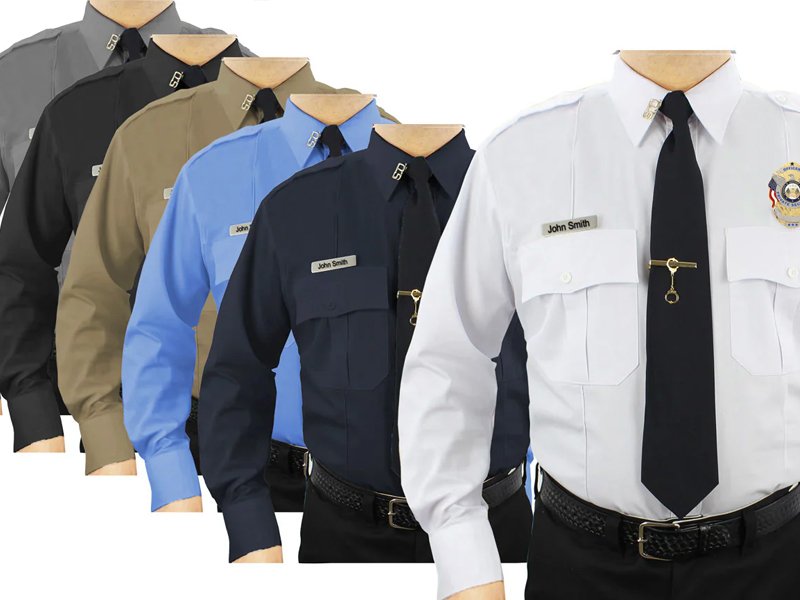
first class uniform shirts
Construction: The Difference Between Surviving 10 Washes and 100 Washes
Fabric gets the attention. Construction is what actually determines whether the shirt lasts.
Stitches Per Inch (SPI)
| Grade | Seam SPI | Hem SPI | Life Expectancy |
|---|---|---|---|
| Economy | 10-12 | 8-10 | 10-20 washes before seam failure |
| Standard | 14-16 | 10-12 | 30-50 washes |
| First Class | 18-20 | 14-16 | 80-100+ washes |
18 SPI means the seam is tighter, stronger, and less likely to pop under stress. It also costs more in production time. That's why most suppliers stop at 14-16.
Seam Types
- Single-needle construction throughout — not chain-stitch on sleeves and side seams. Chain stitching unravels when a single thread breaks. Single-needle locks the seam.
- Double-needle felled seams on shoulders and side seams — the flat-felled seam is the gold standard for uniform shirts. It lies flat, doesn't chafe, and is stronger than a plain overlock.
- Reinforced stress points — crotch/seat seam (yes, on shirts too), underarm gusset, button placket bottom. These are the first places cheap shirts fail.
How to spot a downgrade: Turn the shirt inside out. If the shoulder seam is a simple overlock (serger stitch) instead of a flat-felled seam, it's not first class.
Collar, Cuffs, and Buttons: The Components That Give Away a Cheap Shirt
The collar is what people see. It's also where manufacturers cut the most corners.
Collar Construction
| Feature | Economy | Standard | First Class |
|---|---|---|---|
| Interlining | Fused cheap non-woven | Fused woven | Fused woven + floating canvas |
| Collar stays | None | Removable plastic | Removable brass or metal |
| Collar roll | Flat, no shape | Basic roll | 3-roll construction that holds shape |
| Life before collar flops | 5-10 washes | 15-25 washes | 50+ washes |
A floating canvas collar (the interlining isn't fused to the full collar but floats between the layers) is the defining feature of a true first class shirt. It's how shirts like Charles Tyrwhitt and TM Lewin used to be made before they cut costs.
Cuffs
- First class: Double-button rounded or mitered barrel cuffs — allows adjustment and looks sharper than single-button
- First class: Removable cuff links option on French cuffs for executive roles
Buttons
- Economy: Plastic injection-molded, thin, cracks in industrial laundry
- Standard: Polyester resin, okay for 30-40 washes
- First class: Natural mother-of-pearl (MOP) or high-grade polyester with cross-stitch shank
Cross-stitch mounting (the thread forms an 'X' under the button rather than parallel lines) is important — it keeps the button from twisting and fraying the thread after repeated industrial pressing.
Industrial Laundry Tolerance: The Real Test
A shirt that looks good on a hanger means nothing. The test is: what does it look like after 50 industrial wash cycles at 75°C with industrial detergent and high-speed extraction?
First class shirts survive this because:
| Test | First Class Pass | Economy Will |
|---|---|---|
| Shrinkage after 5 washes | < 3% in all dimensions | 5-8%, collar shrinks a full size |
| Color fade after 20 washes | Delta E < 2 (barely perceptible) | Visible fading, white weft showing |
| Pilling after 20 washes | Grade 4+ (minimal surface change) | Grade 2-3 (obvious pilling on collar and cuffs) |
| Button survival after 50 washes | 95%+ retention | 30-50% replaced |
| Collar integrity after 30 washes | Still holds shape, no bubble | Interlining delaminated, collar floppy |
How to spot a downgrade: Ask for a wash test report. If they can't provide one, they haven't tested it, which means they don't know how it performs.
What the Amateur Buyer Does vs. What the Pro Does
Amateur: 'I need blue uniform shirts, 100% cotton, size large.'
Amateur with a budget: 'I need premium cotton shirts for my hotel staff.'
Pro: 'I need a poplin-weave TC 65/35 uniform shirt, 80s two-ply, 18 SPI single-needle construction with fused floating collar and MOP buttons, in Navy and White, with left-chest pocket and mic tab on the shoulder. Industrial laundry rated. CE-certified. 500 pieces per color, size run 2XS-4XL, deliver in 45 days.'
The pro knows exactly what they're asking for because they've been burned before by the 'premium' label.
Why Buy First Class Uniform Shirts from XINGYE TEXTILE?
We manufacture the fabric and sew the garment in the same facility. That's vertical integration, and it means:
- We control the spec — from yarn count to SPI to button anchor thread
- We don't buy fabric from a broker — we spin it. You get the same quality at production cost
- We can customize — your fabric composition, your collar style, your button, your wash spec. No minimum fabric order because we're the mill
- We test what we sell — wash test reports are standard, not special request
We build first class uniform shirts for airlines, luxury hotels, executive security teams, and government agencies. If you're buying uniform shirts for 100+ staff and your current supplier can't answer the questions in this article, you should be talking to us.