Here's the shortest honest answer: there is no single best work uniform fabric — but for most workwear programs, TC 65/35 poly cotton is the best overall value, and CVC 60/40 is the best overall comfort. Everything else wins in a specific scenario.
The 'best' fabric depends on three questions:
- What does the job do to the fabric? (heat, tearing, staining, abrasion)
- How are the uniforms washed? (industrial laundry vs. home wash)
- What does compliance require? (FR, hi-vis, antistatic)
Answer those three questions and the right fabric picks itself. This guide gives you the direct answer for every common workwear scenario — no fluff, just the recommendation and the reason.
Best Fabric for Work Uniforms
Quick Answer: The Best Work Uniform Fabric by Scenario
| Your Scenario | Best Fabric | Runner-Up |
|---|---|---|
| Most industrial workwear programs | TC 65/35 poly cotton twill | CVC 60/40 |
| Comfort-first (12-hour shifts, hot work) | CVC 60/40 twill | Cotton twill |
| Work near heat/sparks (non-FR) | 100% cotton twill | CVC 60/40 |
| FR compliance required (welding, electrical) | FR cotton / FR blend | FR-treated cotton twill |
| Tear-heavy environments (mining, forestry, tactical) | Nylon-cotton ripstop | TC 65/35 |
| Roadside / traffic visibility required | Hi-vis Class 2 or 3 | Hi-vis + cotton under-layer |
| Industrial laundry / rental programs | TC 65/35 | TC 50/50 |
| Mechanics, mobile technicians | Performance stretch poly-cotton | CVC 60/40 |
| Budget programs | TC 50/50 | TC 65/35 |
Need the detailed fabric-by-fabric breakdown? See our full guide to [work uniform fabric types].
1. Best Overall Value: TC 65/35 Poly Cotton Twill
The winner for most workwear programs.
| Why It Wins | Detail |
|---|---|
| Durability | Polyester content resists tearing, abrasion, and chemical degradation |
| Industrial laundry | Survives 85°C commercial washing — the #1 requirement for rental programs |
| Wrinkle-free | Out of the dryer ready to wear — no ironing budget needed |
| Colorfast | Holds color through 50+ washes |
| Lowest cost per year | Longest lifespan at the lowest price |
When to choose it: Warehouse, logistics, manufacturing, hotels, schools, rental uniform services — anywhere uniforms go through commercial laundering and need to last.
When to avoid it: Work near open flame or extreme heat (polyester melts), or staff who work in hot environments all day (poor breathability).
2. Best Overall Comfort: CVC 60/40 Twill
The winner for comfort-first programs.
| Why It Wins | Detail |
|---|---|
| Cotton-rich feel | 60% cotton — 90% of pure cotton comfort |
| Breathable | Absorbs sweat, keeps wearers cooler |
| Still wrinkle-resistant | The 40% polyester handles easy care |
| Skin-friendly | Hypoallergenic, comfortable for sensitive skin |
When to choose it: Chef coats, scrubs, hospitality, school uniforms, any uniform worn 10–12 hours in warm conditions.
When to avoid it: Harsh industrial laundry programs (shorter life than TC) — or when budget is the absolute priority.
3. Best for Heat Safety (Non-FR): 100% Cotton Twill
The winner where heat and sparks are present but FR isn't required.
| Why It Wins | Detail |
|---|---|
| No melt/drip | Cotton chars; polyester melts and drips onto skin |
| Breathable | Best comfort near ovens, furnaces, and summer sun |
| Traditional look | Rich color depth, professional appearance |
When to choose it: Kitchens, foundries (non-FR zones), construction, general labor near sparks or heat.
Critical caveat: Cotton twill is safer than polyester near heat — but it is not FR-rated. For welding, electrical, or flash-fire risk, you need certified FR fabric.
4. Best for Compliance: FR Fabric (FR Cotton / FR Blends)
The non-negotiable winner where standards require it.
| Standard | Applies To | Typical Fabric |
|---|---|---|
| NFPA 70E | Electrical / arc flash | FR cotton, FR cotton-nylon |
| ASTM D6413 | Flame resistance testing | FR-treated cotton |
| EN ISO 11612 | Heat & flame (EU) | FR blends, inherent FR |
When to choose it: Welding, electrical utilities, oil & gas, foundries, any job with arc flash or flash fire risk.
Key facts:
- FR rating is a certification, not a fabric feature — verify the label
- Treated FR fabrics lose rating with washing — follow care instructions
- Never layer untreated polyester over FR clothing — it melts
5. Best for Tear-Prone Environments: Nylon-Cotton Ripstop
The winner where snagging and tearing kill uniforms.
| Why It Wins | Detail |
|---|---|
| Tear resistance | Reinforced grid stops tears from spreading |
| Abrasion resistance | Excellent in rough terrain |
| Quick-drying | Nylon content sheds water |
When to choose it: Mining, forestry, tactical/police, heavy industry, outdoor workwear.
When to avoid it: Hot environments (nylon is less breathable) or when budget is tight (costs more than TC).
6. Best for Visibility: Hi-Vis Fabric (Class 2 or 3)
The compliance winner for roadside and traffic work.
| Class | Background + Reflective | Typical Use |
|---|---|---|
| Class 1 | 155 in² + 155 in² | Low-risk: parking lots |
| Class 2 | 201 in² + 201 in² | Most construction, roadside |
| Class 3 | 310 in² + 310 in² | Highway, high-speed traffic |
When to choose it: Road construction, traffic control, railway, airport ground crew, utility work near vehicles.
Key fact: Bright color is NOT the same as certified hi-vis. The garment must carry the ANSI/ISEA 107 or EN ISO 20471 label.
7. Best for Mobility: Performance Stretch
The winner for active, mobile roles.
| Why It Wins | Detail |
|---|---|
| Stretch | 2–5% spandex — bend, reach, climb freely |
| Comfort | Modern, professional, all-day wear |
| Appearance | Fits well, looks sharp |
When to choose it: Mechanics, technicians, security, maintenance, hospitality.
Caveat: Spandex degrades in harsh industrial laundry — best for home-washed or mild commercial programs.
How Washing Determines the 'Best' Fabric
This is the factor buyers overlook most. The same fabric has a completely different lifespan depending on the laundry system:
| Laundry System | Best Fabric | Lifespan |
|---|---|---|
| Third-party industrial laundry (85°C, strong chemicals) | TC 65/35 | 18–24 months |
| In-house commercial machines (60–80°C) | CVC 60/40 | 12–18 months |
| Staff home wash | CVC 60/40 or cotton twill | 2–3 years |
Rule: Match the fabric to the washing machine, not just the job. A comfortable fabric that dies in 4 months of industrial laundry is worse than a less comfortable one that lasts 2 years.
Cost Per Year: The Real Comparison
| Fabric | Cost per Uniform | Lifespan (Industrial Wash) | Cost per Year |
|---|---|---|---|
| TC 65/35 | $12–18 | 18–24 months | $6–12 |
| TC 50/50 | $11–16 | 12–18 months | $7–13 |
| CVC 60/40 | $15–22 | 6–12 months | $15–44 |
| Cotton twill | $18–30 | 6–12 months | $18–60 |
| Ripstop nylon-cotton | $22–35 | 12–18 months | $15–35 |
| FR fabric | $25–50 | 12–18 months | $17–50 |
| Hi-vis | $20–40 | 12–18 months | $13–40 |
| Stretch | $25–40 | 6–12 months | $25–80 |
The insight: The cheapest fabric per piece is often the most expensive per year. TC 65/35 costs more per meter than budget blends but delivers the lowest cost per year of service.
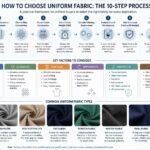
The 5-Step Selection Method
Step 1 — Compliance first. Does the job require FR, hi-vis, or antistatic certification? If yes, the fabric family is decided. Go no further.
Step 2 — Identify the #1 failure mode. What kills your current uniforms? Tears → ripstop. Heat → cotton-rich. Stains/fading → TC. This is your priority property.
Step 3 — Match the laundry system. Industrial laundry → TC 65/35. Home wash → CVC or cotton.
Step 4 — Check the work environment. Hot and physical → cotton-rich. Air-conditioned → TC is fine.
Step 5 — Wash-test before committing. Order samples of your top two candidates, run 5 industrial wash cycles, and compare shrinkage, fading, and tear strength.
About Xingye Textile — Work Uniform Fabric Manufacturer
XINGYE TEXTILE manufactures the full range of work uniform fabrics — TC 65/35, CVC 60/40, cotton twill, ripstop, FR, hi-vis, and performance stretch — for workwear brands, uniform manufacturers, and industrial programs in 50+ countries. With 30 years in textile manufacturing, we supply fabric rolls and finished garments from one source.
Why buyers choose us:
| Strength | Detail |
|---|---|
| Full fabric range | Every workwear fabric type from one factory — compare before you choose |
| Sample service | Order swatches of competing fabrics and run your own wash test |
| Custom development | Custom weight, weave, color, and functional finishes |
| Quality verified | AATCC testing, Pantone matching, single-dye-lot production |
| Fabric-to-garment | Finished uniforms or fabric rolls, private label available |
| Global supply | Reliable lead times to 50+ countries |
Not sure which fabric is best for your program? [Contact us] — tell us the job, the laundry system, and the compliance requirements, and we'll recommend the right fabric with samples for your own wash test.
By Andy Tian, Export Sales Manager, XINGYE TEXTILE
Andy Tian has 10 years of experience in textile export at XINGYE TEXTILE, covering fabric sourcing, pricing, sampling, and order execution for uniform fabric buyers worldwide.