A construction site dress code is not a style guide. It's a safety document with legal weight.
Under OSHA (29 CFR 1926), employers are required to ensure workers wear appropriate protective clothing — and they can be cited for violations caused by improper attire. A worker wearing shorts, loose synthetic fabric, or open-toe shoes isn't just underdressed; they're a compliance failure waiting to be discovered by an inspector or a hospital.
The challenge: a dress code must be strict enough to protect workers, clear enough to enforce consistently, and practical enough that workers actually follow it.
This guide provides the complete framework for a construction site dress code — the required garments, the prohibited items, the standards that govern each piece, and a ready-to-use policy template.
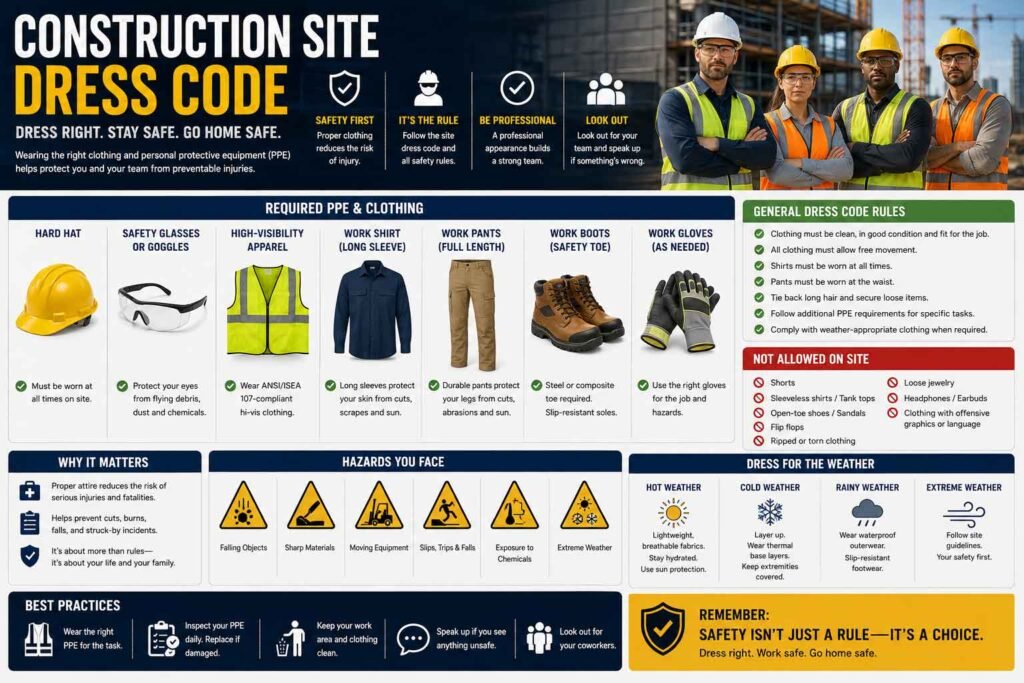
Construction Site Dress Code
Why a Construction Dress Code Matters
| Reason | The Reality |
|---|---|
| Legal compliance | OSHA 29 CFR 1926 requires protective clothing; violations mean citations and fines |
| Injury prevention | Most clothing-related injuries (burns, cuts, snags) are preventable with correct attire |
| Insurance liability | Improper attire in an injury case shifts liability to the employer |
| Consistency | A written dress code is enforceable; an unwritten one is not |
| Professionalism | Clients and inspectors judge site discipline by worker appearance |
Key legal point: If a worker is injured while wearing clothing the employer knew (or should have known) was inadequate, the employer shares liability. A written, enforced dress code is your first line of defense.
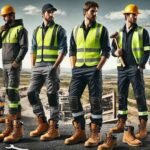
The Required Clothing — From Head to Toe
Head
| Item | Requirement | Standard |
|---|---|---|
| Hard hat | Mandatory on all active construction sites | ANSI/ISEA Z89.1 (US), EN 397 (EU) |
| Head covering under hard hat | Optional — bandana, do-rag, or thin cap for sun/sweat | Must not interfere with hard hat fit |
Note: Hard hats must be worn with the brim forward unless the manufacturer specifies otherwise. Suspension systems should be inspected regularly — a hard hat that has taken an impact should be replaced.
Torso — Upper Body
| Item | Requirement | Why |
|---|---|---|
| Shirt | Long-sleeve or short-sleeve, high-coverage work shirt | Protects from sun, sparks, debris, abrasion |
| Fabric | Cotton or cotton-rich blend (CVC, cotton twill) | Cotton chars instead of melting near heat |
| Hi-vis | Class 2 or 3 hi-vis vest/shirt where vehicles or equipment operate | ANSI/ISEA 107 compliance |
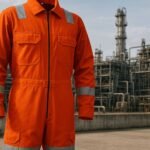
| FR clothing | Where arc flash, welding, or flash fire risk exists | NFPA 70E, ASTM D6413 |
Torso — Lower Body
| Item | Requirement | Why |
|---|---|---|
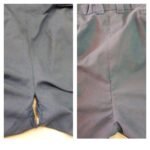
| Pants | Full-length, durable work pants | Legs are the most frequently injured body part |
| Fabric | Denim, cotton twill, canvas, or workwear blends | Abrasion resistance + no melt |
| Hi-vis pants | Where required (roadwork, night work) | ANSI Class 2/3 compliance |
Shorts are generally prohibited on construction sites — OSHA guidance and most company policies require full-length pants due to debris, sparks, and abrasion hazards.
Footwear
| Item | Requirement | Standard |
|---|---|---|
| Boots | 6-inch or taller, leather or leather-like work boots | ASTM F2413 (impact/compression) |
| Toe protection | Steel, composite, or alloy toe | ASTM F2413-18 |
| Slip resistance | Rubber or similar outsole | Site-dependent |
| Puncture resistance | Where nails/debris are present | ASTM F2413 |
Prohibited: Sneakers, running shoes, cloth shoes, open-toe footwear, sandals — even on 'light duty' days.
Hands & Eyes
| Item | Requirement | Standard |
|---|---|---|
| Gloves | Cut-resistant, task-specific (leather, knit, chemical) | EN 388 (cut), ASTM F2992 |
| Safety glasses | Always, when not wearing a face shield | ANSI Z87.1 |
The Prohibited List — What Workers Cannot Wear
Post this list. Enforce it. These items cause real injuries:
| Prohibited Item | Hazard |
|---|---|
| Shorts | Leg exposure to debris, sparks, abrasion |
| Tank tops / sleeveless shirts | Arm exposure, sunburn, cuts |
| Loose/baggy clothing | Snagging on machinery, rebar, scaffolding |
| Hoodie drawstrings | Snag/entanglement — a known OSHA hazard |
| Jewelry (rings, necklaces, watches) | Ring avulsion, electrocution, snagging |
| Synthetic-heavy clothing near heat | Polyester/nylon melts and drips onto skin |
| Sneakers / open-toe footwear | Crushing, puncture injuries |
| Headphones/earbuds (non-OSHA-approved) | Hearing loss + situational awareness |
| Clothing with loose hanging straps/tails | Entanglement in rotating equipment |
Dress Code by Role
| Role | Standard Base | Additional Requirements |
|---|---|---|
| General laborer | Cotton work shirt, denim/twill pants, boots, hard hat, glasses | Hi-vis vest where vehicles operate |
| Carpenter / framer | Same + tool belt | Knee pads where kneeling work |
| Electrician | FR-rated clothing required | NFPA 70E arc flash compliance |
| Welder | FR jacket/apron, welding sleeves, leather gloves | Welding helmet with proper shade |
| Equipment operator | Standard + hi-vis | Seatbelt, no loose clothing near moving parts |
| Roofer | Cotton twill shirt, durable pants, non-slip boots | Fall protection harness |
| Concrete worker | Waterproof/resistant boots, rubber gloves, full-length pants | Concrete is caustic — no skin exposure |
| Foreman / supervisor | Standard + hi-vis vest | Distinctive vest color for identification |
| Safety officer | Hi-vis with 'Safety' markings | Must be immediately identifiable |
| Visitor / office staff on site | Hard hat, safety glasses, hi-vis vest, closed-toe shoes minimum | Site-specific |
Compliance Standards Reference
| Standard | Region | What It Governs |
|---|---|---|
| OSHA 29 CFR 1926 | USA | Construction PPE requirements |
| ANSI/ISEA Z89.1 | USA | Hard hats |
| ANSI/ISEA 107 | USA | Hi-vis clothing classes |
| ANSI Z87.1 | USA | Eye protection |
| ASTM F2413 | USA | Foot protection |
| NFPA 70E | USA | Electrical safety / FR clothing |
| ASTM D6413 | USA | Flame resistance test |
| EN 397 | EU | Industrial safety helmets |
| EN ISO 20471 | EU | Hi-vis clothing |
| EN 388 | EU | Protective gloves |
| EN ISO 11612 | EU | Heat and flame protective clothing |
Dress Code Enforcement: What Actually Works
| Approach | Effectiveness | Notes |
|---|---|---|
| Written policy + toolbox talks | Essential baseline | Reiterate weekly — policies get forgotten |
| Supervisor spot checks | High | Daily checks at start of shift |
| PPE vending/dispensing at gate | High | Workers can't 'forget' what's provided |
| Provide the right gear | Highest | Workers comply when gear is comfortable and fits |
| Progressive discipline | Medium | Enforce consistently — favoritism kills compliance |
The #1 enforcement insight: Workers follow dress codes they understand and support. A worker wearing a hoodie in winter isn't defying policy — they're cold. Provide the compliant alternative (FR-rated fleece with breakaway drawstrings, layered workwear) and compliance follows.
Fabric Selection for Construction Workwear
| Garment | Recommended Fabric | Why |
|---|---|---|
| Work shirts | Cotton twill, CVC 60/40 | Breathable, no melt, durable |
| Work pants | Denim, cotton twill, ripstop nylon-cotton | Abrasion + tear resistance |
| Hi-vis garments | Polyester (standard), poly-cotton | ANSI-certified fluorescent + reflective |
| FR layers | FR cotton, FR cotton-nylon | NFPA 70E compliant |
| Hoodies (cold weather) | Cotton fleece, FR fleece (hot work) | Warmth + breakaway drawstrings required |
| Base layers | Cotton, wool, poly base (cold) | Moisture management |
Fabric rules for construction:
- No melt, no drip — cotton or cotton-rich near any heat source
- No loose synthetic shine — polyester knit over a flame is a burn injury
- Hi-vis must be certified — bright colors without ANSI certification don't count
- FR is non-negotiable where required — no exceptions, no 'cotton is fine'
About Xingye Textile — Construction Workwear Fabric Manufacturer
XINGYE TEXTILE manufactures workwear fabrics for construction — cotton twill, denim, CVC, ripstop, hi-vis, and FR fabrics — for workwear brands and uniform programs in 50+ countries. With 30 years in textile manufacturing, we supply fabric rolls and finished garments built for the demands of construction sites.
Our construction workwear range:
| Fabric | Composition | Weight | Use |
|---|---|---|---|
| Cotton Twill | 100% cotton, pre-shrunk | 260–360 GSM | Work shirts, pants — breathable, no melt |
| CVC 60/40 Twill | 60% cotton / 40% poly | 240–300 GSM | Comfort-first work shirts |
| Nylon-Cotton Ripstop | 50/50 or 60/40 | 200–280 GSM | Heavy-duty pants, outerwear |
| FR Cotton & FR Blends | FR-treated | 280–360 GSM | NFPA 70E compliant workwear |
| Hi-Vis Fabric | Polyester / poly-cotton | 200–280 GSM | ANSI Class 2/3 hi-vis garments |
| Cotton Fleece | 100% cotton | 280–400 GSM | Work hoodies — breakaway drawstrings |
Our capabilities:
- ✅ Full range from one factory — simplify sourcing
- ✅ Custom development — weight, weave, color, finish
- ✅ Pantone color matching with spectrophotometer verification
- ✅ Single-dye-lot production for uniform programs
- ✅ Finished garment manufacturing — shirts, pants, hi-vis, FR garments
- ✅ Private labeling for workwear brands
Need compliant construction workwear? [Contact us] for samples, spec sheets, and bulk pricing.
By Andy Tian, Export Sales Manager, XINGYE TEXTILE
Andy Tian has 10 years of experience in textile export at XINGYE TEXTILE, covering fabric sourcing, pricing, sampling, and order execution for uniform fabric buyers worldwide.