A uniform fabric specification is the technical language that turns 'we need durable, comfortable workwear' into something a mill can actually produce consistently — it typically covers four core elements: fiber composition (what it's made of), GSM (how dense/heavy it is), weave construction (how it's woven), and finish (added functional treatments). Misreading any one of these is the most common reason bulk uniform orders come back wrong. Here's how to actually read a spec sheet instead of just skimming it.
Uniform Fabric Specifications Explained
Why Spec Sheets Get Misread So Often
Most uniform buyers can describe what they want in plain language — 'something durable but not too stiff, breathable, holds color well.' The problem is that translating that into a spec sheet requires knowing that these four elements interact with each other, not stand alone. A 220 GSM fabric in a loose weave can feel thinner than a 180 GSM fabric in a tight twill. A 65/35 poly-cotton blend with a wrinkle-resistant finish behaves completely differently from the same blend without it.
Reading a spec sheet correctly means understanding not just what each number means, but how they modify each other.
Fiber Composition: What the Fabric Is Actually Made Of
This is usually written as a percentage ratio — 65/35, 60/40, CVC, TC, or 100% of a single fiber. It tells you the raw material, but on its own it says almost nothing about how the finished fabric will perform.
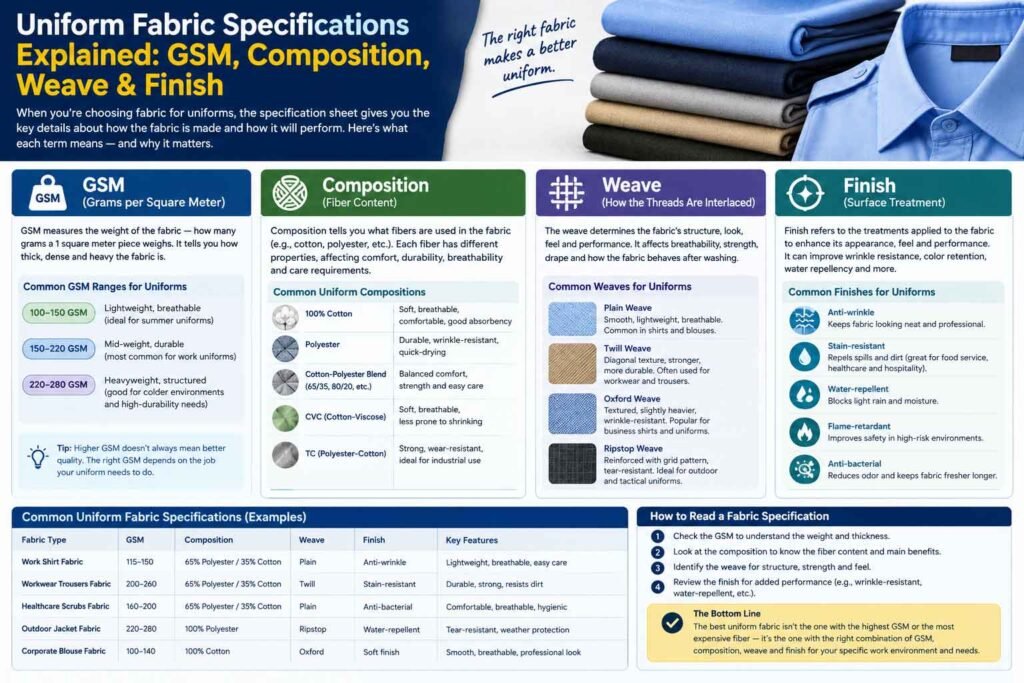
Common uniform compositions:
- 100% Cotton — natural, breathable, soft; wrinkles and shrinks more than blends
- 100% Polyester — durable, wrinkle-resistant, quick-drying; less breathable
- TC (Terylene/Cotton, polyester-dominant blend, typically 65/35) — durability-leaning blend, common in workwear
- CVC (Chief Value Cotton, cotton-dominant blend, typically 60/40 cotton-rich) — comfort-leaning blend, common in medical and hospitality uniforms
The trap in this spec field: two suppliers quoting '65/35' can deliver noticeably different-feeling fabric, because the ratio doesn't specify yarn quality, staple length, or spinning method. Composition tells you the recipe, not the execution — always request a physical swatch, not just a written ratio.
GSM: The Density Number That Gets Over-Trusted
GSM (grams per square meter) measures fabric weight per unit area. It's the spec most buyers fixate on, largely because it's the easiest number to compare across suppliers at a glance.
Typical uniform GSM ranges:
- 120–180 GSM — lightweight shirts, summer uniforms, hospitality wear
- 180–250 GSM — general workwear, school uniforms, corporate apparel
- 250+ GSM — industrial workwear, heavy-duty and protective garments
The trap in this spec field: higher GSM does not mean higher quality — it means denser and heavier. A supplier can hit a target GSM with either high-quality tightly-spun yarn or cheaper bulk fiber loosely packed to reach the same weight. Two fabrics can share an identical GSM and feel completely different in hand, drape, and durability. GSM should be read alongside composition and weave, never as a standalone quality signal.
Weave Construction: The Spec Most Buyers Skip Past
This describes how the yarns are physically interlaced, and it changes a fabric's strength, texture, and appearance independently of both composition and weight.
Common uniform weaves:
- Plain weave — simple over-under pattern, smooth surface, lightweight feel; used for shirts and lighter uniforms
- Twill — diagonal rib pattern, stronger and more abrasion-resistant, more structured drape; the default for workwear pants and heavier uniforms
- Ripstop — reinforced grid pattern designed to stop small tears from spreading; used where tear resistance matters more than smoothness (outdoor and tactical workwear)
- Poplin — a finer plain weave variant with a slight rib, common in dress-style uniform shirts for a crisper appearance
Why this spec is easy to overlook: buyers often specify composition and GSM correctly but leave weave unspecified, assuming 'the supplier will use the standard one.' Two fabrics with identical fiber and identical GSM will still perform and look different depending on weave — this is often the missing variable when a delivered fabric 'technically matches the spec' but doesn't feel right.
Finish: The Functional Layer Added on Top
Finish refers to any treatment applied to the base fabric to add a specific functional property. This is the spec field most often confused with the fabric itself — a finish is an addition, not a fabric type.
Common uniform finishes:
- Wrinkle-resistant / easy-care — reduces ironing needs, common on poly-cotton shirting
- Water-repellent (DWR) — sheds light moisture; not the same as waterproof
- Flame-retardant — either inherent to the fiber or a topical treatment (topical treatments degrade with washing — ask which type you're getting)
- Antistatic — relevant for electronics, chemical, or explosive-risk environments
- Antimicrobial — common in healthcare uniforms for hygiene control
- Stain/oil-resistant — useful for food service and maintenance workwear
The trap in this spec field: a topical finish and an inherent fiber property look identical on day one but perform very differently after 50+ industrial wash cycles. Always ask whether a functional property is built into the fiber itself or applied as a coating — this single question prevents most post-delivery disappointment with 'durable' finishes.
How These Four Elements Interact — A Worked Example
Consider two fabrics both listed as '65/35 poly-cotton, 200 GSM':
- Fabric A: Twill weave, no additional finish → structured, durable, workwear-appropriate drape
- Fabric B: Plain weave, wrinkle-resistant finish → smoother, lighter-feeling, more shirt-appropriate drape
Same composition. Same GSM. Completely different end product. This is exactly why a spec sheet listing only composition and GSM is incomplete — weave and finish are what actually determine how the fabric behaves in the finished garment.
How to Read a Supplier's Spec Sheet Without Getting Misled
When reviewing a quoted specification, check that it includes all four elements together, not just one or two:
| Spec Field | What to Confirm |
|---|---|
| Composition | Exact fiber ratio + fiber quality/staple length if possible |
| GSM | Target weight + acceptable tolerance range (e.g., ±5%) |
| Weave | Named weave type, not just 'standard' |
| Finish | Type of finish + whether it's inherent or topical, and wash durability |
If a quote only lists composition and GSM, ask the supplier directly for the weave type and any finishes — leaving these unspecified is how two 'identical' spec sheets produce two different-feeling fabrics.
A Quick Glossary for Spec Sheet Terms
- TC: Polyester-dominant cotton blend (typically 65/35)
- CVC: Cotton-dominant polyester blend (typically 60/40)
- GSM: Grams per square meter (fabric weight/density)
- Oz/yd²: Ounces per square yard (US equivalent of GSM; GSM = oz/yd² × 33.91)
- DWR: Durable Water Repellent finish
- Colorfastness: Resistance to color fading/bleeding during washing
- Pilling: Small fiber balls forming on fabric surface from friction/wear
- Shrinkage tolerance: Acceptable percentage of shrinkage after washing, usually specified as a maximum (e.g., ≤3%)
Conclusion
A uniform fabric specification isn't one number to check — it's four interacting variables that only tell the full story together. Composition tells you the raw material, GSM tells you the density, weave tells you the structure, and finish tells you the added function. Buyers who request all four explicitly, rather than accepting a partial spec sheet, are far less likely to receive bulk fabric that 'technically matches' the order but doesn't perform the way they expected.