A fabric specification sheet lists the technical details of a fabric — composition, weight, width, construction, and performance data — but most buyers only read the numbers they already understand and skim past the rest. The fields that cause the most costly misunderstandings are usually the ones buyers assume are 'standard' and don't ask follow-up questions about: tolerance ranges, test methods, and finish durability. Here's how to read a spec sheet the way an experienced buyer does — checking not just what each field says, but what it's actually promising.
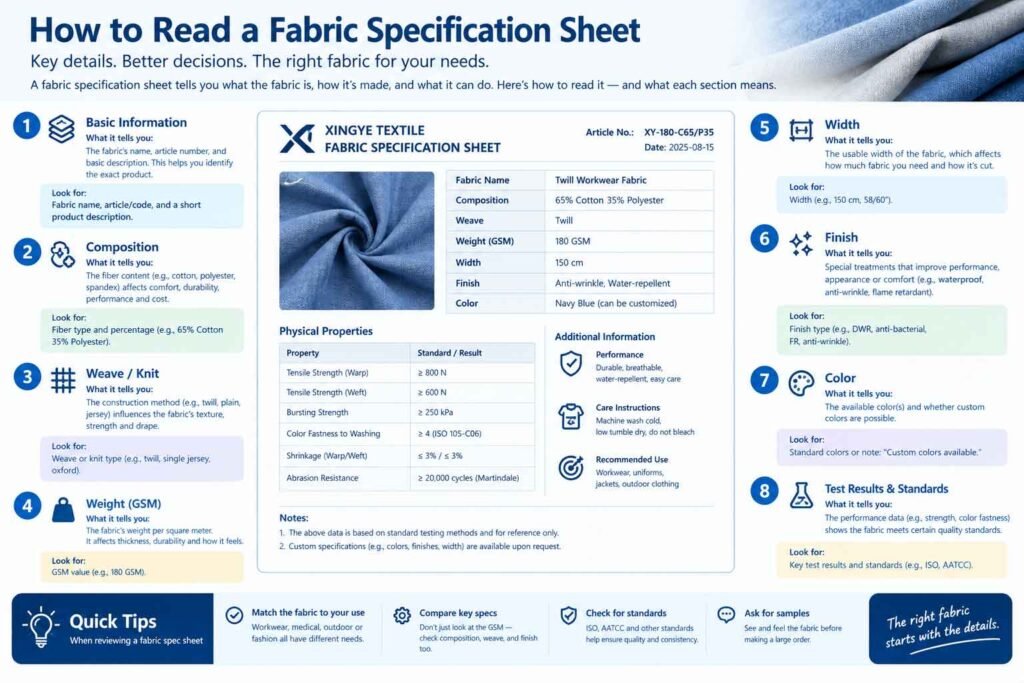
How to Read a Fabric Specification Sheet
Why Spec Sheets Cause More Problems Than They Solve
A spec sheet looks authoritative — it's full of numbers, percentages, and technical terms, which makes it easy to assume it's a complete and precise description of the fabric. In reality, a spec sheet is often a starting point for negotiation and clarification, not a finished guarantee. Two suppliers can send spec sheets that look nearly identical on paper and deliver fabric that performs very differently, because spec sheets frequently state a target value without stating the tolerance, test method, or conditions behind it.
The goal in reading a spec sheet isn't just understanding each field — it's knowing which fields need a follow-up question before you approve bulk production.
The Core Fields Every Spec Sheet Should Include
1. Fiber Composition
Usually shown as a percentage (e.g., '65% Polyester / 35% Cotton') or a blend code (TC, CVC, etc.).
What it tells you: the raw material makeup.
What it doesn't tell you: yarn quality, staple length, or spinning method — two fabrics with identical composition percentages can feel completely different depending on fiber grade.
Follow-up question to ask: 'What's the fiber staple length or grade?' — especially important for cotton, where staple length affects softness and pilling resistance more than the percentage does.
2. Fabric Weight (GSM or oz/yd²)
Grams per square meter (GSM) or ounces per square yard, depending on region.
What it tells you: fabric density.
What it doesn't tell you: how that weight is distributed — a fabric can hit its target GSM through tight, efficient yarn or loose, bulky fiber, and these feel and perform differently despite an identical number.
Follow-up question to ask: 'What's the tolerance range on this GSM?' — a ±5% swing is normal, but ±10% or more can mean noticeably inconsistent fabric across production lots.
3. Fabric Width
Usually listed in inches or centimeters, sometimes with a 'usable width' distinct from the total roll width.
What it tells you: how much fabric you get per linear yard/meter.
What it doesn't tell you: whether the edges (selvage) are usable for cutting — usable width is often 1–2 inches narrower than total width, which affects yield calculations.
Follow-up question to ask: 'Is this total width or usable/cuttable width?' — this directly affects how much fabric you need to order for a given garment quantity.
4. Construction / Weave Type
Plain weave, twill, satin, ripstop, knit type, etc.
What it tells you: the structural pattern of the fabric.
What it doesn't tell you: thread count or yarn density within that weave — a 'twill' can range from lightweight to heavy-duty depending on yarn thickness and weave tightness, which the word 'twill' alone doesn't specify.
Follow-up question to ask: 'What's the thread/yarn count for this construction?' — relevant when comparing two fabrics with the same weave name but different hand feel.
5. Color and Colorfastness Rating
Color is usually specified against a physical or digital color standard (like Pantone). Colorfastness is often rated on a numeric scale (commonly 1–5, with 5 being best) for resistance to washing, rubbing, and light exposure.
What it tells you: how well the color should hold up under specific conditions.
What it doesn't tell you: which test standard was used — colorfastness ratings from different testing methods (e.g., AATCC vs. ISO) aren't always directly comparable.
Follow-up question to ask: 'Which test standard and test conditions produced this rating?' — especially important for uniform programs with heavy industrial laundering, where real-world wash conditions may be harsher than the test conditions used to generate the rating.
6. Shrinkage
Usually expressed as a maximum percentage (e.g., '≤3% shrinkage').
What it tells you: expected dimensional change after washing.
What it doesn't tell you: how many wash cycles that percentage is based on — a fabric tested after one wash can shrink further after repeated industrial laundering.
Follow-up question to ask: 'Is this shrinkage rating based on one wash or multiple wash cycles?'
7. Finish
Any functional treatment applied to the base fabric — wrinkle-resistant, water-repellent, flame-retardant, antimicrobial, etc.
What it tells you: an added functional property.
What it doesn't tell you: whether that property is built into the fiber itself or applied as a topical coating — this single distinction determines whether the finish survives repeated washing or fades out within months.
Follow-up question to ask: 'Is this finish inherent to the fiber or a topical treatment, and how many wash cycles does it last?'
8. Tensile Strength and Tear Strength
Usually given in units like Newtons or pounds-force, measuring how much force the fabric can withstand before tearing or breaking.
What it tells you: a raw durability number.
What it doesn't tell you: how that number was measured (direction of pull, sample size, test method) — strength figures aren't meaningfully comparable across suppliers unless the same test standard was used.
Follow-up question to ask: 'Which test standard (e.g., ASTM, ISO) was used, and in which direction (warp/weft) was it measured?'
The Fields Buyers Should Never Skip Past
If a spec sheet is missing any of these, it's worth requesting before approving bulk production:
- Tolerance ranges on GSM, width, and shrinkage — a spec without tolerances is a target, not a guarantee
- Test standards behind any performance number — without this, ratings from different suppliers can't be fairly compared
- Wash cycle basis for shrinkage, colorfastness, and finish durability — a rating 'as new' tells you almost nothing about year-two performance
- Finish type (inherent vs. topical) — this determines whether a functional claim will still be true after repeated laundering
A Simple Way to Stress-Test Any Spec Sheet
Before approving a spec sheet, run it through this filter: for every number on the page, ask 'compared to what, measured how, and valid for how long?' A GSM number is meaningless without a tolerance range. A colorfastness rating is meaningless without knowing the test method. A finish claim is meaningless without knowing if it survives washing. Suppliers who can answer these follow-ups clearly and specifically are typically the ones who deliver consistent bulk production; vague or evasive answers here are a reliable early warning sign.
Quick Reference: Spec Sheet Field Checklist
| Field | What to Confirm Beyond the Headline Number |
|---|---|
| Composition | Fiber grade/staple length |
| GSM/Weight | Tolerance range |
| Width | Usable vs. total width |
| Construction | Yarn/thread count |
| Color | Test standard for colorfastness rating |
| Shrinkage | Number of wash cycles the rating is based on |
| Finish | Inherent vs. topical, wash durability |
| Strength ratings | Test standard and direction of measurement |
Conclusion
A fabric specification sheet is only as useful as the follow-up questions asked about it. The numbers themselves — composition, GSM, shrinkage, colorfastness — are starting points, not complete answers, and the buyers who avoid costly bulk-production surprises are the ones who ask what's behind each number: what tolerance, what test method, and what that number still looks like after real-world washing and wear. Reading a spec sheet well means treating it as a conversation starter with your supplier, not a finished document to simply sign off on.